

Yes, self-employed borrowers get approved for mortgages every day. If your tax returns understate your real cash flow because of business write-offs, the fastest practical route is usually a bank-statement (non-QM) program, or a CPA letter that documents your true expense ratio for a conventional loan. Both paths work; the right one depends on how your income actually looks on paper.
TL;DR:
- Self-employed borrowers should consider bank-statement or CPA-letter programs if their tax returns understate actual cash flow due to business write-offs.
- Lenders typically require two years of self-employment history and a minimum credit score of 620 for non-QM options, with higher scores unlocking better terms.
- A comprehensive application includes two years of tax returns, bank statements, a CPA expense letter, and proof of reserves, preferably in PDF format.
- Non-QM bank-statement loans often have higher rates, larger down payments, and steeper reserves, making lender shopping essential for best terms.
- Proper preparation, including fixing credit errors and organizing documents, significantly improves approval odds, especially when working through licensed wholesale brokers.
Table of Contents
- What are the self employed mortgage requirements?
- What documents do you need for a self employed mortgage?
- Which mortgage loan type fits self employed income?
- How does a bank statement loan actually work?
- How can you improve your approval odds?
- Why brokers matter more for self-employed borrowers
- Get matched with a broker who understands self-employed income
- The gap between what self-employed borrowers expect and what actually happens
- Sources
What are the self employed mortgage requirements?
Lenders underwrite self-employed income differently than a W-2 paycheck, but the guardrails are not mysterious. Freddie Mac's guidance for self-employed borrowers notes that conventional underwriting typically wants two years of self-employment history and relies on tax returns to prove that income is stable, not a one-time spike. Some lenders will consider a 12-month history if you've worked in the same field for years before going independent, but that's the exception, not the rule.
Credit score floors matter more for self-employed applicants because the income picture already carries more variability in the underwriter's eyes. A 620 credit score might get you into a non-QM bank-statement program, while 680 or higher usually unlocks better pricing and more lender options across both conventional and non-QM channels.
Debt-to-income ratio (DTI) gets calculated against your net qualifying income after underwriters apply expense adjustments, not your gross deposits or gross revenue. Most conventional programs cap DTI around the mid-40s percentage range, though some non-QM lenders may allow higher ratios if reserves and credit compensate.
Reserves and down payment expectations shift by program:
- Conventional loans often ask for two to six months of reserves depending on loan size and credit profile.
- Bank-statement non-QM loans commonly require larger down payments, generally in the low double-digit percentage range, and deeper reserve cushions.
- FHA loans allow smaller down payments but still require the same self-employment documentation depth.
Quick reference: A borrower with two years of tax returns, a 700+ credit score, and six months of reserves will generally qualify for the widest set of loan options and the best pricing available to self-employed applicants.
What documents do you need for a self employed mortgage?
Getting your paperwork organized before you apply saves weeks. Here's what actually lands on the underwriter's desk.
- Two years of personal tax returns (1040s), including all schedules. The IRS Self-Employed Individuals Tax Center lays out which forms sole proprietors, partners, and S-corp owners typically file, and underwriters cross-reference these against your bank deposits.
- Schedule C, K-1s, or corporate returns (1120/1120S), depending on your business structure. These show the underwriter your net profit after deductions, which is often lower than what you actually take home.
- 12 to 24 months of bank statements, business or personal (sometimes both), showing consistent deposit patterns.
- A CPA letter stating your expense ratio, if you want to argue for a higher qualifying income than your tax returns show on their own.
- Year-to-date profit and loss statement, business formation documents (articles of incorporation, business license), and signed client contracts if your income is project based.
- Asset statements, government ID, and a signed loan application, plus proof that your reserve funds are seasoned and traceable.
Pro Tip: Request PDF statements directly from your bank rather than screenshots or downloaded transaction lists. Underwriters want every page, including blank ones, and a missing page is one of the most common reasons non-QM files bounce back for re-submission.
Which mortgage loan type fits self employed income?
The right program depends on how your tax returns compare to your actual cash flow, and how much down payment you're bringing.
- Conventional tax-return loans work best when your net income after deductions still comfortably supports the payment. If you haven't maximized write-offs, this route usually gets you the lowest rate.
- FHA and VA loans suit eligible borrowers who want a smaller down payment. Documentation depth is similar to conventional, since both still lean on tax returns, but FHA's more flexible credit and DTI standards can help borderline files.
- Non-QM bank-statement loans make sense when your write-offs are aggressive and your tax returns don't reflect what you actually earn. You'll pay a higher rate for the flexibility, but it's often the only path to the loan amount you actually need.
- Property type changes the math too. Owner-occupied purchases generally get better terms than investment properties, and larger loan amounts (jumbo territory) may need extra reserves regardless of which program you choose.
The CFPB's explanation of qualified mortgages is worth reading before you commit to a non-QM path. Because bank-statement loans fall outside standard QM rules, some consumer protections that apply to conventional loans don't extend the same way. That's not a reason to avoid them, but it's a reason to read the terms carefully. For a broader rundown of alternative structures like asset-depletion and DSCR loans, see non-traditional mortgage options for flexible buyers.
How does a bank statement loan actually work?
A bank-statement loan isn't a shortcut around documentation. According to Experian's explanation of bank-statement loans, it's a different, often more detailed documentation path that trades tax returns for deposit history, and it can carry higher fees than a standard mortgage. Here's the mechanical process most non-QM lenders follow:
- The underwriter totals your qualifying deposits across 12 to 24 months of statements.
- Non-revenue items (transfers between your own accounts, loan proceeds, one-time gifts) get stripped out.
- An expense factor gets applied, either a flat percentage (often 50%) or the ratio documented in your CPA letter, whichever is more favorable to you.
- The remaining figure gets divided by the number of months and annualized into a monthly qualifying income.
Lenders also typically want proof your business has existed for at least two years, plus every single page of every statement in the review window. Missing pages or unexplained large deposits are the fastest way to stall a file.
Pricing on these loans tends to run higher than conventional rates, and down payment or reserve requirements are usually steeper too. Program terms vary considerably from one non-QM lender to the next, which is exactly why shopping multiple lenders through a broker matters more here than on a plain-vanilla conventional loan.
How can you improve your approval odds?
A few weeks of preparation can change your outcome and your rate. Work through these in order:
- Pull your credit report and fix errors first. If you're sitting at 660 and a quick fix gets you to 700, delaying your application by a month can be worth a meaningfully better rate.
- Gather and label your bank statements in consecutive order, then flag any large one-time deposits with a written explanation before the underwriter asks.
- Get a CPA expense letter drafted early. If your deductions are heavy, this single document can raise your qualifying income more than almost any other step you take.
- Build reserves beyond the minimum. Six to twelve months of payment reserves, rather than the bare minimum, tends to offset a thinner income file.
- Compare lenders instead of applying with one. Non-QM pricing varies enough between lenders that shopping through a broker matching service like LoFiRate can surface better terms than the first quote you get.
Pro Tip: Ask your CPA to prepare the expense letter on letterhead with your business's actual industry expense ratio, not a generic estimate. Underwriters weigh a documented, itemized ratio far more heavily than a rounded guess.
Why brokers matter more for self-employed borrowers
Self-employed income is where wholesale broker shopping earns its keep. Non-QM pricing and underwriting guidelines differ meaningfully from one lender to the next, so the loan that gets you approved at one shop might get flatly declined, or priced two points higher, at another. Lofirate connects borrowers with licensed wholesale mortgage brokers who shop multiple lenders on your behalf, rather than pitching you a single retail rate sheet.
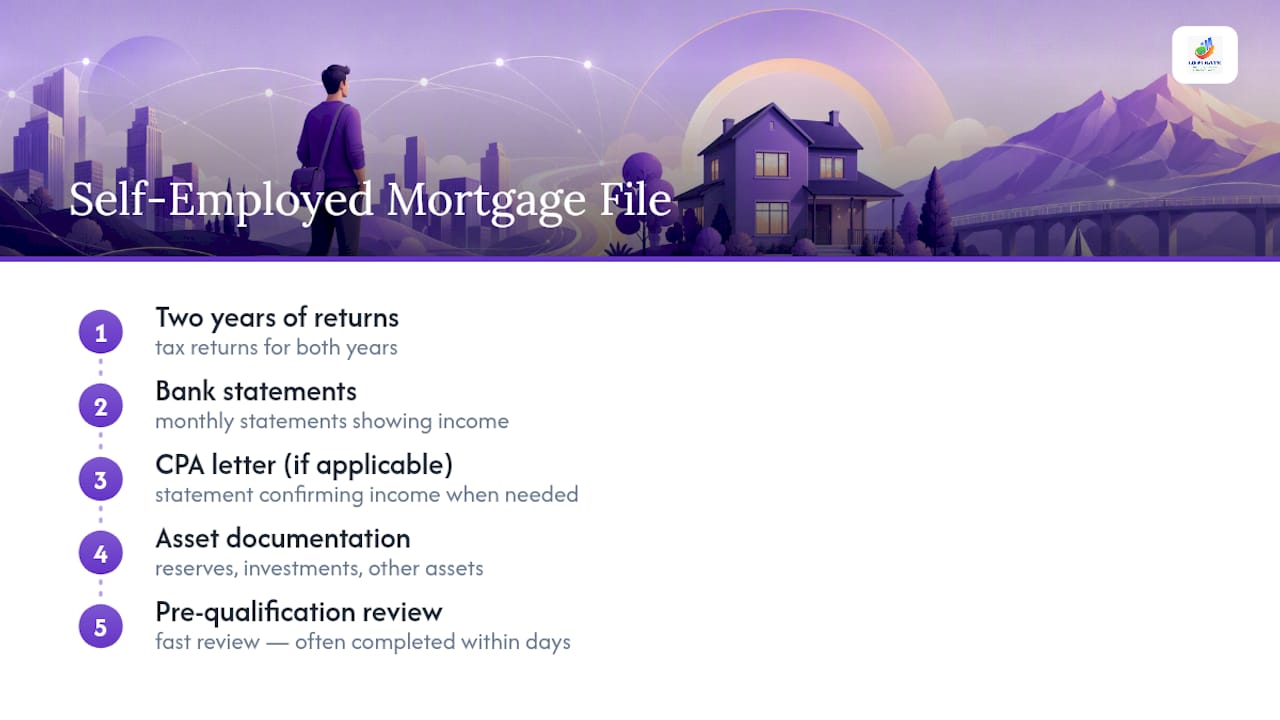
Expect a broker to request the same core file discussed above: two years of returns, bank statements, a CPA letter if applicable, and asset documentation. Pre-qualification conversations typically move fast once that file is organized, often within days rather than weeks; for a clear walkthrough, see our mortgage approval process explained for homebuyers. LoFiRate's own guide to mortgage qualification steps walks through the sequence in more depth if you want the fuller preparation timeline before you talk to anyone.
Get matched with a broker who understands self-employed income
Lofirate is the alternative to walking into a single retail bank and taking whatever rate they quote. Because Lofirate connects you with licensed wholesale brokers who shop your file across multiple non-QM and conventional lenders at once, you get a comparison instead of a single take-it-or-leave-it offer, at no cost to request it.

If you've read this far, you already know your file is more complicated than a standard W-2 application. That's precisely the kind of file wholesale brokers are built to place well, since they know which lenders are currently flexible on expense ratios, reserve requirements, or 12-month bank-statement history. A retail loan officer at one bank can only offer that bank's guidelines; a broker can test your numbers against several. For readers weighing whether a non-QM path is even the right call, Lofirate's checklist for loan approvals breaks down documentation side by side across loan types. When you're ready to see what your actual file qualifies for, request a consultation through Lofirate and get a second opinion before you commit to any single lender's number.
The gap between what self-employed borrowers expect and what actually happens
Most self-employed borrowers walk into the mortgage process assuming their tax returns will sink them. That fear is usually backwards. Aggressive deductions don't disqualify you; they just shift which program fits. The real failure point isn't income, it's preparation. Borrowers who show up with disorganized statements, unexplained deposits, and no CPA letter get treated like a risk, even when their business is thriving.
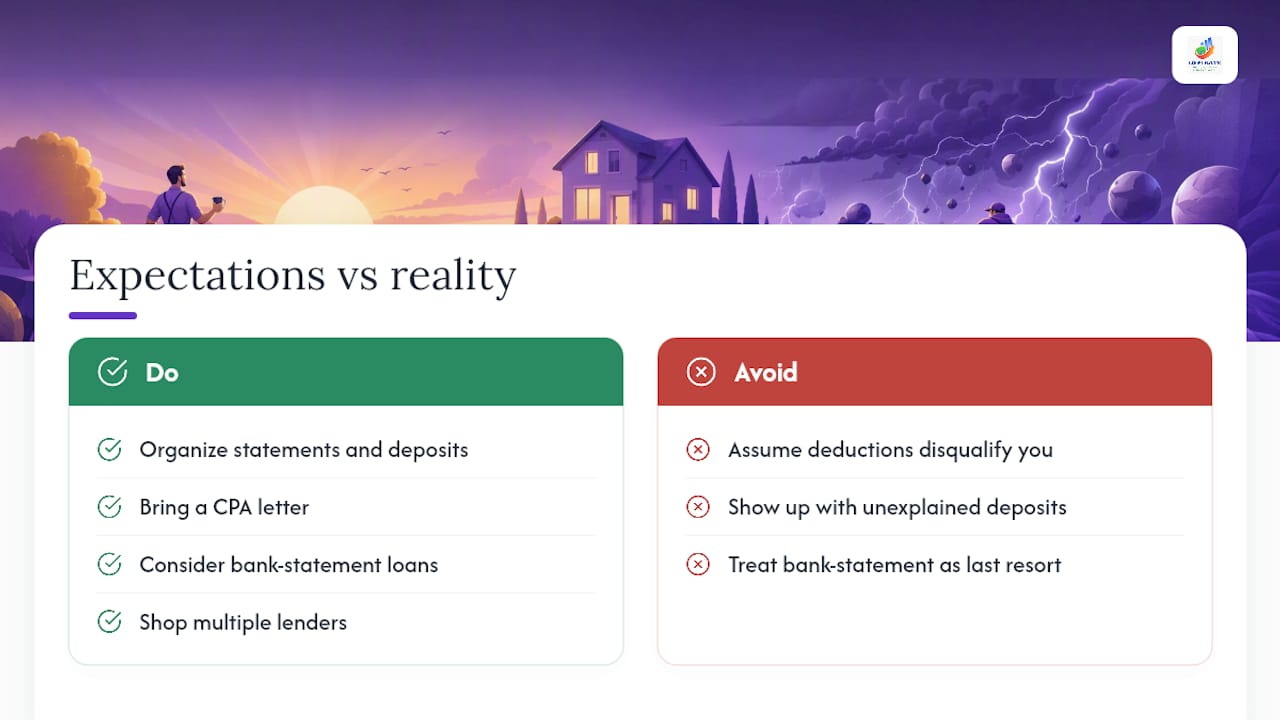
The other misconception worth killing: bank-statement loans are not a consolation prize for people who "can't qualify normally." They're a legitimate underwriting method that simply measures income a different way, and for plenty of business owners, they produce a more accurate number than a Schedule C ever could. The tradeoff is real. You'll likely pay a higher rate and put more down. But an accurate, higher qualifying income beats a low one that technically got you a better rate on paper and still didn't get you the house.
If there's one thing self-employed borrowers underestimate, it's how much lender-to-lender variation exists in this corner of the market. Two non-QM lenders can look at the identical file and land on qualifying incomes tens of thousands of dollars apart, simply because of how each applies its expense factor. That's not a reason to panic. It's a reason to shop.
— LoFi
This article is general information, not a substitute for advice from a qualified financial advisor. Consult a qualified financial professional about your own circumstances before acting on anything here.
Sources
- What is a qualified mortgage? (CFPB)
- Self-Employed Individuals Tax Center (IRS)
- What Is a Bank Statement Loan? (Experian)
- Qualifying for a mortgage when you're self‑employed (Freddie Mac)