

The secondary mortgage market is where completed home loans get bought and sold after a lender originates them, and it's the reason you can walk into a bank today and get a 30-year fixed-rate mortgage. Without it, lenders would run out of money to lend. They'd have to wait decades for borrowers to repay before issuing new loans. Instead, they sell your mortgage to investors, replenish their capital, and start lending again immediately. The whole system keeps mortgage money flowing across the country.
Here's what that means for you as a homebuyer or homeowner:
- Lenders originate loans, then sell them to free up capital for new borrowers
- Fannie Mae and Freddie Mac are the dominant buyers, purchasing loans that meet conforming standards
- Sold loans get bundled into mortgage-backed securities (MBS) and sold to investors
- Your loan terms, including your interest rate and repayment schedule, do not change when your loan is sold
- The market supports lower rates, longer loan terms, and broader mortgage availability nationwide
How the secondary mortgage market actually works
The process starts the moment a lender closes your loan. That lender, whether a bank, credit union, or mortgage company, now holds a long-term asset that ties up capital. To get that capital back quickly, the lender sells the loan to an aggregator, typically Fannie Mae or Freddie Mac, or to a private financial institution.
The aggregator pools hundreds or thousands of individual mortgages together and packages them into mortgage-backed securities. Those securities are then sold to institutional investors through securities dealers. Investors receive regular payments funded by the principal and interest borrowers pay each month.
Here's the cycle in plain terms:
- Origination: A lender closes your mortgage and holds the loan briefly
- Sale: The lender sells the loan to an aggregator like Fannie Mae or Freddie Mac
- Securitization: The aggregator bundles loans into MBS and issues securities
- Distribution: Securities dealers sell MBS to institutional investors
- Reinvestment: Sale proceeds return to the lender, who issues new mortgages
One detail worth knowing: the TBA market (To-Be-Announced) lets lenders lock in pricing on MBS before loans even close. That forward-trading mechanism is a big reason mortgage rates stay consistent across the country rather than varying wildly by region.
Who are the key players in this market?
The home loan secondary market involves four distinct groups, each with a specific job.
Mortgage originators are the lenders you deal with directly: banks, credit unions, mortgage companies, and wholesale brokers. They create the loans and typically sell them quickly rather than holding them long-term.

Aggregators are the buyers. Fannie Mae and Freddie Mac dominate this role as government-sponsored enterprises (GSEs). They purchase loans that meet conforming standards, bundle them into agency MBS, and provide a credit guarantee to investors. Approximately two-thirds of residential mortgages have been repackaged as agency MBS in recent years. Private institutions also securitize mortgages, creating what's called non-agency or "private-label" MBS, though these carry higher credit risk because no government guarantee backs them.
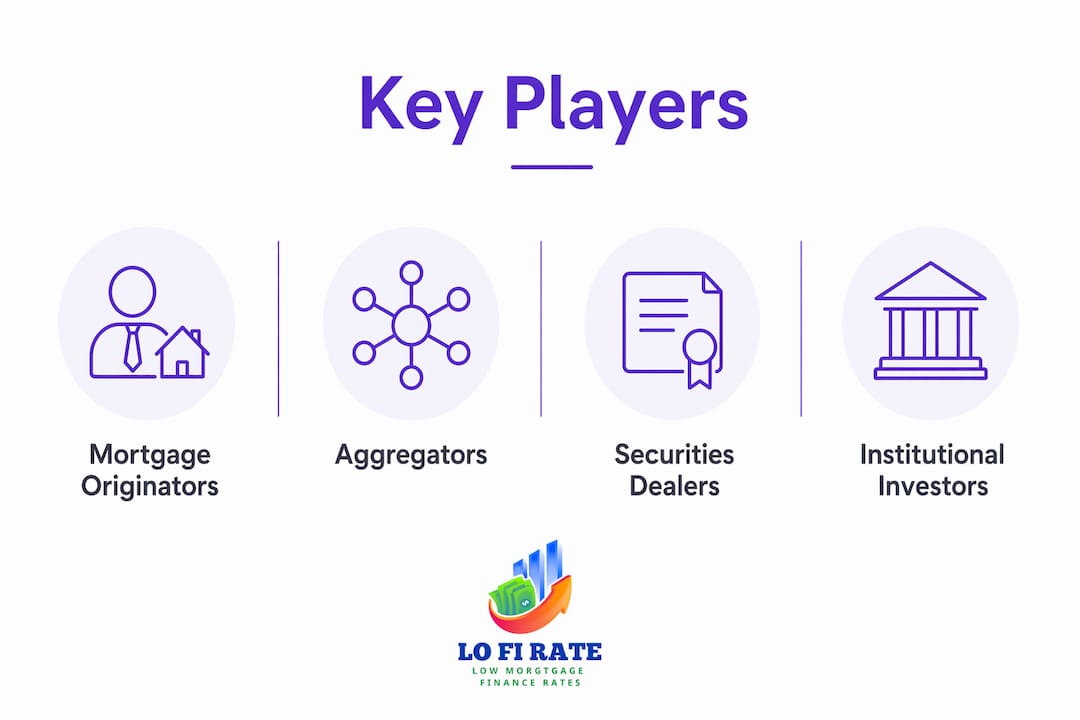
Securities dealers act as intermediaries, distributing MBS to buyers in the broader financial markets.
Institutional investors are the end buyers: pension funds, insurance companies, banks, and the Federal Reserve. They purchase MBS for steady income. The tradeoff is prepayment risk: when interest rates drop and homeowners refinance en masse, investors get their principal back earlier than expected, often when reinvestment options are less attractive.
How does this market benefit you as a homebuyer?
The secondary mortgage market lowers your interest rate. By spreading lending risk among global investors, it decouples mortgage lending from mortgage investing, which means your local bank doesn't have to absorb decades of interest rate risk just to give you a loan. That risk transfer is what makes mortgage credit cheaper and more widely available.

The 30-year fixed-rate mortgage exists specifically because of this market. Without the ability to offload long-term interest rate risk to investors, lenders would stick to shorter terms or adjustable-rate products. The secondary market makes 30-year fixed loans viable for lenders to offer at all.
Other direct benefits for homebuyers and homeowners:
- More access: Lenders can keep originating loans because they're not stuck holding them
- Lower rates: Competition among investors for MBS pushes yields down, which translates to lower mortgage rates
- Consistent pricing: The TBA market creates uniform rates nationally, so geography doesn't penalize you
- Easier refinancing: The same liquidity that funds purchase loans also funds refinances
Pro Tip: If you're shopping for a mortgage, understanding that your lender will likely sell your loan means you should focus on the loan terms, not lender loyalty. Your rate and repayment schedule are locked in at closing regardless of who ends up holding the note.
Primary vs. secondary mortgage market: what's the difference?
Most homebuyers interact only with the primary market, which is the direct transaction between you and your lender. The secondary market operates entirely behind the scenes.
| Primary market | Secondary market | |
|---|---|---|
| Who's involved | Borrower and lender | Lenders, GSEs, dealers, investors |
| What's traded | New mortgage loans | Existing loans and MBS |
| Your role | Active participant | Indirect beneficiary |
| Capital direction | Flows to borrower | Flows back to lender |
The primary market is where your loan gets created. The secondary market is where it gets funded, again and again, by recycling lender capital. Risk also transfers in this process: the lender sheds long-term interest rate risk, and investors take it on in exchange for yield.
One reassuring fact: selling your mortgage does not change your loan terms. Your interest rate, monthly payment, and repayment schedule stay exactly the same. The only thing that might change is who you send your payment to, and you'll receive formal notice before that happens.
How this market developed and why it's regulated
The secondary mortgage market grew out of a real problem: local lenders in some regions had more demand for mortgages than they had capital to fund, while lenders in other regions had excess capital sitting idle. The solution was a national market where loans could flow from capital-rich areas to capital-short ones.
Fannie Mae was created in 1938 and Freddie Mac in 1970, both chartered by Congress to build exactly this kind of liquidity infrastructure. By the 1980s, banks were routinely bundling and selling mortgage loans to GSEs and private institutions. The MBS market expanded rapidly through the 1990s and into the mid-2000s, with the volume of traded MBS reaching a very large share of U.S. gross domestic product around the time of the housing crisis.
The 2008 financial crisis exposed a structural flaw: when lenders could sell loans immediately, they had weaker incentives to verify that borrowers could actually repay. Lax underwriting standards in the subprime segment contributed to a wave of defaults that collapsed MBS values and triggered the Great Recession. Post-crisis reforms tightened underwriting requirements, improved borrower screening incentives, and strengthened oversight of both GSEs and private securitizers. The agency MBS market recovered and remains highly active today. The non-agency market, which lacks government backing, has stayed well below its pre-crisis volume.
What risks does this market carry?
The secondary mortgage market creates real benefits, but it also concentrates and redistributes risk in ways worth understanding.
Prepayment risk is the most common issue for MBS investors. When rates fall, homeowners refinance, paying off their old loans early. Investors get their principal back sooner than expected, then have to reinvest at lower yields. This dynamic ties investor returns directly to borrower behavior, which is hard to predict.
Credit risk matters most in non-agency MBS. Without a government guarantee, investors absorb losses when borrowers default. Agency MBS holders are shielded from this because Fannie Mae and Freddie Mac guarantee timely payment even if the underlying borrower defaults.
Systemic risk is the lesson of 2008. When underwriting standards slip across the entire market simultaneously, defaults cluster rather than cancel each other out. The aggregation that normally reduces risk can amplify it when the loans in the pool are all flawed in the same way. Regulations introduced after the crisis are designed to prevent that scenario from repeating, though no system is failure-proof.
Liquidity risk affects investors who need to sell MBS before maturity. Agency MBS trade in one of the largest and most liquid fixed-income markets in the world, with trading volumes averaging very high daily amounts and over several trillion dollars of securities outstanding. Non-agency MBS are far less liquid, which adds a meaningful risk premium for investors in that segment.
How Lofirate connects you to better rates through wholesale access
The secondary mortgage market creates liquidity, and wholesale mortgage brokers are positioned to tap that liquidity more directly than retail lenders. A retail lender offers you its own rates. A wholesale broker shops your loan across multiple lenders competing for that secondary market business, which typically produces better pricing for you.
Lofirate connects homebuyers and homeowners with licensed wholesale mortgage brokers in their state. The platform doesn't lend money or quote rates directly. It matches you with a broker who can access wholesale mortgage pricing that retail channels don't offer.
Key benefits of this approach:
- Brokers shop multiple lenders rather than presenting a single in-house rate
- You get a no-obligation consultation with a licensed professional
- Wholesale pricing reflects secondary market competition, not a single lender's margin
- Lofirate's process is built around transparency and consumer protection
If you're buying a home or considering a refinance, getting a second opinion on your rate costs nothing and could save you thousands over the life of your loan. The secondary mortgage market exists to keep capital flowing. Lofirate exists to make sure some of that benefit reaches you directly.

Ready to see what wholesale rates look like for your situation? Connect with a broker through Lofirate for a free, no-obligation consultation.
Key Takeaways
The secondary mortgage market is the engine behind U.S. mortgage availability, and understanding it helps you make smarter decisions about your home loan.
| Point | Details |
|---|---|
| Market purpose | Lenders sell loans to free capital, enabling continuous mortgage origination nationwide. |
| Fannie Mae and Freddie Mac | These GSEs buy conforming loans and package them into agency MBS, backing roughly two-thirds of residential mortgages. |
| Your loan terms stay fixed | Selling your mortgage does not change your rate, payment, or schedule; only the servicer may change. |
| 30-year fixed loans depend on it | Without secondary market risk transfer, lenders would limit offerings to shorter or adjustable-rate products. |
| Wholesale access matters | Wholesale brokers tap secondary market competition to offer pricing retail lenders typically can't match. |