

TL;DR:
- A bridge loan is a short-term, higher-cost financing tool that helps buyers purchase a new home before selling their current one. It requires substantial equity, a clear sale timeline, and a detailed exit plan to avoid financial risks and costly fees. Using a broker-matching service can help borrowers compare offers and navigate the complex market effectively.
A bridge loan is a short-term loan that lets you buy a new home before your current one sells. It's the right move if you have at least 20% equity in your existing home, a realistic timeline to sell within 6–12 months, and the financial cushion to carry higher short-term costs. According to the CFPB, short-term mortgage products like bridge loans require careful review of disclosures — and platforms like Lofirate and NMLS-licensed brokers can help you compare offers before committing.
Table of Contents
- How does a bridge loan work?
- When does a bridge loan actually make sense?
- What does a bridge loan actually cost?
- What do lenders look for when you apply?
- How do you repay a bridge loan?
- Pros and cons of bridge loans
- What are the alternatives to a bridge loan?
- How do you get a bridge loan and what should you ask lenders?
- How Lofirate helps you shop bridge and short-term financing
- Key Takeaways
- The real risk most bridge loan articles skip
- Lofirate connects you with licensed brokers for bridge financing
- Authoritative sources and further reading
How does a bridge loan work?
A bridge loan uses your existing home as collateral to generate cash you can deploy toward a new purchase — before the old home closes. Bridge loans typically run from a few weeks up to several years, though most residential deals land in a few months' range.
Here's how the mechanics break down:
- Collateral and lien placement: The lender places a lien on your current home, your new home, or both. A first-lien position is less common when you still carry a mortgage; most bridge lenders take a second position behind your existing mortgage.
- Disbursement: Funds are released at closing and typically applied directly to the down payment or closing costs on the new property.
- Repayment profile: Most bridge loans are structured as interest-only monthly payments, with the full principal due as a balloon payment when the loan matures — usually when your old home sells.
- Closed vs. open structure: Closed bridge loans have a fixed payoff date; open bridge loans have no set payoff date, which gives flexibility but carries more risk for both sides.
Funding speed is one of the biggest practical advantages. Some lenders can fund a bridge loan rapidly, compared to the longer timeline of a conventional mortgage. That speed matters when you're competing for a home in a tight market.
One important caveat: bridge loans are often offered by regional banks, credit unions, and specialized lenders rather than large national banks. That means consumer protections can differ. Some bridge loans don't fall under the same federal or state regulations that govern traditional residential mortgages, so reading every disclosure carefully is non-optional.

When does a bridge loan actually make sense?
The ideal candidate has substantial equity, a home that will sell quickly, and a clear plan for what happens if it doesn't. That's a narrower profile than most people assume.
Common use cases:
- Buy-before-you-sell: The most common scenario. You've found the right home, but your current one hasn't sold yet. A bridge loan covers the down payment gap.
- Breaking a property chain: In competitive markets, sellers prefer buyers without a sale contingency. A bridge loan lets you make a clean offer.
- Auction or quick-close purchases: Auctions often require closing in 30 days or less. A bridge loan can fund that when a conventional mortgage can't.
- Fix-and-flip or renovation: Investors use short-term financing to acquire, renovate, and resell before converting to permanent financing.
The ideal borrower profile:
You're a strong candidate if you have at least 20% equity in your current home, a realistic sale timeline (ideally under six months), and enough monthly cash flow to cover both your existing mortgage and the bridge loan's interest payments simultaneously. You should also have a contingency plan — whether that's savings, a HELOC, or a family loan — if the sale takes longer than expected.
Where bridge loans tend to fall short:
Low equity is the clearest disqualifier. If you owe close to what your home is worth, there's no collateral base to lend against. Slow or declining markets amplify that risk considerably. First-time buyers with limited cash reserves are also poor candidates — the cost and complexity of carrying two loans simultaneously can create real financial stress fast.
What does a bridge loan actually cost?
Bridge loans are materially more expensive than conventional mortgages, and the gap is wider than most borrowers expect. Lenders charge a premium because the loan is short-term, the exit depends on a sale that hasn't happened yet, and the underwriting risk is higher.
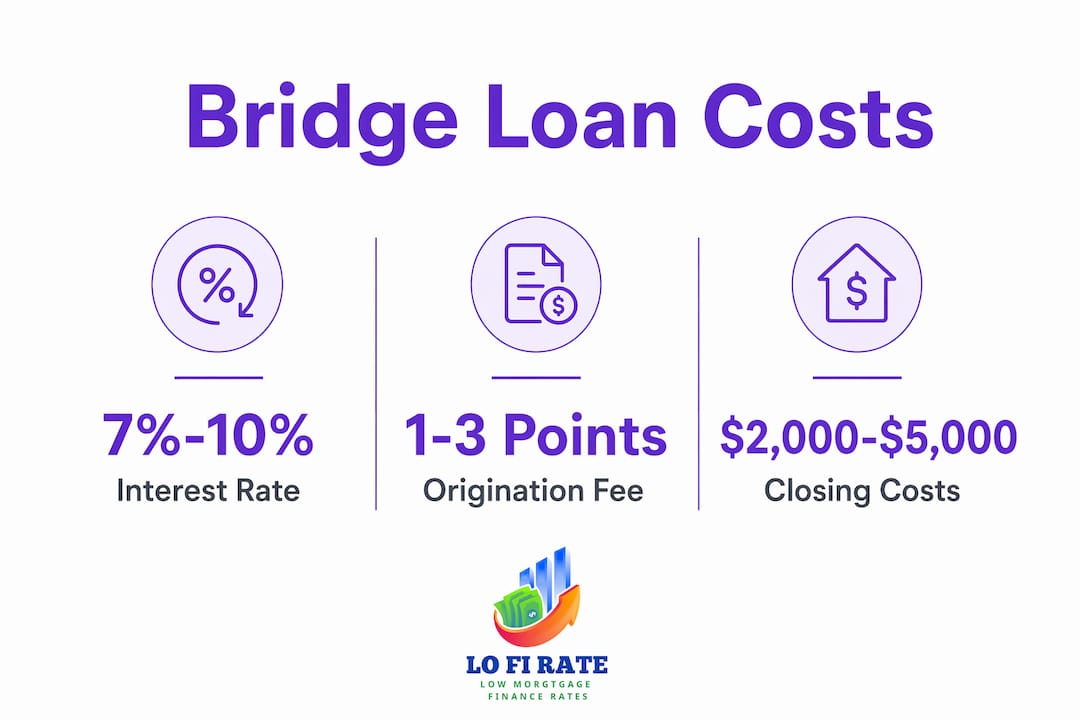
Typical costs include higher interest rates, points, and closing costs that can be a few percent of the loan amount. In late 2024, reported interest rates for bridge loans ran approximately 7%–10%, compared to lower conventional mortgage rates at the same time.
Key cost parameters at a glance
| Cost component | Typical range |
|---|---|
| Interest rate | 7%–10% (late 2024 typical range) |
| Origination points | 2–4 points |
| Closing costs | 1.5%–3% of loan amount |
| Common loan term | Several months to a few years |
Worked example: $100,000 bridge loan over 6 months
Assume an interest rate, origination points, and closing costs within typical higher-cost ranges.
- Monthly interest payment: Calculated based on the stated annual rate divided over monthly periods.
- Total interest over the loan term: Calculated accordingly.
- Origination points and closing costs: Additional fees applied as percentages of the loan amount.
- Total all-in cost: Summation of interest and fees can be a significant fraction of the loan amount over a short period. Extended terms increase total costs further, not including any possible extension fees. Understanding origination fees in detail before signing is worth the time.
What do lenders look for when you apply?
Underwriting for a bridge loan centers on one question: can you repay this when the time comes? Lenders lean heavily on your equity position and the realistic marketability of your existing home.
Primary criteria:
- Home equity: Most lenders require a substantial equity position in the property used as collateral to approve the loan.
- Credit score: Guidance varies by lender. Some sources list credit-score thresholds from roughly 620 to 740 depending on the lender and product type.
- Debt-to-income ratio: Lenders want to see that you can carry both your existing mortgage and the bridge loan's interest payments simultaneously. A DTI under 43% is a common benchmark, though some specialty lenders are more flexible.
- Proof of sale timeline: Lenders may require evidence of a listing agreement, an accepted offer, or escrow instructions to approve higher LTVs. The closer you are to a signed contract, the stronger your position.
Documents to prepare:
- Two months of pay stubs and bank statements
- Most recent mortgage statement(s) for all properties
- Proof of listing or accepted purchase offer on your current home
- Title information for both properties
- Tax returns (typically two years)
- Homeowner's insurance documentation
Because bridge loans are specialized products, many large retail banks don't offer them. You'll more often find them through regional banks, credit unions, or private specialty lenders. That's exactly where a broker-matching service earns its keep — more on that below.
How do you repay a bridge loan?
There are three main exits, and you should have a plan for all of them before you sign.

1. Sale of your current home. This is the primary exit for most residential borrowers. When the sale closes, the proceeds pay off the bridge loan's balloon balance. Lenders may allow bridge loans that cover a down payment on a new home while tying repayment directly to the sale of the existing property. Timing matters: if your bridge loan matures before the sale closes, you'll need an extension or an alternative.
2. Refinance into a permanent mortgage. If you're not selling the existing property — or if you want to consolidate debt after the purchase — you can refinance the bridge loan into a conventional or portfolio mortgage. This works best when your financial picture is clean and rates are favorable.
3. Draw on other liquidity. Savings, a HELOC on the new property, or a family loan can cover the balloon if the sale is delayed. This is the contingency, not the plan.
What happens if the sale stalls?
Ask your lender upfront about extension options and what they cost. Some lenders offer 30–90 day extensions for a fee; others don't. If the market softens and your home sits unsold past the loan term, you're looking at carrying two full mortgage payments simultaneously. That's a real financial strain, and in the worst case, a lender can move toward foreclosure if the balloon goes unpaid. Savvy borrowers plan for multiple exit scenarios and negotiate origination points and prepayment clauses up front.
Pros and cons of bridge loans
Speed and liquidity are the core appeal. The core risk is cost and the pressure that comes with a hard repayment deadline.
Pros:
- Close fast — sometimes in days — without waiting for your current home to sell
- Make a clean, non-contingent offer in competitive markets
- Potentially avoid PMI by using bridge proceeds for a larger down payment
- Flexibility to move on your timeline, not the market's
Cons:
- Interest rates and fees are significantly higher than conventional mortgages
- Risk of carrying two mortgage payments simultaneously if the sale delays
- Fewer consumer protections compared to standard retail mortgage products
- Short loan terms create real pressure — a slow market can turn a manageable situation into a financial crunch fast
- Stricter underwriting and limited lender availability
Pro Tip: If your current home has been sitting on the market for more than 60 days, or if comparable sales in your area are slowing, reconsider the bridge loan and look at a HELOC or contingent offer instead. The cost of a delayed exit compounds quickly.
What are the alternatives to a bridge loan?
A bridge loan is one of several short-term loan solutions for homebuying transitions. Each alternative has a different risk and cost profile.
| Alternative | Best when | Key trade-off |
|---|---|---|
| HELOC | You have strong equity and time to set it up | Slower to arrange; variable rate risk |
| Cash-out refinance | Rates are favorable; you want one loan | Resets your mortgage; closing costs apply |
| Contingent offer | Market is slow; seller is flexible | Seller may reject or accept a lower price |
| Personal or family loan | Small gap; strong personal relationships | Informal; can strain relationships |
| Seller financing | Seller owns free and clear; motivated to deal | Rare; requires negotiation |
| Short-term private loan | Investor scenario; speed is critical | Very high cost; less regulation |
A HELOC is often the lowest-cost alternative when you have time to set it up — typically 2–4 weeks minimum. A cash-out refinance makes sense if you'd benefit from resetting your rate anyway, but it extends your loan term and carries its own closing costs. Contingent offers are underused in slower markets; many sellers will accept a sale contingency when inventory is high and days-on-market are rising.
Consumer protections also vary across these products. HELOCs and cash-out refinances are regulated under standard mortgage rules. Personal loans and private short-term loans carry fewer protections and should be reviewed carefully.
How do you get a bridge loan and what should you ask lenders?
The safest path is to compare multiple offers — either through a broker or by contacting several specialty lenders directly. A single quote from one lender is rarely the best deal available.
Step-by-step process:
- Check your equity position. Calculate your current home's market value minus what you owe. You need at least 20% to be a viable candidate.
- Gather your documents. Pay stubs, bank statements, mortgage statements, listing agreement or accepted offer, and tax returns.
- Request lender disclosures upfront. Before you agree to anything, ask for a full fee schedule and loan estimate.
- Confirm your exit terms. Know exactly what triggers the balloon payment, what extension options exist, and what they cost.
- Compare at least three offers. Rate, points, closing costs, and prepayment terms all vary significantly across lenders.
- Close with a clear repayment plan in place. Don't close the bridge loan without a signed contract or a realistic, documented timeline for your current home's sale.
Questions to ask every lender:
- What is the total all-in cost, including points, origination fees, and closing costs?
- Are there prepayment penalties if I pay off early?
- What exactly triggers the balloon payment?
- Do you offer extensions, and what do they cost?
- Do you require me to use your permanent mortgage product after the bridge period?
- What consumer protections apply to this specific loan?
Pro Tip: A broker-matching service should ask these questions on your behalf and present you with itemized comparisons across multiple lenders. One negotiation lever worth using: if you have a signed purchase contract on your current home, use it. Lenders view a pending sale as significantly lower risk than an unlisted property — and that can translate into a lower rate or reduced points.
For a deeper look at what to ask, top questions for mortgage brokers covers the full checklist in detail.
How Lofirate helps you shop bridge and short-term financing
Using a broker-matching service speeds the comparison process and increases the chance of finding competitively priced short-term options — especially for a product as specialized as a bridge loan.
Here's what that looks like in practice: a buyer in a competitive market found their new home before their current one sold. Rather than accepting the first bridge loan quote from their existing bank, they used Lofirate to connect with a licensed wholesale broker who shopped multiple specialty lenders. The result was a lower origination fee and a rate closer to the bottom of the 7%–10% range, saving several hundred dollars per month in interest during the transition period.
What Lofirate brings to the process:
- Access to licensed wholesale brokers who work with multiple lenders, not just one institution's product shelf
- Multiple lender quotes from a single application, so you can compare rate, points, and terms side by side
- Help organizing documentation and understanding fee disclosures before you sign
- Transparency on expected timelines and what each lender requires for approval
The practical question is when to go direct versus brokered. If you already have a relationship with a regional bank that offers bridge loans and you know their pricing is competitive, going direct is fine. But if you're starting from scratch — or if your existing bank doesn't offer bridge products — a broker match is the faster path to a real comparison. Lofirate fits as the matchmaker: it doesn't lend money directly, but it connects you with licensed wholesale brokers who can shop the market on your behalf.
Key Takeaways
A bridge loan is a short-term, higher-cost tool that works well for equity-rich homebuyers with a clear, near-term exit plan — and poorly for everyone else.
| Point | Details |
|---|---|
| Core definition | A bridge loan covers the gap between buying a new home and selling your current one. |
| Cost reality | All-in costs on a $100,000 loan over 6 months can reach $8,250 or more in interest and fees. |
| Qualification threshold | Most lenders require at least 20% equity and a credit score between 620 and 740, depending on the lender and product. |
| Exit plan is mandatory | Plan for sale proceeds, a refinance, or backup liquidity before you sign. |
| Lofirate next step | Connect with a licensed wholesale broker through Lofirate to compare multiple bridge loan offers before committing. |
The real risk most bridge loan articles skip
Most guides on this topic spend a lot of time on rates and mechanics, and not nearly enough on the psychological trap that catches borrowers: the assumption that the sale will happen on schedule.
Real estate markets don't move on your timeline. A home that looked like a 60-day sale in a hot market can sit for 120 days when sentiment shifts. Bridge loans are priced for the optimistic scenario. The fees, the interest rate, the balloon structure — all of it assumes you'll be out in six months. When you're not, the math turns ugly fast, and your options narrow considerably.
The honest advice is this: before you take a bridge loan, stress-test the exit. What happens if your home takes twice as long to sell? Can you cover two mortgage payments for 12 months? Do you have a HELOC or savings buffer? If the answer to any of those is no, the bridge loan isn't a tool — it's a bet. And the house is the collateral.
The other thing worth saying plainly: not all bridge lenders are created equal. Because this is a specialty product with fewer regulatory guardrails than a conventional mortgage, predatory pricing is a real risk. Comparing multiple offers isn't just smart — it's protective. That's precisely where a broker-matching service like Lofirate earns its value: it puts competitive pressure on lenders before you sign anything.
Lofirate connects you with licensed brokers for bridge financing
Retail banks often don't offer bridge loans at all. The lenders who do are specialists — and their pricing varies more than most borrowers realize. Lofirate connects you with licensed wholesale mortgage brokers who shop multiple lenders on your behalf, so you're comparing real offers instead of guessing at the market rate.

The process is straightforward: submit your details once, get matched with a licensed broker in your state, and receive multiple quotes you can actually compare. No obligation, no upfront cost to you. Brokers in the Lofirate network cover purchase loans, refinances, cash-out options, and short-term financing scenarios — including the buy-before-you-sell transition that bridge loans are built for.
What to expect:
- Free broker match with no obligation
- Multiple lender quotes from a single application
- Guidance on documentation and disclosure review
- Typical timeline from match to first quotes: a few business days
Ready to see what's available for your situation? Visit Lofirate's services page to request a broker match, or review the full range of loan options Lofirate supports.
Authoritative sources and further reading
These sources were used to build and verify the information in this article. Each covers a distinct aspect of bridge loan mechanics, costs, and regulation.
- Bridge loan — Wikipedia: Covers the definition, typical term lengths, and the distinction between closed and open bridge loans.
- What Is a Bridge Loan? — Investopedia: Detailed breakdown of costs, points, and why bridge loans are more expensive than conventional mortgages.
- What Is a Bridge Loan and How Does It Work? — CNBC Select: Covers qualification thresholds, lender types, and reported 2024 interest rate ranges.
- What Is a Bridge Loan? — Chase: Explains funding timelines and consumer protection differences for bridge products.
- NMLS Consumer Access: Verify that any broker or lender you work with holds a valid NMLS license before signing anything.
- Lofirate — Bridge Loan Buyer's Guide: Buyer-focused explanation of how bridge loans work in residential transactions, with practical examples.
- Lofirate — Loan Options: Overview of the loan types Lofirate's broker network covers, including short-term and non-traditional financing.
This article is general information, not financial or legal advice. Confirm current rates, terms, and eligibility requirements with a licensed mortgage professional or the relevant regulatory authority for your specific situation.