

Many homebuyers assume all mortgages come with unpredictable payment changes, but that's not true. A fixed rate mortgage locks in your interest rate and monthly principal and interest payments for the entire loan term, whether that's 15, 30, or even 40 years. This stability makes budgeting easier and protects you from market volatility. Understanding how fixed rate mortgages work, when they make sense, and how to secure the best rates can save you thousands over the life of your loan. This guide breaks down everything you need to know about fixed rate mortgages in 2026, from basic mechanics to smart shopping strategies.
Table of Contents
- What Is A Fixed Rate Mortgage? Basic Mechanics And Definitions
- Advantages And Ideal Use Cases For Fixed Rate Mortgages
- Types And Variations: Term Lengths, Government Backed Loans, And Wholesale Vs Retail Rates
- How To Apply And Save On Your Fixed Rate Mortgage In 2026
- Explore Low Fixed Rate Mortgage Options With Lofirate
- Frequently Asked Questions About Fixed Rate Mortgages
Key takeaways
| Point | Details |
|---|---|
| Fixed payments | Your interest rate and monthly principal plus interest payments stay constant throughout the entire loan term. |
| Common terms | Most borrowers choose 15 or 30 year terms, with shorter terms building equity faster but requiring higher monthly payments. |
| Predictability advantage | Fixed rate mortgages eliminate payment uncertainty, making them ideal for long term homeowners who value budgeting stability. |
| ARM comparison | Adjustable rate mortgages offer lower initial rates but carry the risk of payment increases when rates adjust. |
| Wholesale savings | Wholesale mortgage channels often provide better rates than retail lenders by shopping multiple pricing sources. |
What is a fixed rate mortgage? Basic mechanics and definitions
A fixed rate mortgage is a home loan with a constant interest rate for the entire term, resulting in fixed monthly principal and interest payments. Unlike adjustable rate mortgages where your rate can change, a fixed rate mortgage guarantees the same rate from day one until you pay off the loan or refinance. This means your monthly payment for principal and interest never changes, though property taxes and insurance may fluctuate.
The way your payment works involves something called amortization. Early payments are mostly interest, with only a small portion going toward principal. Over time, this ratio shifts until your final payments are almost entirely principal. This happens automatically based on a mathematical formula that ensures you pay off the loan completely by the end of the term.
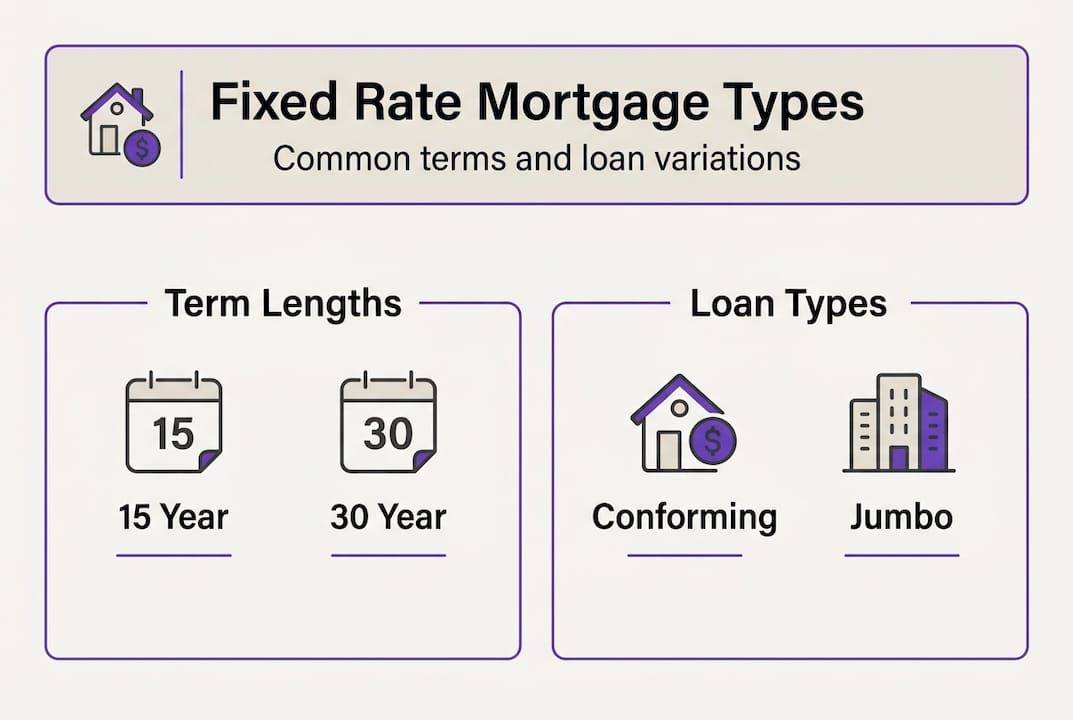
Most fixed rate mortgages come in two common terms: 15 years or 30 years. A 15 year mortgage builds equity faster and costs less in total interest, but requires higher monthly payments. A 30 year mortgage spreads payments over more time, lowering your monthly obligation but increasing total interest paid. Some lenders also offer 10, 20, or 40 year terms, though these are less common.

Here's how monthly payments compare for a $350,000 loan at 7% interest:
| Loan Term | Monthly Payment | Total Interest Paid |
|---|---|---|
| 15 years | $3,146 | $216,280 |
| 30 years | $2,329 | $488,440 |
The monthly payment calculation follows this formula:
- M = P [i(1+i)^n] / [(1+i)^n minus 1]
- M = monthly payment
- P = principal loan amount
- i = monthly interest rate (annual rate divided by 12)
- n = number of payments (loan term in years times 12)
Fixed payments benefit your budgeting because you know exactly what you'll owe each month. You can plan other expenses, savings goals, and financial decisions without worrying about surprise payment increases. This predictability is especially valuable during economic uncertainty when interest rates might rise significantly. Understanding mortgage rate basics helps you grasp how your fixed rate compares to current market conditions.
Advantages and ideal use cases for fixed rate mortgages
Fixed rate mortgages deliver several compelling advantages for homebuyers. Payment stability tops the list because your monthly principal and interest never change regardless of what happens in the broader economy. You can budget confidently knowing your housing cost won't spike. This stability also protects you from rising interest rates, which can increase payments substantially for borrowers with adjustable rate mortgages.
These mortgages are ideal for long term homeowners seeking payment predictability and protection from rate rises. If you plan to stay in your home for seven years or more, a fixed rate mortgage usually makes financial sense. You value knowing your exact payment over the potential savings from an ARM's lower initial rate. Fixed rate mortgages also suit borrowers who prefer conservative financial planning and want to avoid payment shock.
Comparing fixed rate mortgages to adjustable rate mortgages (ARMs) reveals important trade offs. ARMs typically start with lower interest rates, which means smaller initial monthly payments. However, after an initial fixed period (usually 3, 5, 7, or 10 years), the rate adjusts based on market indexes. ARMs suit short term homeowners planning to sell within 5 to 10 years but involve rate risk. If rates rise significantly, your payment could jump hundreds of dollars per month.
Key advantages of fixed rate mortgages include:
- Predictable monthly payments that never change
- Protection from interest rate increases in volatile markets
- Easier long term budgeting and financial planning
- Peace of mind knowing your housing cost is stable
- Simplified comparison shopping since rates are straightforward
Pro Tip: Consider how loan term length impacts both equity building and total interest paid. A 15 year mortgage costs more monthly but saves you over $270,000 in interest compared to a 30 year loan on a $350,000 mortgage at 7%.
Refinancing opportunities exist if rates drop significantly after you lock in your fixed rate. You can replace your existing mortgage with a new one at a lower rate, reducing your monthly payment or shortening your loan term. However, refinancing involves closing costs, so you need rates to drop enough to justify the expense. Market volatility makes fixed rates safer for cautious buyers who want certainty over speculation. You won't benefit if rates drop slightly, but you're protected if they rise sharply.
Understanding home loan application tips and monitoring mortgage rate trends 2026 helps you time your fixed rate mortgage decision effectively. The right choice depends on your financial situation, how long you plan to own the home, and your tolerance for payment uncertainty.
Types and variations: Term lengths, government backed loans, and wholesale vs retail rates
Fixed rate mortgages come in several variations beyond the standard 15 and 30 year options. Understanding these differences helps you choose the mortgage that fits your financial goals and circumstances. Term length is the most obvious variation, but other factors like loan structure and origination channel significantly impact your costs.
Term length pros and cons break down clearly. A 15 year fixed rate mortgage builds equity faster because more of each payment goes toward principal. You'll own your home outright in half the time and pay dramatically less total interest. The downside is higher monthly payments that strain some budgets. A 30 year fixed rate mortgage offers lower monthly payments, freeing up cash for other investments or expenses. However, you'll pay much more interest over the life of the loan and build equity more slowly in the early years.
Open versus closed mortgages represent another important distinction. Closed fixed rate mortgages typically offer lower interest rates but charge prepayment penalties if you pay off the loan early or make extra principal payments beyond a certain limit. Open fixed rate mortgages allow unlimited prepayments without penalties but usually come with slightly higher rates. Most U.S. mortgages are effectively open, allowing prepayments, but some lenders impose restrictions.
Government backed fixed rate options provide accessible financing for qualified borrowers. FHA loans require smaller down payments (as low as 3.5%) and accept lower credit scores, making homeownership possible for first time buyers. VA loans offer zero down payment options for eligible veterans and service members. USDA loans support rural homebuyers with no down payment requirements in designated areas. All three programs offer competitive fixed rates.
Wholesale mortgage rates versus retail rates create a significant cost difference many borrowers overlook. Retail lenders like banks offer only their own mortgage products and pricing. Wholesale mortgage brokers shop multiple lenders to find competitive rates, often securing better terms. Wholesale channels comprise 26% of mortgage originations and frequently offer better rates than retail options. The trade off is less direct contact with the actual lender, though your broker manages the process.
Here's how 15 year and 30 year fixed rate mortgages compare:
| Feature | 15 Year Fixed | 30 Year Fixed |
|---|---|---|
| Monthly payment | Higher | Lower |
| Total interest paid | Much lower | Much higher |
| Equity building | Faster | Slower |
| Interest rate | Typically 0.25% to 0.5% lower | Typically 0.25% to 0.5% higher |
| Budget flexibility | Less (higher required payment) | More (lower required payment) |
When choosing your loan type and channel, consider these factors:
- Your monthly budget and how much payment you can comfortably afford
- How long you plan to stay in the home
- Whether you qualify for government backed programs
- If you want flexibility to make extra principal payments
- Whether wholesale broker access could save you money
Pro Tip: Ask your mortgage advisor about wholesale rates to potentially save thousands. Even a 0.25% rate difference on a $350,000 mortgage saves you over $20,000 in interest over 30 years.
Jumbo versus conforming loans also affect rate availability. Conforming loans stay within limits set by Fannie Mae and Freddie Mac ($766,550 in most areas for 2026), typically offering the best rates. Jumbo loans exceed these limits and often carry slightly higher rates due to increased lender risk. Exploring loan options helps you understand which category fits your home purchase price.
How to apply and save on your fixed rate mortgage in 2026
Applying for a fixed rate mortgage in 2026 requires preparation, comparison shopping, and strategic timing. The process involves several steps, but understanding them upfront makes the experience smoother and helps you secure the best possible rate. Smart borrowers treat mortgage shopping like any major purchase, comparing multiple options before committing.
Start by checking your credit score and report at least six months before applying. Scores above 740 typically qualify for the best rates, while scores below 620 may face challenges or higher costs. Pay down existing debts to improve your debt to income ratio, which lenders scrutinize closely. Gather financial documents including pay stubs, tax returns, bank statements, and employment verification letters. Having these ready speeds up the application process.
Comparing lenders carefully saves thousands and leverages competition to secure better fixed rate deals. Don't accept the first offer you receive. Get quotes from at least three to five lenders, including banks, credit unions, and mortgage brokers. Compare not just interest rates but also closing costs, points, and fees. A slightly higher rate with lower fees might cost less overall than a lower rate with expensive closing costs.
Mortgage brokers play a valuable role in securing better fixed rate deals. Unlike retail lenders who offer only their own products, mortgage brokers shop multiple lenders on your behalf. They understand which lenders offer the best rates for your specific financial profile and can often access wholesale pricing unavailable directly to consumers. Brokers earn commissions from lenders, so their services typically don't cost you extra money.
Basic mortgage qualification criteria include steady employment history (usually two years in the same field), sufficient income to cover the mortgage payment plus other debts, adequate down payment (typically 3% to 20%), and acceptable credit score. Lenders also verify you have cash reserves to cover several months of payments. Understanding these requirements helps you prepare a strong application.
Five key application tips to maximize your success:
- Lock your rate when you find a favorable offer to protect against increases during the 30 to 60 day closing period
- Avoid major financial changes like switching jobs or opening new credit accounts during the application process
- Respond quickly to lender requests for additional documentation to prevent delays
- Review your Loan Estimate carefully to understand all costs and compare offers accurately
- Consider paying points to lower your rate if you plan to keep the mortgage long term
Pro Tip: Lock your rate early during favorable market conditions to avoid increases. Rate locks typically last 30 to 60 days, protecting you if rates rise while your loan processes.
Monitoring market trends helps you time your application optimally. Mortgage rates fluctuate based on economic factors like inflation, Federal Reserve policy, and bond market performance. While timing the absolute bottom is impossible, understanding general trends helps you recognize good opportunities. If rates have been climbing steadily and show signs of stabilizing, that might signal a good time to lock in a fixed rate.
Working with experienced professionals simplifies the process. A knowledgeable loan officer or mortgage broker can guide you through paperwork, explain complex terms, and help you avoid common mistakes. They can also suggest strategies to strengthen your application or structure your loan for maximum benefit. The effort you invest in preparation and comparison shopping pays dividends through lower rates and better loan terms.
Explore low fixed rate mortgage options with LoFiRate
Now that you understand fixed rate mortgages and how to shop for the best terms, taking action is your next step. LoFiRate connects homebuyers with licensed wholesale mortgage brokers who can access competitive fixed rate mortgage offers in 2026. Instead of being limited to one lender's pricing, you can explore multiple options and find rates that fit your financial goals.

Wholesale mortgage channels often provide better rates than retail banks because brokers shop multiple lenders on your behalf. This competition drives down costs and puts you in control. Whether you're buying your first home, moving up to a larger property, or refinancing an existing mortgage, LoFiRate's network of licensed brokers can help you leverage wholesale pricing advantages. Explore loan options tailored to different borrower profiles, from conventional fixed rate mortgages to government backed FHA and VA loans. Visit LoFiRate to connect with mortgage specialists who can explain your best fixed rate terms and help you save money over the life of your loan.
Frequently asked questions about fixed rate mortgages
What happens if I refinance a fixed rate mortgage?
Refinancing replaces your existing fixed rate mortgage with a new loan, potentially at a lower rate or different term. You'll pay closing costs again (typically 2% to 5% of the loan amount), but could save thousands in interest if rates have dropped significantly. The new loan resets your amortization schedule, so consider how many years you've already paid.
Can I pay off a fixed rate mortgage early without penalty?
Most fixed rate mortgages in the U.S. allow early payoff without penalties, but you should verify this with your lender before signing. Some loans include prepayment penalties that charge fees if you pay off the mortgage within the first few years. Making extra principal payments throughout the loan term reduces total interest and shortens the payoff timeline.
How do wholesale mortgage rates compare to retail rates?
Wholesale mortgage rates are often 0.125% to 0.5% lower than retail bank rates because brokers shop multiple lenders and access wholesale pricing channels. On a $350,000 mortgage, even a 0.25% rate difference saves over $20,000 in interest over 30 years. Wholesale brokers earn lender commissions, so you typically don't pay extra for their services.
Is a 15 year fixed mortgage always better than 30 year?
Not always. A 15 year mortgage saves substantial interest and builds equity faster, but the higher monthly payment might strain your budget or prevent you from investing money elsewhere. A 30 year mortgage offers payment flexibility and frees up cash for retirement accounts, emergency funds, or other investments that might earn higher returns than your mortgage interest rate.
Do all lenders offer the same fixed rate mortgage terms?
No. Lenders vary significantly in rates, fees, and qualifying requirements. Banks, credit unions, and mortgage brokers each have different pricing and underwriting standards. Some lenders specialize in certain loan types or borrower profiles. Comparing at least three to five lenders ensures you find competitive terms that match your financial situation.
What's the difference between interest rate and APR on a fixed rate mortgage?
The interest rate is what you pay on the loan principal, while APR (annual percentage rate) includes the interest rate plus other loan costs like origination fees, points, and mortgage insurance. APR provides a more complete picture of the loan's true cost and helps you compare offers accurately. A loan with a lower interest rate but high fees might have a higher APR than one with a slightly higher rate and lower fees.