

TL;DR:
- Rate shopping involves requesting and comparing mortgage offers from multiple lenders to secure the best rates and terms.
- Most homebuyers overlook this step, missing out on significant savings that can amount to tens of thousands of dollars over time.
Rate shopping is the practice of comparing mortgage interest rates and loan terms from multiple lenders to secure the most affordable home loan possible. Most homebuyers treat this step as optional, but nearly 7 in 10 mortgage shoppers apply to only one lender, leaving thousands of dollars on the table. The Consumer Financial Protection Bureau (CFPB), Freddie Mac, and Zillow all confirm that comparing offers from competing lenders is one of the highest-return financial moves a homebuyer can make. Understanding what is rate shopping, and doing it correctly, can mean the difference between a loan that strains your budget and one that works in your favor.
What is rate shopping and why does it matter for homebuyers?
Rate shopping, also called mortgage comparison shopping, is defined as the process of requesting loan offers from multiple lenders, then evaluating those offers side by side to find the best combination of interest rate, fees, and loan terms. The industry standard term for this practice is "mortgage comparison shopping," though "rate shopping" is widely used by borrowers and lenders alike.
The financial stakes are real. Reducing your mortgage rate by 50 basis points saves roughly $1,100 per year on a typical $360,000 home loan. Over a 30-year term, that compounds into tens of thousands of dollars. That is not a rounding error. It is a car, a college fund, or years of retirement contributions.
The benefits of rate shopping extend beyond the interest rate itself. Competing lenders also adjust origination fees, discount points, and closing cost structures when they know you are comparing offers. A borrower who shops around gains negotiating leverage that a borrower who accepts the first offer simply does not have.
How much can rate shopping actually save you?
The savings from comparing lenders are well documented and consistently larger than most borrowers expect. Shopping with 3 to 5 lenders produces average savings of $3,000 compared to accepting the first offer. In high-cost markets like San Jose, Dallas, and Seattle, where loan amounts are larger, even a quarter-point rate difference translates to significantly more.
Consider a concrete example. On a $500,000 loan at 7.25%, your monthly principal and interest payment is approximately $3,412. At 6.75%, that same loan costs about $3,243 per month. That $169 monthly difference adds up to $2,028 per year and over $60,000 across a 30-year mortgage. The math is not complicated. The problem is that borrowers spend months finding the right home but only minutes comparing lenders.
Here is what the data shows about borrower behavior and missed savings:
- Nearly 70% of homebuyers apply to just one lender, forfeiting any competitive advantage.
- Even small rate differences expand the number of homes within a buyer's budget, improving affordability directly.
- Borrowers who compare at least three lenders consistently secure lower rates than those who do not.
- High-cost markets amplify savings because the same rate difference applies to a larger loan balance.
The takeaway is straightforward. Rate shopping is not a complex financial strategy reserved for sophisticated investors. It is a basic step that most buyers skip, and skipping it costs real money.
What are the main types of rate shopping strategies?
Rate shopping explained simply comes down to one core action: get multiple offers and compare them honestly. But the strategy behind how you do that determines how much you save and how smoothly the process goes.

1. Apply to 3 to 5 lenders simultaneously. This is the most effective approach. Fewer than three lenders limits your data. More than five creates diminishing returns and unnecessary complexity. Target a mix of lender types: a national bank, a credit union, and a licensed wholesale mortgage broker like those connected through Lofirate.
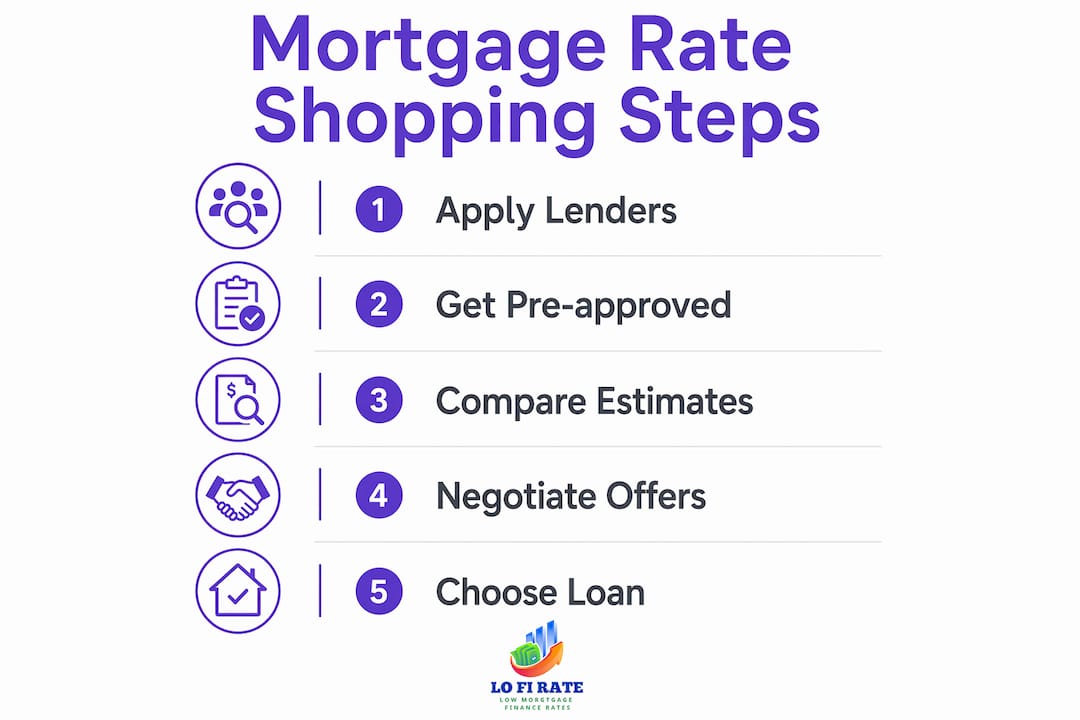
2. Get pre-approved, not just pre-qualified. Mortgage pre-approval requires a full credit check and income verification, which produces realistic rate quotes rather than teaser rates. Pre-qualification is an estimate. Pre-approval is a commitment-ready offer you can actually compare.
3. Request and compare Loan Estimates. Federal law requires lenders to provide a standardized Loan Estimate within three business days of your application. This document shows the interest rate, APR, monthly payment, closing costs, and total loan cost over five years. Comparing Loan Estimates is the only way to make an apples-to-apples comparison across lenders.
4. Negotiate with competing offers in hand. Lenders may lower origination fees or offer rate discounts when you present a competing Loan Estimate. This is not aggressive negotiation. It is a standard industry practice. Ask directly: "Can you match or beat this offer?" You will be surprised how often the answer is yes. For a deeper look at how this works, read about broker rate negotiation and how wholesale access changes the dynamic.
5. Avoid focusing only on the advertised rate. Advertised rates are marketing tools. They often require excellent credit, a large down payment, or the purchase of discount points. Always request a personalized quote based on your actual financial profile.
Pro Tip: Use a mortgage shopping worksheet to record each lender's rate, APR, origination fee, closing costs, and loan term in one place. This makes side-by-side comparison fast and prevents you from relying on memory or scattered emails.
What factors beyond interest rates affect your total mortgage cost?
The lowest interest rate is not always the cheapest loan. This is the most common and costly misunderstanding in mortgage shopping. The APR, or Annual Percentage Rate, reflects the true cost of borrowing by incorporating the interest rate plus fees, making it the more accurate number for comparison.
Here is how the key cost components differ:
| Cost factor | What it means | Why it matters |
|---|---|---|
| Interest rate | The base cost of borrowing, expressed as a percentage | Determines your monthly payment before fees |
| APR | Interest rate plus lender fees, expressed annually | Reflects the true cost of the loan for comparison |
| Origination fee | Lender's charge for processing the loan | Can range from 0% to 1%+ of the loan amount |
| Discount points | Prepaid interest to buy down the rate | One point equals 1% of the loan; reduces rate but increases upfront cost |
| Closing costs | All fees due at settlement | Typically 2% to 5% of the loan amount |
A lender offering 6.75% with $8,000 in fees may cost more over five years than a lender offering 6.90% with $2,000 in fees. Many borrowers fail to consider closing costs and points when evaluating offers, which leads to overpaying despite securing a lower headline rate. The Loan Estimate's "Comparisons" section shows the total cost over five years, which is the most useful single number for evaluating competing offers.
Fixed-rate and adjustable-rate mortgages (ARMs) add another layer. A 30-year fixed rate provides payment certainty. A 5/1 ARM offers a lower initial rate that adjusts after five years. If you plan to sell or refinance within five years, an ARM may genuinely cost less. If you plan to stay long term, the fixed rate protects you from future rate increases.
Pro Tip: Always compare the "Total Interest Paid" figure on each Loan Estimate, not just the monthly payment. A lower monthly payment with a longer term can cost significantly more over the life of the loan.
How to rate shop without hurting your credit score
Multiple credit inquiries are the most common reason homebuyers avoid rate shopping, and this fear is largely misplaced. Multiple mortgage inquiries within a 15 to 30-day window count as a single inquiry on your FICO Score. Credit bureaus recognize mortgage shopping as a responsible financial behavior, not a sign of credit distress.
Here is how to protect your credit while comparing lenders:
- Cluster your applications. Submit all mortgage applications within a two-week period. FICO's scoring models treat all mortgage inquiries in this window as one event.
- Check your own credit first. Pull your credit report from AnnualCreditReport.com before applying anywhere. Soft inquiries from self-checks do not affect your score.
- Avoid new credit accounts. Do not open a new credit card or auto loan while rate shopping. New accounts lower your average account age and can reduce your score.
- Keep existing balances low. Credit utilization above 30% on revolving accounts can drag your score down before lenders see it.
Applying to multiple lenders within a short period carries minimal score impact when timed correctly. TransUnion confirms that the credit scoring system is specifically designed to encourage mortgage comparison shopping. A well-organized approach, using a mortgage shopping checklist, keeps the process efficient and protects your credit profile at the same time.
Pro Tip: Get pre-approved before you start touring homes seriously. Pre-approval locks in your rate window, gives sellers confidence in your offer, and means your credit inquiry is already done before the clock starts on your comparison shopping period.
Key takeaways
Rate shopping is the single most effective step a homebuyer can take to reduce long-term mortgage costs, and it requires nothing more than requesting and comparing offers from 3 to 5 lenders within a focused time window.
| Point | Details |
|---|---|
| Definition of rate shopping | Comparing mortgage offers from multiple lenders to find the best rate, fees, and total loan cost. |
| Savings potential | Shopping 3 to 5 lenders saves an average of $3,000 compared to accepting the first offer. |
| APR over interest rate | Always compare APR and total five-year cost, not just the headline interest rate. |
| Credit score protection | Cluster all mortgage applications within 15 to 30 days to count as a single credit inquiry. |
| Pre-approval advantage | Pre-approval produces accurate, comparable offers and strengthens your position with sellers. |
The part most buyers get wrong about rate shopping
Most articles on this topic focus on the mechanics: get three quotes, compare the APR, watch your credit. That advice is correct, but it misses the psychological barrier that stops most buyers from doing any of it.
Homebuyers are emotionally exhausted by the time they reach the mortgage stage. You have toured dozens of homes, survived a competitive offer process, and now you are staring at a stack of lender paperwork. The path of least resistance is to say yes to whoever your real estate agent recommends and move on. I understand that impulse completely.
But here is what I have seen repeatedly: the buyers who take two extra days to get competing Loan Estimates almost always find meaningful differences. Not always in the rate itself, but in the fees, the points structure, or the closing cost total. One lender charges $4,000 in origination fees. Another charges $1,200. That gap does not show up in the interest rate. It only shows up when you read the Loan Estimate carefully.
The other mistake I see is treating the first offer as a ceiling rather than a starting point. Lenders expect negotiation. When you walk in with a competing offer, you are not being difficult. You are being a prepared borrower, and prepared borrowers get better deals. Getting a second opinion on your mortgage costs nothing and consistently reveals savings that the first lender had no reason to volunteer.
Rate shopping is not about distrust. It is about knowing that mortgage pricing is not fixed, and that the market rewards the buyers who take the time to find out.
— LoFi
See how Lofirate helps you compare mortgage rates
Rate shopping works best when you have access to more than just retail lenders. Lofirate connects homebuyers and homeowners with licensed wholesale mortgage brokers who shop multiple lenders on your behalf, often accessing pricing that is not available through a bank's direct channel.

Unlike going directly to a single bank, wholesale brokers bring competing offers to you, which means the comparison shopping is built into the process. Whether you are purchasing your first home or refinancing an existing loan, Lofirate's broker matching service gives you a no-obligation consultation to explore your options. You can also review available loan options to understand which products fit your financial situation before you commit to anything. The goal is simple: make sure you are not overpaying for your mortgage when better pricing exists.
FAQ
What is rate shopping in simple terms?
Rate shopping is the process of requesting mortgage offers from multiple lenders and comparing them to find the best interest rate, fees, and loan terms before committing to a home loan.
Does rate shopping hurt your credit score?
Rate shopping has minimal credit score impact when you complete all mortgage applications within a 15 to 30-day window, because credit bureaus count those inquiries as a single event under FICO scoring rules.
How many lenders should I contact when rate shopping?
Contacting 3 to 5 lenders produces the best balance of savings and effort, with research showing average savings of $3,000 compared to accepting the first offer.
What is the difference between interest rate and APR in mortgage shopping?
The interest rate is the base cost of borrowing, while the APR includes the interest rate plus lender fees and closing costs, making it the more accurate figure for comparing total loan costs across lenders.
When is the best time to start rate shopping?
The best time to start rate shopping is after you receive a pre-approval, which gives you a realistic rate range based on your actual credit and income profile rather than a generic advertised rate.