

TL;DR:
- Refinance timing depends on a rate drop of at least 0.50% to 0.75% below your current rate and your financial readiness.
- Calculating the break-even point by dividing closing costs by monthly savings helps determine if refinancing is worthwhile.
Optimal refinance timing is defined as the point when your new mortgage rate, loan terms, and personal finances align to produce savings that exceed the cost of refinancing. Most homeowners treat refinancing as a reaction to falling rates, but the best decisions come from a clear formula: rate reduction plus credit readiness plus a break-even calculation you can actually verify. This guide to optimal refinance timing walks you through every factor that matters, from interest rate thresholds to closing cost math, so you can act with confidence rather than guesswork.
What key financial indicators signal the best time to refinance?
The single most reliable trigger for refinancing is a rate drop of 0.50% to 0.75% below your current mortgage rate. That threshold matters because smaller drops often fail to cover closing costs before you move or pay off the loan. Your break-even timeline determines whether the savings are real.
Credit score is the second major indicator. Improving your credit score by paying down debt and maintaining a low debt-to-income ratio for at least six months before applying puts you in a stronger position to qualify for the best available rates. A higher score does not just improve your odds of approval. It directly lowers the rate a lender will offer you. For a deeper look at how your credit profile affects your rate, see this credit score guide.
Home equity is the third trigger most homeowners overlook. Once you hold at least 20% equity, you eliminate private mortgage insurance (PMI) on a conventional loan, which reduces your monthly payment even if your rate stays flat. Equity above that threshold also opens the door to cash-out refinancing, where you borrow against your home's value for renovations, debt payoff, or other goals. Learn more about home equity strategies before you apply.
Key indicators to track before you apply:
- Rate gap: Your new rate should be at least 0.50% lower than your current rate.
- Credit score: Aim for six months of consistent credit improvement before submitting an application.
- Equity position: Confirm your loan-to-value ratio and whether PMI removal is possible.
- Remaining loan term: A shorter remaining term reduces the window to recoup closing costs.
- Debt-to-income ratio: Lenders typically want this below 43% for conventional refinances.
Pro Tip: Pull your credit report at least 90 days before you plan to apply. That gives you time to dispute errors and pay down balances before a lender runs a hard inquiry.
How to calculate your refinance break-even point
The break-even point is closing costs divided by monthly savings. That single formula tells you how many months you need to stay in your home before refinancing pays off.
Closing costs range from 2% to 6% of the loan amount. On a $350,000 loan, that means $7,000 to $21,000 in upfront costs. That range is wide, so get a Loan Estimate from at least two lenders before you commit. The monthly savings figure comes from subtracting your projected new payment from your current payment, then accounting for any change in remaining loan term.
Here is a simple example to make the math concrete:
| Scenario | Current loan | Refinanced loan |
|---|---|---|
| Loan balance | $300,000 | $300,000 |
| Interest rate | 7.25% | 6.50% |
| Monthly payment | $2,047 | $1,896 |
| Monthly savings | — | $151 |
| Closing costs (3%) | — | $9,000 |
| Break-even point | — | 60 months |
In this example, you need to stay in the home for five years to break even. If you plan to sell or move before that, refinancing costs you money rather than saving it. The break-even calculation is the single most important number in your refinance decision. For a full walkthrough of this math, the break-even point guide from Lofirate covers every variable in detail.
Simplistic rules of thumb about needing a 1% or 2% rate drop are misleading. Your loan balance, remaining term, and actual closing costs determine whether refinancing makes sense. Generic thresholds ignore all three.
Pro Tip: Ask each lender for a Loan Estimate on the same day so you compare identical market conditions. Rate quotes shift daily, and a one-day gap can distort your comparison.
When does refinancing make sense beyond just lowering your rate?
Rate reduction is the most common reason to refinance, but it is not the only valid one. Refinancing to lock a fixed rate when your adjustable-rate mortgage (ARM) is approaching an adjustment period removes payment volatility entirely. If your ARM is set to reset upward, the certainty of a fixed payment can be worth paying slightly higher closing costs.
Shortening your loan term is another strong reason. Switching from a 30-year to a 15-year mortgage raises your monthly payment but cuts total interest paid dramatically. Extending your term works in the opposite direction. If your income has dropped or your expenses have risen, stretching back to a 30-year term lowers your monthly obligation even if your rate stays similar.
Personal financial changes are just as important as market conditions. A significant income increase, a large debt payoff, or a major credit score improvement all change what rate you qualify for. These personal shifts can create a refinance opportunity even when market rates have not moved. For a full list of scenarios where refinancing pays off, see top refinancing scenarios for 2026.
Common strategic reasons to refinance beyond rate reduction:
- ARM to fixed conversion: Locks your payment before an adjustment period raises your rate.
- Term shortening: Reduces total interest paid over the life of the loan.
- Term extension: Lowers monthly payments when cash flow is tight.
- Cash-out refinance: Accesses home equity for high-priority expenses at mortgage rates, which are lower than personal loan or credit card rates.
- PMI removal: Refinancing once you reach 20% equity eliminates a monthly insurance cost that adds nothing to your equity.
What are the practical steps to prepare and execute a refinance?
Preparation determines how fast and smoothly your refinance closes. The average refinance closes in about 48 days, but homeowners who gather documents early consistently close faster. That matters because rate locks typically run 30–60 days, and delays can cost you the rate you were quoted.
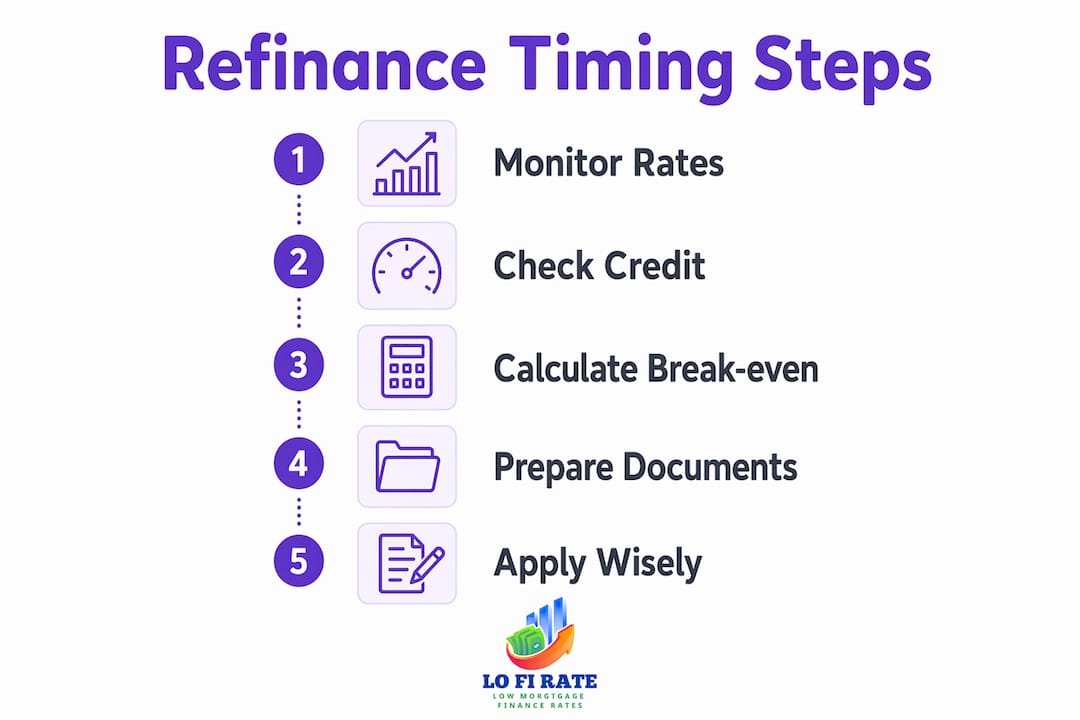
Follow these steps in order:
- Check your credit report. Pull reports from all three bureaus (Equifax, Experian, TransUnion) and dispute any errors before you apply. Even one incorrect late payment can cost you a better rate tier.
- Calculate your break-even point. Use your current balance, estimated closing costs, and projected new payment to confirm the math works before you spend time on applications.
- Gather your documents. Lenders require two years of W-2s or tax returns, recent pay stubs, two months of bank statements, and your current mortgage statement. Having these ready cuts processing time significantly.
- Shop at least three lenders. Rate shopping within a 14-day window counts as a single hard inquiry on your credit report under FICO scoring rules. Use that window to compare Loan Estimates side by side.
- Lock your rate. Once you choose a lender, lock your rate in writing. Confirm the lock period covers your expected closing date with a few days of buffer.
- Respond to underwriting requests immediately. Delays in returning documents are the most common reason refinances miss their closing date and rate lock expiration.
- Review your Closing Disclosure. Your lender is legally required to provide the Closing Disclosure at least three business days before closing. Read every line and confirm the rate, fees, and loan terms match what you agreed to. For context on what a fast close looks like from a documentation standpoint, this fast closing guide explains the process clearly.
The most common pitfall is applying before your credit is ready. A score improvement of even 20 points can move you into a better rate tier and save thousands over the life of the loan. Patience in preparation pays more than speed in application.
Key Takeaways
Refinancing delivers real savings only when the rate drop, break-even timeline, and your personal financial position all align at the same time.
| Point | Details |
|---|---|
| Rate drop threshold | A rate reduction of 0.50% to 0.75% is the minimum worth calculating for most homeowners. |
| Break-even math | Divide total closing costs by monthly savings to find how many months until refinancing pays off. |
| Credit preparation | Spend six months improving your credit before applying to qualify for the best available rates. |
| Strategic scenarios | ARM conversions, term changes, and cash-out refinancing are valid reasons beyond rate reduction. |
| Document readiness | Preparing all documents before applying helps close within the average 48-day window. |
Why I stopped waiting for the "perfect" rate
The most expensive mistake I see homeowners make is waiting for rates to hit bottom before refinancing. The problem is that nobody rings a bell at the bottom. By the time rates start rising again, the window has closed and the homeowner is stuck.
Waiting for the absolute rate bottom is risky. If a refinance delivers clear, calculable savings today, the right move is to proceed. You can always refinance again if rates drop further. The cost of a second refinance is far smaller than the months of higher payments you paid while waiting.
The other thing I have seen consistently is that homeowners underestimate how much their own credit profile controls the outcome. Market rates are the headline, but your personal rate is set by your credit score, your debt-to-income ratio, and your equity position. Two homeowners with the same loan balance can receive rates that differ by half a percentage point or more, purely because of credit preparation.
My honest advice: run the break-even math first, get your credit in order, then act when the numbers work. Do not let the search for a perfect moment cost you a good one.
— LoFi
How Lofirate connects you with better refinance rates
Retail lenders quote you one rate. Wholesale mortgage brokers shop dozens of lenders to find the most competitive option for your specific profile. Lofirate connects homeowners directly with licensed wholesale brokers in their state for a no-obligation consultation, so you see what the broader market actually offers before you commit.

If you are ready to run the numbers on your refinance, Lofirate makes it straightforward. Browse available loan options to understand what refinance products fit your goals, then request a broker match to get a personalized rate quote. There is no cost to compare, and the difference between a retail quote and a wholesale quote is often significant enough to change your break-even calculation entirely.
FAQ
What rate drop makes refinancing worth it?
A rate reduction of 0.50% to 0.75% below your current rate is the standard threshold, but your break-even calculation with actual closing costs is the definitive test.
How long does a refinance take to close?
The average refinance closes in about 48 days. Preparing your documents before applying is the most effective way to stay within that window.
Can I refinance more than once?
Yes. Refinancing again later is a valid strategy if rates drop further after your first refinance. Each refinance requires a new break-even calculation to confirm it makes financial sense.
What is the Closing Disclosure and why does it matter?
The Closing Disclosure is a legally required document your lender must deliver at least three business days before closing. It lists your final loan terms, rate, and all fees, and you should verify every line matches your Loan Estimate before signing.
Does improving my credit score before refinancing actually help?
Yes. Six months of credit improvement before applying, including paying down balances and reducing your debt-to-income ratio, directly lowers the rate lenders will offer you.