

TL;DR:
- Most homeowners overlook the upfront closing costs when refinancing, which can delay true financial benefits. The break-even point is when monthly savings cover initial expenses, calculated by dividing total closing costs by monthly payment reductions. Considering factors like loan term, interest rate drops, and long-term plans is essential to making an informed refinancing decision.
Refinancing sounds like a straightforward win — lower rate, lower payment, done. But that's not the full picture. What most homeowners miss is the upfront cost: closing fees that can run several thousand dollars before you save a single cent. Understanding what is the refinance break-even point is what separates a smart refinance from an expensive mistake. It's the moment when your monthly savings finally add up to cover what you paid to close the loan. Once you know it, you can answer the real question: will you stay long enough to benefit?
Table of Contents
- What is the refinance break-even point?
- How to calculate your refinance break-even point accurately
- Factors that influence the break-even point and what they mean for you
- Common misconceptions and nuances when evaluating refinance break-even
- How to apply your break-even calculation to make smarter refinancing decisions
- Why relying solely on break-even points can be misleading without full context
- How LoFiRate helps you navigate refinance break-even effectively
- Frequently asked questions
Key Takeaways
| Point | Details |
|---|---|
| Break-even definition | It’s the month when your savings equal refinance closing costs, marking when refinancing starts saving you money. |
| Calculate with P&I only | Use just principal and interest difference, excluding escrow, to avoid overestimating your savings. |
| Consider your stay length | Refinancing makes sense only if you plan to stay longer than the break-even period. |
| Closing costs impact | Higher closing fees lengthen the break-even time; negotiate to improve your timeline. |
| Break-even isn’t total cost | Pair break-even analysis with total interest costs to avoid costly loan term pitfalls. |
What is the refinance break-even point?
The refinance break-even point is simpler than it sounds, but most homeowners skip calculating it entirely. According to break-even point basics, a mortgage refinance break-even point is the time in months when your accumulated monthly payment savings equal your upfront refinance closing costs, meaning you start net saving rather than recovering sunk costs. Until you hit that month, you're still in the hole.
The formula is equally direct. The standard break-even formula used across the industry is:
Break-even (months) = Total closing costs ÷ Monthly savings
Here's what each piece of that formula actually represents:
- Total closing costs — Every fee the lender and third parties charge to close your new loan. This includes origination fees, appraisal, title insurance, and prepaid items. On a $300,000 loan, expect $6,000 to $18,000 in closing costs.
- Monthly savings — The difference between your current principal and interest payment and your new one after refinancing.
- Break-even months — The result of dividing those two numbers, telling you exactly when your savings start outpacing what you spent.
If your closing costs are $8,000 and you save $250 per month, you break even at month 32. Stay in the home past month 32, and refinancing made financial sense. Move before that, and you lost money on the deal.
To get a solid grip on the mechanics before you run your own numbers, reviewing refinancing basics explained is a smart starting point. Understanding how refinancing works at a structural level makes the break-even calculation much more meaningful.
How to calculate your refinance break-even point accurately
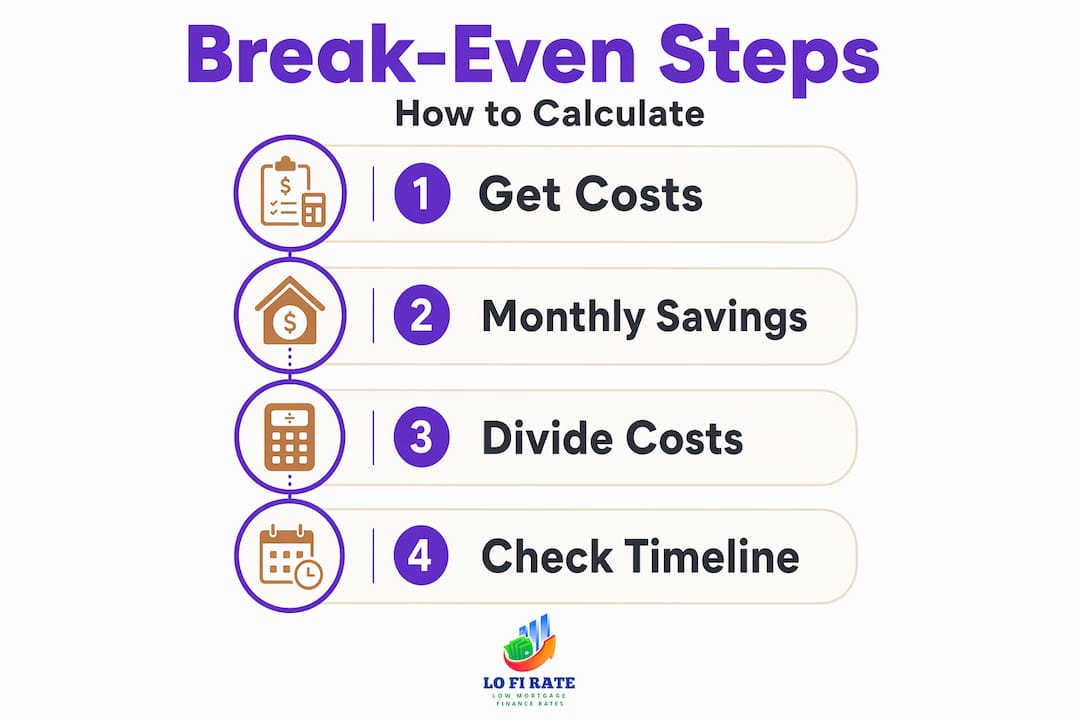
Knowing the formula is one thing. Plugging in the right numbers is where most people get tripped up. Here's how to do it correctly, step by step.
- Get your Loan Estimate. When you apply with a lender, they are legally required to send you a Loan Estimate within three business days. This document itemizes every closing cost. As NerdWallet explains, you calculate your break-even month by adding up the total loan costs from the Loan Estimate, then dividing by your monthly savings.
- Identify your current principal and interest payment. Look at your most recent mortgage statement or amortization schedule. Write down only the P&I amount, not the full payment.
- Get a quote for your new P&I payment. Your lender can calculate this based on your new rate, loan balance, and term. Make sure you're comparing apples to apples: same loan structure, just a new rate.
- Subtract new P&I from current P&I. That difference is your monthly savings.
- Divide total closing costs by monthly savings. The result is your break-even in months.
One of the most common errors is including escrow in the savings calculation. Property taxes and homeowners insurance should not be included in monthly savings because they don't change when you refinance. If your escrow payment is $400 per month and your P&I drops by $200, your true monthly savings is $200, not $600.
What to watch for:
- Paying discount points upfront lowers your rate but raises your closing costs, which pushes out the break-even date.
- Rolling closing costs into your loan balance raises your loan amount, meaning your monthly savings shrinks (because you're financing more) and your break-even extends further.
- A no-closing-cost refinance has a zero break-even, but your rate will be higher, so you trade a lower upfront hurdle for a longer-term cost.
Pro Tip: Run the calculation twice — once with points and once without. The difference in break-even months will tell you exactly how much those points are costing you in time, and whether the lower rate justifies the longer recovery window.
If you want to review the fundamentals before starting your own numbers, this overview of home refinance basics covers the key concepts clearly.
Factors that influence the break-even point and what they mean for you
Your break-even isn't just about the math on paper. Several real-world factors can compress or extend it significantly. Understanding these gives you real leverage when shopping for a refinance.
Key factors and their effects:
- Closing costs size: Refinance closing costs typically run 2% to 6% of your outstanding principal. On a $400,000 balance, that's $8,000 to $24,000 — a massive range that directly dictates how long it takes to recover.
- Interest rate reduction: A smaller rate drop means smaller monthly savings, which means a longer break-even. Dropping from 7.5% to 7.1% is very different from dropping to 6.5%.
- Loan term changes: Stretching from 15 years back to 30 years can dramatically lower your monthly payment, making break-even look favorable on paper. But you're paying interest for more years, so total loan cost rises.
- How long you plan to stay: According to Chase's break-even guidance, if your expected time in the home is shorter than the break-even period, the refinance probably won't pay off.
- Negotiating closing costs: Shopping multiple lenders or working with a wholesale broker can reduce closing costs significantly, shortening your break-even by months.
| Factor | Effect on break-even |
|---|---|
| Higher closing costs | Longer break-even |
| Larger rate reduction | Shorter break-even |
| Shorter new loan term | May lengthen (higher P&I) |
| Longer new loan term | May shorten (lower P&I, but more interest) |
| Discount points paid | Longer upfront, shorter if you hold long |
| Lower closing costs negotiated | Shorter break-even |
Pro Tip: If two lenders offer the same rate but different closing costs, calculate the break-even for each. The lower-cost option nearly always wins unless you're planning to hold the loan for 10 or more years and one option includes deep discount points.
Explore the full picture of benefits of refinancing to see how break-even fits into the broader case for or against refinancing your current mortgage.
Common misconceptions and nuances when evaluating refinance break-even
The math is simple, but the traps are real. Here's what trips up even experienced homeowners.
Mistakes to avoid:
- Including escrow in savings. This is the most common error. A key practical misconception is treating escrow components like property taxes and homeowners insurance as part of your refinance savings. They don't change, so they can't be counted.
- Ignoring rolled-in costs. If you roll $8,000 of closing costs into your loan balance, your new loan is $8,000 larger. That increases your payment slightly, which reduces monthly savings and pushes your real break-even further out than the lender's estimate suggests.
- Misreading no-cost refinances. "No closing cost" means you're paying via a higher rate, not that costs disappeared. Your break-even looks great on paper because your numerator (closing costs) is zero, but your monthly savings are smaller, so you're actually saving less each month forever.
- Ignoring amortization reset. When you refinance into a new 30-year loan, you restart the amortization clock. Early payments are mostly interest. So even if your monthly payment drops, you're paying mostly interest again for years.
"Break-even in months is a cash-flow test, not a total-interest test." — CalcBold Mortgage Refinance Calculator
This is the insight most homeowners never hear from their lender. A positive break-even analysis confirms you'll recover your closing costs. It does not confirm you'll pay less interest over the life of the loan. These are two completely different outcomes.
Pro Tip: Always calculate the break-even both with and without discount points. Then ask your lender for the total interest paid under each scenario over your expected holding period. That comparison tells you far more than break-even alone.
For a deeper understanding of how points interact with your total costs, see this breakdown of mortgage points demystified.
How to apply your break-even calculation to make smarter refinancing decisions
You've run the numbers. Now what? Here's how to actually use the break-even result to decide whether refinancing makes sense for your specific situation.
- Compare break-even months to your planned time in the home. If your break-even is 28 months and you're relocating in two years, stop there. The refinance won't pay off.
- Account for life changes. Job changes, growing families, and retirement plans all affect how long you realistically stay. Be honest about this number.
- Look at total interest, not just monthly savings. NerdWallet notes that refinance savings are often offset by upfront closing costs, and you need to confirm your savings cover those costs before you sell or move.
- Factor in your long-term financial goals. Is building equity faster more important to you than cash flow? Then a shorter-term loan might be better even if break-even looks longer.
- Run multiple scenarios. Compare a 30-year refinance versus a 20-year or 15-year. The monthly payment may differ, but total interest savings can be dramatic.
"Break-even is a key metric but not the only factor; refinance depends on your situation and if you'll keep the loan long enough to realize savings." — Chase Mortgage Education
A real example: Say your break-even is 25 months. You plan to stay in the home for at least 7 years. That's 84 months of savings after break-even, with $250 per month in savings. That's $21,000 in net gain beyond your closing costs. Suddenly the decision looks obvious.
For a structured walkthrough of how to put all of this together before you commit, see this refinance evaluation process that walks you through it step by step.

Why relying solely on break-even points can be misleading without full context
Here's an opinion you won't hear from most lenders: the break-even point is a useful metric, but treating it as the final word on refinancing is one of the costlier mistakes a homeowner can make.
The reason is what we call the amortization trap. When you refinance into a fresh 30-year mortgage, your early payments go almost entirely toward interest. You might have had 20 years left on your original loan, meaning you were building equity fast. A refinance resets that clock. Your break-even calculation says you recover costs in 24 months, but what it doesn't show is that you've added years of mostly-interest payments back into your mortgage life.
This is exactly what CalcBold's refinance calculator flags: break-even measures cash flow, not total interest. Refinancing can reset your amortization and increase total interest paid even when the break-even calculation looks favorable. That's not a small caveat. That can mean paying $40,000 or more in additional interest over the life of the loan, even though your monthly cash flow improved.
Points create a similar complexity. Paying two discount points upfront to secure a lower rate might produce a 20-month break-even that looks great. But those same two points need their own break-even analysis: at what point do the savings from the lower rate outpace the cost of the points specifically? That's often a separate calculation that spans five to seven years.
Chase acknowledges this directly: break-even is a key metric but not the only factor, and it depends on your interest rate, term, closing costs, and how long you keep the loan. Smart homeowners layer break-even analysis alongside a full total-cost comparison for their expected holding period.
Our recommendation: always calculate break-even AND total interest paid under the new loan versus keeping your existing mortgage. Then look at equity position in both scenarios. The full picture takes 20 minutes and can save you from a decision that looks smart on the surface but costs you dearly over time.
For a practical look at how working with a wholesale broker changes the math on refinancing workflow, the savings on closing costs alone can meaningfully shift your break-even timeline.
How LoFiRate helps you navigate refinance break-even effectively
With this knowledge in hand, the next step is running your actual numbers with the right support. Calculating your break-even accurately requires real closing cost data and a current rate quote, and that's where most homeowners struggle.

LoFiRate connects you with licensed wholesale mortgage brokers who shop multiple lenders on your behalf, which can lower both your rate and your closing costs. Fewer closing costs means a shorter break-even period from day one. The loan options at LoFiRate give you access to wholesale pricing that retail banks simply don't offer directly to consumers. And because brokers work with multiple lenders, they can help you compare scenarios, such as with points versus without, or 30-year versus 20-year terms, so your break-even analysis reflects reality, not just one lender's offer. Explore mortgage broker matching services to get a no-obligation consultation tailored to your refinance goals.
Frequently asked questions
What exactly is the refinance break-even point?
It's the number of months it takes for your monthly mortgage savings to fully recover your upfront refinance closing costs. After that month, you're genuinely ahead financially rather than still paying back what you spent to close.
How do I calculate the break-even point for refinancing my mortgage?
Take your total refinance closing costs from your Loan Estimate and divide by your monthly principal and interest savings. The result, as shown in the standard industry formula, gives you your break-even in months.
Can I include property taxes and insurance in my monthly savings calculation?
No. Only compare principal and interest portions of your payment, because taxes and homeowners insurance don't typically change when you refinance and including them will overstate your savings.
Is refinancing always worth it if I get a lower interest rate?
Not automatically. A lower rate reduces your payment, but upfront closing costs must be recovered first, and if you sell or move before your break-even date, you'll come out behind financially.
What happens if I extend my mortgage term when refinancing?
Your monthly payment drops, which looks favorable in break-even math, but extending your loan term restarts amortization and typically increases the total interest you pay over the life of the loan, a trade-off your break-even calculation alone won't reveal.