

An escrow waiver lets you remove taxes and insurance from your monthly mortgage payment and handle those bills yourself. Most conventional borrowers with sufficient equity and a clean 12 month payment history are the usual candidates. FHA and USDA loans are typically excluded, and lenders can revoke the waiver if you miss a tax or insurance payment.
TL;DR:
- Escrow waivers require at least 80% loan-to-value (LTV), a clean payment history, and no recent loan modifications or missed payments.
- Opting for a waiver often involves a one-time fee or a small increase in interest rate, with the fee usually being more cost-effective over the long term.
- Once approved, borrowers must pay property taxes and insurance bills directly, risking revocation if payments are missed or thresholds are not maintained.
- The process to request an escrow waiver is simpler at closing but can take weeks afterward, with approval dependent on documentation and strict criteria.
- Changes in refinance or loan modification can revoke existing waivers, making early coordination with your lender essential for maintaining a waiver qualification.
Table of Contents
- What an Escrow Waiver Changes in Your Mortgage Payment
- Who Typically Qualifies for an Escrow Waiver
- Costs and Tradeoffs: Fee vs. Rate Increase
- How to Request an Escrow Waiver, Step by Step
- Risks, Revocation, and What Fannie Mae's Servicing Rules Allow
- A Practical Checklist for Before and After Approval
- Escrow Waivers and Your Monthly Budget Stability
- How Escrow Waiver Policies Differ by Lender Type
- Legal Protections Around Escrow Waivers
- Escrow Waivers, Refinancing, and Loan Modifications
- LoFi's Take: When a Waiver Actually Makes Sense
- Get a Second Opinion on Escrow Waiver Costs
- Sources
What an Escrow Waiver Changes in Your Mortgage Payment
Your mortgage payment is usually broken into four pieces, known by the acronym PITI: principal, interest, taxes, and insurance. An escrow waiver only touches the last two. Once approved, your servicer stops collecting a monthly slice for property taxes and homeowners insurance, and stops paying those bills on your behalf.
That responsibility shifts to you entirely. When the county tax bill or the insurance renewal invoice arrives, it comes straight to your mailbox instead of your servicer's escrow department, and you're on the hook for the full amount by the due date.
The change is bigger than it sounds on paper. Escrow works as forced savings, spreading a $6,000 annual tax bill into $500 monthly chunks you barely notice. Without it, you need the discipline to set that money aside yourself. Consumer guidance and mortgage industry commentary consistently flag this as the part borrowers underestimate: the challenge isn't math, it's follow through on paying large, infrequent bills without a system doing it for you.
A few practical shifts happen once the waiver is active:
- Your monthly mortgage payment drops to just principal and interest.
- You receive tax and insurance bills directly and pay them yourself, on your own schedule.
- Your servicer no longer tracks whether those bills got paid.
- You take on full responsibility for avoiding late fees, tax liens, or an insurance lapse.
Who Typically Qualifies for an Escrow Waiver
Lenders don't hand these out automatically. Eligibility depends on your loan type, your equity position, and your payment record, and every lender applies its own written policy on top of the baseline rules.
Loan type matters most. Conventional loans sold to Fannie Mae are generally the easiest candidates for a waiver, provided the lender's own policy allows it. FHA loans almost always require escrow because HUD's mortgage insurance program builds it into the structure of the loan. USDA loans follow a similar pattern. VA loans sit in a gray area — some servicers allow waivers, others don't, so you have to ask directly.
Equity is the next filter. Fannie Mae's selling guide points to a loan to value ratio of 80% or lower as a common threshold, meaning you've paid down or built up about 20% equity in the home. Below that line, most lenders decline waiver requests outright, since a delinquent tax bill on a highly leveraged loan is a bigger risk to them.
Beyond those two gates, expect lenders to check:
- At least 12 months of on time mortgage payments with no delinquencies.
- No recent loan modification or forbearance on your account.
- A debt to income ratio within the lender's normal underwriting range.
- No prior history of missed property tax or insurance payments.
Credit score requirements vary by servicer, and some lenders simply don't offer waivers on certain loan programs regardless of how strong your file looks.
Costs and Tradeoffs: Fee vs. Rate Increase
Lenders generally charge for the privilege one of two ways: a one-time escrow waiver fee paid at closing, or a small permanent bump to your interest rate. Both compensate the lender for the added risk of not controlling your tax and insurance payments.
The math usually favors the flat fee. A quarter-point rate increase on a 30-year loan compounds every single month you hold the mortgage, while a one-time fee is paid once and forgotten. Industry analyses of these two pricing models generally show the rate increase costing more over a long loan term, especially if you plan to stay in the home well past the break-even point on the upfront fee.
Before choosing, run your own numbers on managing tax payments yourself:
- Compare the total upfront fee against the extra interest paid over your expected years in the home.
- Factor in what you could realistically earn by holding tax and insurance funds yourself instead of leaving them in a non-interest escrow account.
- Weigh the administrative hassle of tracking two extra bills a year.
Pro Tip: Ask your loan officer to show you the waiver cost both ways, as a flat fee and as a rate adjustment, before you sign anything. Reviewing your Loan Estimate and Closing Disclosure side by side makes the tradeoff obvious in about five minutes.
How to Request an Escrow Waiver, Step by Step
Timing changes how much work this takes. Requesting a waiver at closing is almost always simpler, because the decision gets folded into your rate sheet and closing disclosures as part of the same paperwork you're already signing. Asking after closing means starting a separate verification process with your servicer.
If you're past closing and want to request one now, the general steps look like this:
- Contact your servicer to confirm whether their written policy allows waivers on your loan type, and get the specific request form or portal link.
- Gather your documentation: a homeowners insurance declarations page listing your lender, proof your property taxes are current, and a record of on time mortgage payments.
- Submit the request in writing, either through the servicer's online portal or by mail, attaching every document they specify.
- Continue paying your existing escrow-inclusive payment while the request sits under review.
- Wait for written approval before you stop budgeting for the escrow portion of your payment.
Keep these details in mind during the process:
- Review typically takes several weeks, though timelines vary by servicer.
- Do not stop paying escrow until you have written confirmation the waiver is active.
- Servicers may deny the request without much explanation if you fall short on equity or payment history.
Risks, Revocation, and What Fannie Mae's Servicing Rules Allow
Getting approved for a waiver doesn't make it permanent. Fannie Mae's servicing guide gives servicers the right to deny or reverse a waiver when a borrower misses a payment, falls below the required equity threshold, goes through a loan modification, or fails to pay property taxes or insurance on time.
If you miss a tax or insurance bill after waiving escrow, your servicer can pay it on your behalf, then bill you for that advance, and reinstate the escrow requirement going forward, adding the cost back into your loan.
That last part is the real risk. A missed payment doesn't just cost you a late fee, it can undo the waiver entirely and roll you back into a mandatory escrow account, sometimes with the servicer's advance tacked onto your balance.
The fix is unglamorous but effective: set calendar reminders well ahead of due dates, put tax and insurance payments on autopay from a dedicated account, and keep copies of every payment confirmation in case a dispute comes up later.
A Practical Checklist for Before and After Approval
Before you request a waiver, and again after it's approved, a short checklist keeps you from getting caught off guard by a bill you forgot was coming.
- Pull your current insurance declarations page and confirm it lists your lender correctly.
- Locate your most recent property tax receipt and note the next due date.
- Request a current loan statement showing your payment history is clean.
- Open a separate savings account earmarked only for tax and insurance funds.
- Set two reminders per bill cycle, one a month out and one a week out, to check your balance.
Pro Tip: To find your real break-even point, add the waiver fee to any extra interest you'd pay over five years, then compare that total against what you'd actually earn keeping the funds in a savings account yourself. If the numbers are close, the simplicity of escrow often wins.
Escrow Waivers and Your Monthly Budget Stability
Dropping escrow lowers your baseline mortgage payment, but it trades one kind of stability for another. Your monthly number gets smaller and more predictable in isolation, since it's just principal and interest with no adjustment for tax reassessments or insurance premium hikes.
The tradeoff shows up twice a year instead of twelve times. Property tax bills and insurance premiums tend to rise over time, sometimes sharply after a reassessment or a bad claims year in your area. With escrow, that increase gets smoothed into a slightly higher monthly payment you barely notice. Without it, you absorb the full jump in one or two lump sums.
For homeowners with irregular income or thin cash reserves, this can strain a budget that looked fine on paper. For those with stable income and disciplined savings habits, the lower fixed payment plus self managed reserves can actually improve monthly cash flow, since you're not overpaying into an escrow cushion that some servicers keep as a buffer above the legally allowed minimum.
The practical test isn't your income level, it's whether you'll actually move money into a dedicated account the moment it would have left your paycheck through escrow. Skip that step and a waiver just delays a bill you're less prepared to pay.
How Escrow Waiver Policies Differ by Lender Type
Not every lender treats waiver requests the same way, and the differences can be significant enough to shop around before you commit.
Large national banks tend to have the most rigid, standardized policies, often built directly around Fannie Mae's baseline criteria with little room for exceptions. That consistency makes them predictable, but also less flexible if your file sits just outside their equity or credit thresholds.
Credit unions frequently have more room to negotiate, since underwriting decisions often happen with more direct human review rather than a fully automated system. A member with a long relationship and strong payment history at a credit union may get more flexibility on the equity threshold than a stranger walking into a big bank branch.
Mortgage brokers don't service loans themselves, but they matter here because they can shop your loan across multiple wholesale lenders, some of which have more borrower friendly escrow waiver policies than others. That's a meaningful advantage if a waiver is a priority for you: rather than accepting one lender's fixed policy, a broker can compare several servicers' rules on waiver eligibility, fees, and rate adjustments before you lock in a loan.
Legal Protections Around Escrow Waivers
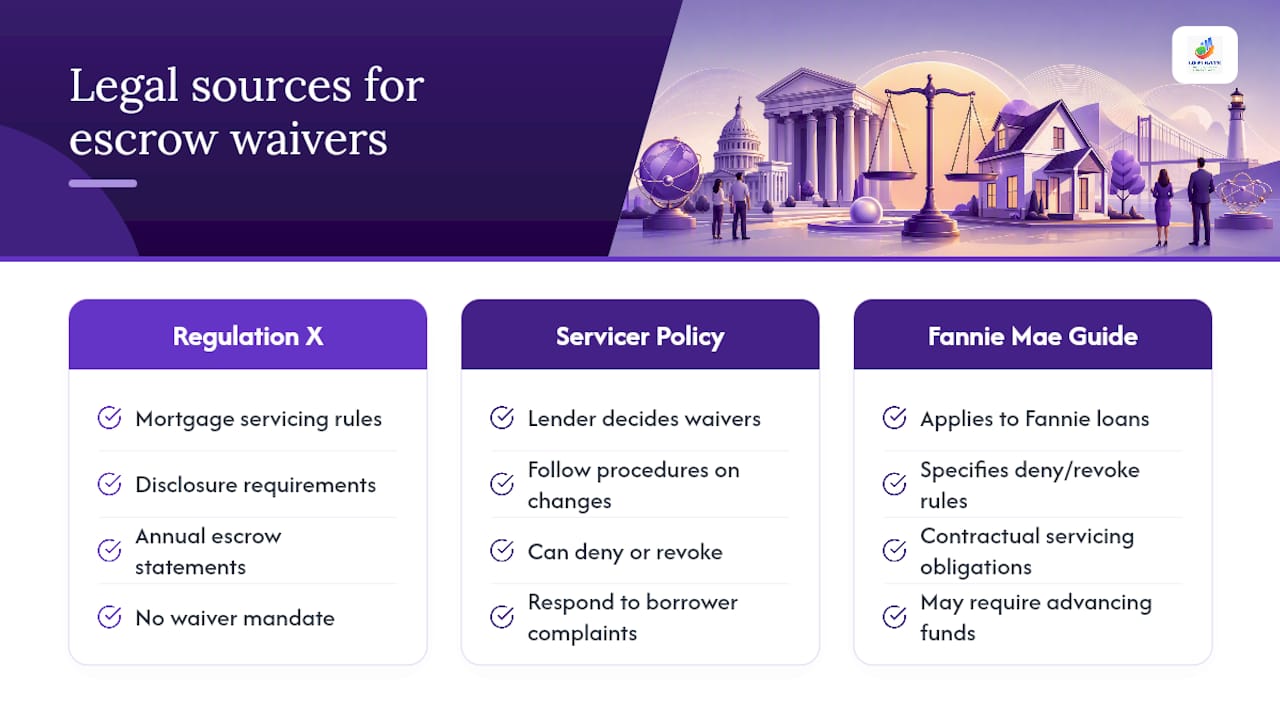
Escrow handling isn't left entirely to lender discretion. The Consumer Financial Protection Bureau's Regulation X sets mortgage servicing rules that govern how servicers manage escrow accounts, including disclosure requirements when accounts are opened, adjusted, or closed.
Regulation X doesn't force any lender to offer waivers, that decision stays with each lender's written policy, but it does require servicers to follow specific procedures once an escrow account exists or changes. That includes annual escrow account statements and clear disclosure of how payments are calculated.
Fannie Mae's own servicing guide adds another layer for loans it owns, spelling out exactly when a servicer can deny a waiver request, revoke an existing one, or advance funds on a borrower's behalf. These aren't just internal guidelines, they're contractual obligations tied to how Fannie Mae purchases and manages loans.
For borrowers, the practical upshot is that a servicer can't waive or revoke escrow on a whim outside its own stated policy, but the law doesn't force any lender to grant a waiver just because you ask. If you ever suspect a servicer mishandled your escrow account or ignored a disclosure requirement, that's a Regulation X issue worth raising with the servicer directly or escalating to a regulator.
Escrow Waivers, Refinancing, and Loan Modifications
An existing escrow waiver doesn't carry over automatically when you refinance. Refinancing creates an entirely new loan with its own underwriting, which means you'll need to requalify for a waiver under whatever policy your new lender applies, even if your old servicer had already approved one.
That matters more than it sounds, since a lot of homeowners assume the waiver just travels with them.
Loan modifications work against waivers directly. If you've gone through a modification, whether from a hardship program or a rate adjustment, Fannie Mae's servicing rules generally treat that as a disqualifying event for an existing waiver, and servicers can reinstate mandatory escrow as part of the modification terms.
If a waiver is a priority in a refinance, bring it up with your loan officer at application, not after closing. It's the same logic that applies to first time waiver requests: settling it inside the closing paperwork is far simpler than reopening the conversation with a new servicer months later.
LoFi's Take: When a Waiver Actually Makes Sense
The ideal candidate for an escrow waiver isn't just someone who qualifies on paper. It's someone who already has a system for paying irregular bills, whether that's a dedicated savings account, a spreadsheet, or a habit of never letting insurance lapse. Red flags are simple: inconsistent income, thin cash reserves, or a track record of paying bills late even when the money was technically there.
Chasing the marginal return on freed up escrow funds is usually the wrong reason to waive. Organization and a real emergency fund matter more than what you'd earn parking that money elsewhere for a year.
If you're weighing the fee versus rate tradeoff on a specific loan, a broker consultation through LoFiRate's services can model both scenarios against your actual numbers before you decide.
— LoFi
Get a Second Opinion on Escrow Waiver Costs
Running the fee versus rate math on your own is doable, but a licensed broker can model both scenarios against your actual loan numbers in minutes instead of guesswork. This service connects you with wholesale mortgage brokers who shop multiple lenders at once, which matters here because escrow waiver policies and pricing genuinely vary by lender, as covered above.

Before that call, pull together your current loan statement, your insurance declarations page, and a rough sense of how long you plan to stay in the home. That's enough for a broker to compare a one-time waiver fee against a rate adjustment and tell you which one actually saves you money over your timeline. It's also worth confirming any broker or servicer you talk to is properly licensed through NMLS Consumer Access before sharing documents.
Whether you're weighing a waiver on a purchase loan or considering it as part of a refinance, request a free consultation through LoFiRate and get pricing options compared side by side before you sign anything.
Sources
- Escrow Accounts | Fannie Mae
- Administering an escrow account and paying expenses | Fannie Mae
- Consumer Financial Protection Bureau — Regulation X (escrow provisions)
- HUD — Single family housing mortgage insurance