

A gift of equity happens when a homeowner sells a property to a relative below its appraised market value, and the difference between that appraisal and the sale price counts as the buyer's down payment. Done correctly, it can help a buyer avoid private mortgage insurance entirely. It does not bypass the lender's process: the loan file still needs an appraisal, a signed gift letter, and full underwriting of the borrower.
TL;DR:
- The gift of equity is calculated as the difference between the home's appraised value and the negotiated sale price, which determines the buyer’s down payment and can eliminate PMI.
- Only certain family members or permitted entities can give a gift of equity, with specific rules varying by loan program such as FHA, VA, USDA, or conventional loans.
- Proper documentation—including an appraisal ordered by the lender, a signed gift letter, and matched figures on the settlement statement—is essential to avoid delays or rejection at closing.
- The donor must report gifts exceeding the annual exclusion on IRS Form 709, impacting future capital gains tax basis for the buyer, who inherits a lower basis than a full-price purchase would provide.
- Starting with lender approval and appraisal before negotiating sale prices, along with comparing lenders through a broker, can streamline the process and reduce the risk of errors or delays.
Table of Contents
- What Is a Gift of Equity and How Does It Work?
- Who Can Give a Gift of Equity, and Do Program Rules Differ?
- What Documents Do You Need for a Gift of Equity?
- What Are the Tax Implications of a Gift of Equity?
- Is a Gift of Equity Worth It? Weighing the Pros and Cons
- How Do You Complete a Gift of Equity Transaction Step by Step?
- How Do You Calculate a Gift of Equity and Its Effect on PMI?
- How Can a Broker Help With a Gift of Equity Loan?
- What Practitioners Wish Every Family Knew Before Closing
- Compare Lenders Before You Finalize a Family Sale Price
- Where to Find Official Guidance on Gift of Equity Rules
- Sources
- FAQ
What Is a Gift of Equity and How Does It Work?
A gift of equity is fundamentally different from a cash gift, even though both help a buyer come up with a down payment. With a cash gift, money physically moves from a donor's bank account into the transaction. With a gift of equity, no cash changes hands at all. Instead, the seller agrees to sell the home for less than what it's worth, and that discount is treated as if the buyer had put down cash.
The math is straightforward. A licensed appraiser establishes the home's fair market value, then the lender subtracts the actual sale price from that number. Whatever is left over is the gift of equity. If a house appraises at $400,000 and a parent agrees to sell it to their child for $340,000, that $60,000 gap is the gift.
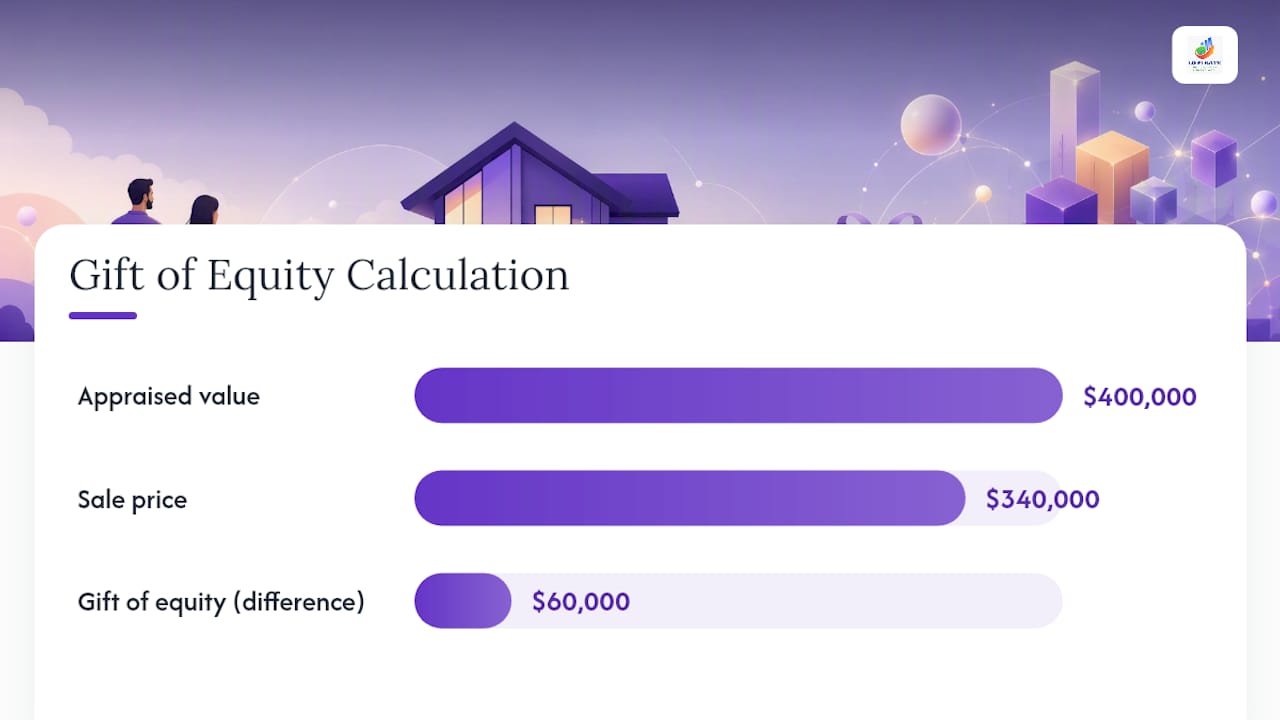
That figure doesn't just live in a spreadsheet. It has to show up formally on the settlement statement, listed as a credit to the buyer, and the lender verifies it the same way it would verify any other source of down payment funds, according to Fannie Mae's Selling Guide. This is where a lot of families get tripped up. They assume that because no money is wired anywhere, the paperwork trail matters less. It's the opposite. Because there's no bank statement showing a deposit, the lender leans harder on the appraisal and the gift letter to prove the transaction is legitimate.
A few things stay true no matter which loan program is involved:
- The gift amount is always the appraised value minus the negotiated sale price, never an estimate the family agrees on informally.
- Lenders treat the gift as if it were the buyer's own funds once it's documented, but the buyer still has to qualify on credit, income, and debt ratios.
- The seller receives less cash at closing than a market-rate sale would generate, since the "gift" is really forgone proceeds.
Who Can Give a Gift of Equity, and Do Program Rules Differ?
Not every relationship qualifies, and the rules shift depending on which loan program the buyer uses. Getting this wrong is one of the fastest ways to stall a closing.
Conventional loans backed by Fannie Mae or Freddie Mac generally require the donor to be a family member, which typically includes parents, grandparents, siblings, and in some cases domestic partners or fiancés. Freddie Mac and Fannie Mae both allow trusts to act as the donor in certain circumstances, which matters for families doing estate planning alongside a property transfer.
Government-backed programs each add their own wrinkles:
- FHA loans allow gifts of equity from family members and, in specific cases, from a tenant who's been renting the property and is now buying it, but the relationship and gift terms need to be spelled out precisely.
- USDA loans require the gift to be structured as a reduction in the sales price rather than a separate credit, and the buyer cannot receive cash back from the transaction, according to The Mortgage Reports.
- VA loans permit gifts of equity toward the down payment, but there are limits on how much of that value can be applied toward closing costs versus the purchase price itself.
There's also a rule that surprises a lot of families: Fannie Mae generally prohibits gifts of equity on investment-property purchases, and multi-unit primary residences or second homes may still require the borrower to contribute a minimum amount from their own funds even after the gift is applied. If you're helping a child buy a duplex they'll partly rent out, don't assume the gift covers everything the way it would on a straightforward single-family purchase.
Before you get attached to a specific loan program, a conversation with a lender who has actually closed gift-of-equity deals will save you weeks of back-and-forth. That's the entire reason mortgage qualification steps matter here just as much as the gift itself.
What Documents Do You Need for a Gift of Equity?
Underwriters don't take anyone's word for a family arrangement. They want a paper trail that makes the transaction airtight, and the sequence matters almost as much as the documents themselves.
- Get the appraisal ordered by the lender, not by the family, since a private appraisal won't satisfy underwriting. This has to happen early because the entire gift calculation depends on it.
- Draft and sign a gift letter naming the donor, stating the exact dollar amount of the gift, confirming the relationship to the buyer, and explicitly stating that no repayment is expected in any form.
- Submit the buyer's standard underwriting file including income verification, tax returns, credit authorization, and bank statements, exactly as you would for any purchase loan.
- Confirm the gift appears on the Closing Disclosure as a credit to the buyer, matching the letter and appraisal figures precisely.
- Have the lender re-verify everything before closing to catch mismatches between the appraisal, the gift letter, and the settlement statement.
The most common documentation failure isn't a missing signature. It's a mismatch: the gift letter says $60,000, but the settlement statement lists $58,500 because someone rounded a number or updated a sale price after the letter was signed. Underwriters flag this instantly, and it can delay closing by days while everyone re-signs corrected paperwork.
Pro Tip: Order the appraisal before you finalize the sale price with your family member. If the appraisal comes in lower than expected, you'll want to renegotiate the number on the gift letter before it's signed, not after.
What Are the Tax Implications of a Gift of Equity?
The donor, not the buyer, carries the tax reporting responsibility, and this is where families most often get blind sided months after closing. If the gift exceeds the annual exclusion amount, the seller generally needs to file IRS Form 709 to report it, even though most people never end up owing actual gift tax.
The gift tax system works on a lifetime exemption, not an annual bill. Amounts above the yearly exclusion don't trigger a tax due immediately for most donors. They count against a much larger lifetime exemption, and only donors who exceed that lifetime threshold across all their gifts actually pay gift tax out of pocket, per IRS guidance.
That doesn't mean the paperwork is optional. Failing to file Form 709 when required can create headaches years later if the IRS ever questions the transaction, particularly during an estate tax review after the donor's death.
The buyer's tax exposure is a slower burn, but it's real:
- The buyer's cost basis in the home is generally based on what they actually paid, not the appraised market value, which is lower than it would have been with a full-price purchase.
- A lower cost basis means a bigger taxable gain if the buyer sells the home later at a profit, since capital gains are calculated against that lower starting number.
- This is different from inheriting a home, where heirs typically get a stepped-up basis that erases most built-in gains.
Tax professionals frequently point out that this long-term capital gains effect gets overlooked entirely in the excitement of a family sale. If the plan is to sell in ten or fifteen years, it's worth running the numbers with a tax advisor now, not after the fact. Keep every document from the transaction, the gift letter, the appraisal, the Closing Disclosure, indefinitely. You'll want them if the home ever sells and the IRS asks how the basis was calculated.
Is a Gift of Equity Worth It? Weighing the Pros and Cons
For families who trust each other and can absorb the seller's reduced proceeds, a gift of equity solves a real problem: it gets a first-time buyer into a home without years of saving for a down payment.
It can also lower certain closing costs that scale with sale price.
The downside is just as real. The seller walks away with less money than a market sale would bring, which matters if they were counting on those proceeds for retirement or a new home purchase. The gift can trigger IRS reporting obligations for the donor. And the buyer inherits a lower cost basis that raises capital gains exposure down the road.
Watch for these specific risks:
- An appraisal that comes in lower than the family expected, shrinking the intended gift amount.
- A lender rejecting the file because the gift letter and settlement statement don't match.
- An underwriter treating an undocumented "gift" as an undisclosed loan, which can sink the application entirely.
If the family relationship or documentation feels shaky, a straightforward cash gift toward a market-rate purchase is sometimes the cleaner path.
How Do You Complete a Gift of Equity Transaction Step by Step?
The families who move through this smoothly follow roughly the same sequence, in roughly the same order, every time.
- Talk to a lender first, before agreeing on a sale price, so everyone understands which loan program fits and what documentation that program requires.
- Order the lender-directed appraisal to lock in the fair market value the entire gift calculation depends on.
- Draft the gift letter once the appraisal and sale price are both final, and have the donor sign it.
- Submit the buyer's full underwriting package, including income, credit, and asset documentation, just as with any purchase loan.
- Review the Closing Disclosure carefully before signing, confirming the gift amount matches the letter exactly.
- Close the transaction, with escrow applying the gift as a credit rather than as cash moving through the buyer's account.
- File copies of every document afterward, and have the donor consult a tax advisor about whether Form 709 is required for that tax year.
Skipping step one is the mistake that costs the most time. Families who pick a sale price first and call a lender second often discover the price doesn't work for the loan program they wanted, forcing a renegotiation after emotions and expectations are already set.
How Do You Calculate a Gift of Equity and Its Effect on PMI?
Here's how the numbers actually play out on a typical family sale, using figures common in real transactions:
| Item | Amount |
|---|---|
| Appraised fair market value | Amount determined by professional appraisal |
| Negotiated sale price | Sale price agreed between buyer and seller |
| Gift of equity | Difference between appraised value and sale price |
| Down payment percentage | Varies depending on loan and gift amount |
| PMI required? | Depends on down payment percentage and lender guidelines |
That $70,000 gift equals exactly 20% of the appraised value, which means the buyer crosses the PMI threshold without contributing a dollar of their own cash toward the down payment. Lenders also won't let an oversized gift get converted into cash reserves. Any gift amount is applied strictly to the purchase.
How Can a Broker Help With a Gift of Equity Loan?
Not every lender is comfortable underwriting a family sale, and some retail banks slow these files down simply because their loan officers don't handle them often. A broker who shops across multiple wholesale lenders is more likely to land on one with real experience closing gift-of-equity transactions cleanly.
Before a consultation, bring:
- The appraisal report or a recent estimate of value.
- A draft or signed copy of the gift letter.
- Standard buyer documentation: pay stubs, tax returns, and bank statements.
LoFiRate connects buyers and sellers with licensed brokers nationwide, at no cost to the consumer, for a no-obligation consultation covering conventional, FHA, VA, and USDA options side by side.
What Practitioners Wish Every Family Knew Before Closing
Most gift-of-equity problems trace back to timing, not intent. Families agree on a price before talking to a lender, order the appraisal too late, or sign a gift letter that doesn't match the final settlement numbers. Start the lender conversation first, get the appraisal moving early, and double check the Closing Disclosure line by line before signing. Keep every document. You'll want it years from now, whether for taxes or for the next sale.
— LoFi
Compare Lenders Before You Finalize a Family Sale Price
Retail banks often quote one rate and one set of terms, take it or leave it. Lofirate works differently: it connects you with licensed wholesale brokers who shop your gift-of-equity file across multiple lenders at once, so you're comparing real offers instead of hoping one bank's underwriter has handled a family transfer before.

That matters more on a gift of equity than on a typical purchase, because not every loan officer wants to touch a below-market family sale, and the ones who do vary widely in how smoothly they process the appraisal, the gift letter, and the Closing Disclosure entry. A broker who already knows which lenders handle these files well can save weeks of back-and-forth. LoFiRate covers conventional, FHA, VA, jumbo, and refinance options, and the consultation is free with no obligation to move forward with any matched broker. Bring your appraisal, your draft gift letter, and standard income documents, and start a broker match today to see what a wholesale-shopped rate actually looks like for your family's transaction.
Where to Find Official Guidance on Gift of Equity Rules
- Fannie Mae's gift of equity guidelines
- HUD's home loan program resources
- IRS gift tax FAQ
- CFPB's explanation of PMI
This article is general information, not a substitute for advice from a qualified financial advisor. Consult a qualified financial professional about your own circumstances before acting on anything here.
Sources
- B3-4.3-05, Gifts of Equity — Fannie Mae Selling Guide
- Gift of Equity: What It Means, Tax Implications, Pros and Cons — Investopedia
- Frequently asked questions on gift taxes — IRS
- What is private mortgage insurance? — CFPB
- Buying a home — HUD
FAQ
Who Pays Taxes on a Gift of Equity?
The donor generally bears any gift tax reporting obligation, filing Form 709 if the gift exceeds the annual exclusion. The buyer isn't taxed on receiving the gift itself, but they inherit a lower cost basis that can increase capital gains taxes when they eventually sell.
Can I Give My Daughter $50,000 to Buy a House?
Yes, either as a cash gift or by structuring it as a gift of equity if you're selling her the home directly. If it exceeds the annual IRS exclusion, you'll likely need to file Form 709, though most donors won't owe actual tax unless they've exceeded their lifetime exemption.
Is a Gift of Equity a Good Idea?
It can be a smart move for families who trust each other and want to help a buyer skip years of saving, especially if it helps them avoid PMI entirely. The tradeoffs are real, though: sellers get less cash, and buyers take on higher future capital gains exposure.
Who Is Eligible for a Gift of Equity?
Eligibility depends on the loan program, but most conventional loans require the donor to be a qualifying family member, and some allow trusts. FHA, VA, and USDA loans each add their own relationship and structuring rules, so confirming eligibility with a lender before setting a sale price is essential.