

TL;DR:
- Proper preparation and early credit-building save thousands over the mortgage lifespan.
- Wholesale mortgage brokers offer access to lower rates and more flexible lending options.
- Prioritizing smart strategies like larger down payments and rate transparency boosts savings.
Buying your first home is one of the biggest financial decisions you'll ever make, and the gap between buyers who prepare and those who wing it is measured in thousands of dollars. Many first-time buyers walk into the process unaware that a 20-point credit score difference or choosing the wrong lender type can cost them $200 or more every single month. This guide walks you through exactly how to get your finances in order, understand your mortgage options, and tap into wholesale mortgage rates that most buyers never even know exist. Follow these steps and you'll show up to the negotiating table stronger, smarter, and ready to save.
Table of Contents
- Assess your finances and build a strong foundation
- Understand your mortgage options and pre-approval process
- Wholesale mortgage rates vs retail: Why brokers matter
- Smart strategies: Points, PMI, and pitfalls
- Our take: What most first-time buyers get wrong (and what actually works)
- Ready to take the next step? Unlock better mortgage options now
- Frequently asked questions
Key Takeaways
| Point | Details |
|---|---|
| Preparation is key | Start 6-12 months ahead to improve your credit, build savings, and understand your purchase power. |
| Compare mortgage options | Shop both retail and wholesale lenders and get pre-approved by at least three to five sources for the best rates. |
| Leverage brokers | Mortgage brokers access wholesale rates, giving you more options and often lower costs than going directly to a bank. |
| Points vs down payment | Evaluate long-term plans before choosing to buy points or increase your down payment, as each has unique benefits. |
| Avoid costly mistakes | Skipping financial prep, ignoring break-even math, and missing broker advantages can cost thousands over your mortgage. |
Assess your finances and build a strong foundation
The single best thing you can do as a first-time buyer is start early. Starting 6-12 months ahead gives you time to fix credit issues, build savings, and line up your team without panic. Most buyers who rush this phase end up with a higher rate, a weaker offer, or both.
Your credit score is your most powerful financial lever when it comes to a mortgage. A score of 740 or above puts you in line for the best rates available. Drop below 700 and lenders start charging more. Drop below 650 and some programs close their doors entirely. The difference between a 680 and a 760 score on a $350,000 loan can mean paying an extra $100 to $150 per month for the life of the loan. That adds up to over $36,000 across 30 years. Understanding how your credit score and mortgage rates interact is not optional knowledge for a first-time buyer.
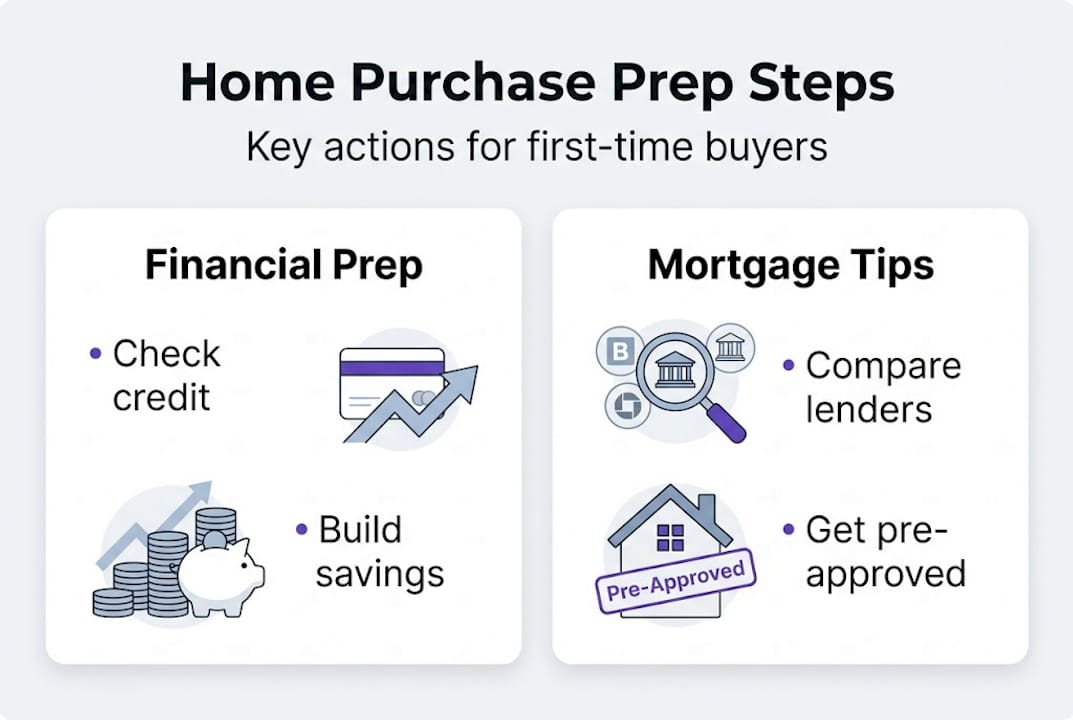
Here is a quick breakdown of what you need to save before you close:
| Cost category | Typical range | Example on $350k home |
|---|---|---|
| Down payment (3-20%) | $10,500 to $70,000 | $10,500 minimum (FHA) |
| Closing costs (2-5%) | $7,000 to $17,500 | $10,500 average |
| Cash reserves (2-3 months) | Varies | $3,000 to $6,000 |
| Total target savings | $24,000 to $87,000 |
Your debt-to-income ratio, or DTI, is the other big number lenders check. Your front-end DTI (housing costs vs. income) should stay below 28-31%, while your back-end DTI (all debts vs. income) should land under 43-45%. Lenders use this to decide how much house you can actually afford, regardless of what you feel comfortable with.
Here is a simple savings checklist to follow:
- Pull your free credit reports from all three bureaus and dispute any errors immediately
- Pay down revolving credit card balances to below 30% of each card's limit
- Avoid opening new credit accounts in the 12 months before applying
- Set up a dedicated home savings account and automate monthly contributions
- Track your DTI monthly as you pay down debt
Pro Tip: If your credit score needs work, focus on paying down credit card balances first. That single move can raise your score by 20-40 points within 60 days, often faster than any other strategy.
Understand your mortgage options and pre-approval process
Once you understand your financial baseline, your next step is learning the mortgage landscape and securing pre-approval. This step separates serious buyers from browsers in the eyes of every seller you'll encounter.
Not all loans are created equal, and choosing the wrong type can cost you upfront or long-term. Here is a quick comparison of the most common loan types available to first-time buyers:
| Loan type | Minimum down payment | Minimum credit score | Best for |
|---|---|---|---|
| Conventional | 3% | 620 | Strong credit, steady income |
| FHA | 3.5% | 580 | Lower credit, limited savings |
| VA | 0% | Varies | Eligible veterans and military |
| USDA | 0% | Varies | Rural and suburban buyers |
Shopping 3-5 lenders before deciding is not just a good idea, it is essential. Even a 0.25% rate difference on a $350,000 loan saves roughly $17,000 over 30 years. Most first-time buyers contact one lender, get a number, and accept it. That is a costly mistake.
Here is how to approach your pre-approval in a smart order:
- Gather your documents first: two years of tax returns, recent pay stubs, bank statements, and a list of all debts
- Check your credit score before any lender pulls it so you know where you stand
- Submit applications to multiple mortgage loan types for first-time buyers within a 14-day window to limit credit score impact
- Compare Loan Estimates side by side, focusing on APR (annual percentage rate), origination fees, and points
- Select the lender that fits your loan type, closing timeline, and total cost
Avoid major financial changes between pre-approval and closing. Do not buy a car, quit your job, or open a new credit card. Lenders re-verify your financial situation before funding, and surprises at that stage can collapse a deal.
Pro Tip: A pre-approval letter is not a guarantee, but it does set a firm budget and proves to sellers that you are a real, qualified buyer. In competitive markets, many listing agents won't even show a home to buyers without one.
Wholesale mortgage rates vs retail: Why brokers matter
With your pre-approval in hand, it's time to explore where wholesale mortgage rates and broker options can maximize your savings. Most first-time buyers only deal with retail lenders, which means banks, credit unions, or direct lenders that offer their own rates and nothing else. What they miss is the wholesale channel.

Wholesale mortgage brokers work differently. They access a network of institutional lenders, sometimes 50 or more options, and shop your loan to find the most competitive pricing. Because these lenders operate with lower overhead and rely on brokers for volume, they can offer rates 0.125% to 0.50% lower than what a retail bank posts publicly.
Here is how retail and wholesale compare on a real loan:
| Factor | Retail lender | Wholesale broker |
|---|---|---|
| Rate options | 1 (their own) | 50+ lenders |
| Rate advantage | Standard pricing | 0.125-0.50% lower |
| Eligibility flexibility | Stricter | More flexible |
| Transparency | Limited | Higher |
For a first-time buyer on a $400,000 loan, a 0.375% rate reduction saves roughly $90 per month. Over five years, that is $5,400 back in your pocket. Over 30 years, it approaches $32,000. Those are real numbers, not projections.
Some key advantages first-timers get from brokers:
- Access to lenders who specialize in low down payment programs
- Flexibility for buyers with non-traditional income or slight credit blemishes
- One application that gets shopped to multiple lenders simultaneously
- Guidance on which loan type fits your specific situation
When talking to a broker, ask how many lenders they work with, how they get paid, and whether they can show you competing Loan Estimates. Understanding how to access competitive mortgage rates via brokers puts you in control of the conversation. You can also learn more about lower rates using wholesale brokers before your first call.
"Wholesale brokers give first-time buyers something retail banks almost never offer: real competition. When lenders know they are being compared side by side, pricing gets sharper."
Retail lenders still make sense in some situations, such as when you already have a strong banking relationship, need a specialized product that brokers don't carry, or are operating on an extremely tight timeline. But for most first-time buyers, the broker route delivers more value with less guesswork.
Smart strategies: Points, PMI, and pitfalls
Securing a great rate is important, but maximizing your lifetime savings also means weighing special options and common traps. Two of the most misunderstood tools in the mortgage world are discount points and private mortgage insurance, known as PMI.
A discount point is prepaid interest. One point equals 1% of your loan amount and typically buys down your rate by about 0.25%. On a $400,000 loan, one point costs $4,000 and saves roughly $66 per month. Your break-even point arrives around month 61, or just over five years.
Here is a break-even table to guide your decision:
| Points paid | Upfront cost | Monthly savings | Break-even (months) |
|---|---|---|---|
| 0.5 | $2,000 | $33 | ~61 |
| 1.0 | $4,000 | $66 | ~61 |
| 2.0 | $8,000 | $132 | ~61 |
If you plan to stay in the home for 7 or more years, buying points can make financial sense. But in a market where rates are projected to ease in 2026, paying heavy upfront costs to lock in a rate you might refinance within 3 years is a losing move.
Here is how to make a smart decision on points and PMI:
- Calculate your personal break-even before agreeing to any points
- Ask yourself honestly: will you stay in this home beyond the break-even period?
- If your down payment is below 20%, factor in PMI costs, which typically run 0.5% to 1.5% of the loan annually
- Compare the savings from buying points versus using that same cash to reach 20% down and eliminate PMI entirely
- For non-traditional borrowers, a wholesale broker can often find programs with reduced or waived PMI even below 20% down
Pro Tip: In many cases, putting an extra $4,000 toward your down payment beats paying one point. Eliminating PMI saves you money every month with no break-even calculation required.
Also avoid these common pitfalls: making large cash deposits without documentation right before closing, applying for new credit after pre-approval, skipping the home inspection to save $300-500, and over-stretching your budget because a lender says you qualify for more than you're comfortable with.
Our take: What most first-time buyers get wrong (and what actually works)
Most first-time buyers fixate on rate as if it is the only number that matters. It matters, but it is not the whole story. Obsessing over a 0.125% rate difference while ignoring a 620 credit score or a weak savings cushion is like polishing the hood of a car with a dead engine.
The buyers who come out ahead consistently do three things differently. First, they treat credit improvement as a financial project, not a minor errand. Every point gained on that score before you apply translates directly into lower pricing. Second, they shop brokers aggressively for wholesale access instead of accepting the first offer a bank gives them. Third, they prioritize mortgage rate transparency and ask every lender to explain their pricing in writing.
We also see a lot of emotional fatigue derail good buyers. After months of searching, many people make rushed decisions just to end the process. That is when costly mistakes happen, from skipping contingencies to ignoring red flags in inspection reports. Patience is not passive. It is a financial strategy.
The most overlooked move? Starting with a broker consultation before you even start house hunting. It resets your expectations, sharpens your budget, and often reveals programs you had no idea existed.
Ready to take the next step? Unlock better mortgage options now
You now have a clear picture of how preparation, credit, loan type selection, and wholesale access all work together. The next step is finding the right partner to help you put it all into practice.

LoFiRate connects first-time buyers with licensed wholesale mortgage brokers in their state, giving you access to pricing and programs that most retail banks simply won't offer. There is no obligation, no pressure, and no hidden fees. You can get matched with a mortgage broker today and request a no-cost consultation that gives you a real comparison of what is available in your market. Ready to see what wholesale access actually looks like for your situation? Take a few minutes to explore loan options and find out what you could save.
Frequently asked questions
How much should I save for a first home purchase?
You should save enough to cover a 3-20% down payment, plus 2-5% in closing costs and at least two to three months of cash reserves, which can total $20,000 or more on a $350,000 home.
What are wholesale mortgage rates and how do I get them?
Wholesale rates are accessed through licensed mortgage brokers who shop your loan to 50-plus institutional lenders, often securing pricing that is 0.125% to 0.50% lower than what retail banks offer.
Is it better to buy points or put more money down?
For most first-time buyers, a larger down payment beats buying points because it eliminates costly PMI immediately, without requiring a multi-year break-even period to realize savings.
How long does it take to prepare to buy a house?
Most buyers should allow 6-12 months to properly improve credit, build savings, and organize their buying team before submitting a serious offer.
What's the first step after deciding to buy a home?
Start by reviewing your credit report, setting a savings target, and shopping 3-5 lenders or brokers for pre-approval so you know exactly what you can afford before house hunting.