

TL;DR:
- Refinancing costs include fees like closing charges and can range from 2% to 6% of the new loan amount.
- Calculating the break-even point by dividing total closing costs by monthly savings shows when refinancing is financially beneficial.
- Most homeowners underestimate costs and overlook the importance of comparing multiple official Loan Estimates before refinancing.
Refinancing costs are the fees and charges a homeowner pays to replace an existing mortgage with a new one. Knowing how to estimate refinancing costs before you apply prevents financial surprises and tells you whether the move actually saves money. Closing fees typically range between 2% and 6% of the new loan amount, which means a $300,000 refinance could cost anywhere from $6,000 to $18,000 upfront. The break-even analysis, which compares those costs against your monthly savings, is the single most important calculation in this process.
What are the typical costs involved when refinancing a mortgage?
Refinancing closing costs fall into several distinct categories, and each one is negotiable to a degree. Understanding the full refinancing cost breakdown before you sign anything puts you in a stronger position with every lender you approach.
The most common fees include:
- Loan origination fee: Charged by the lender to process the new loan, typically 0.5%–1% of the loan amount.
- Appraisal fee: A licensed appraiser assesses your home's current market value. This usually runs $300–$600 and is almost always required.
- Title search and title insurance: Protects the lender against ownership disputes. Costs vary by state but commonly range from $700 to $1,500.
- Credit report fee: Lenders pull your credit history to assess risk. This fee is usually under $50 but is rarely waived.
- Recording fees: Your local government charges these to update public property records. Amounts differ by county.
- Prepaid items: These include prepaid homeowners insurance, property taxes, and mortgage interest due at closing.
Closing fees vary by location, loan type, loan size, and lender. That variability is why two homeowners with identical loan amounts can face very different cost totals.
One option worth understanding is rolling your closing costs into the loan balance. Most lenders allow this, but it increases the total amount you borrow. That means higher monthly payments and more interest paid over the life of the loan. Rolling costs in makes sense only if you lack the cash upfront and your monthly savings still justify the refinance.

Pro Tip: Request a Loan Estimate form from every lender you consider. Federal law requires lenders to provide this document within three business days of your application, and it lists every fee in a standardized format for easy comparison.
How can you calculate your estimated refinance expenses step-by-step?
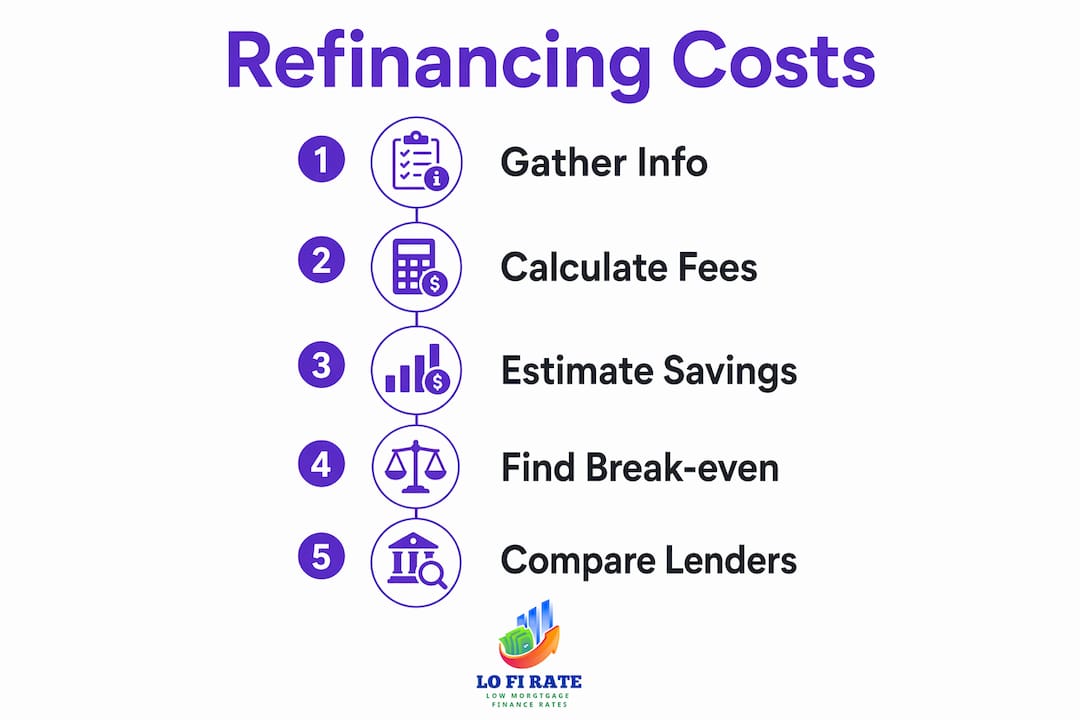
Calculating your mortgage refinance expenses does not require a finance degree. A clear, step-by-step process gives you a reliable number before you commit to anything.
-
Gather your current loan details. Write down your remaining loan balance, current interest rate, monthly payment, and the number of years left on the loan. You also need your home's estimated current value.
-
Estimate total closing costs using the 2%–6% range. Multiply your new loan amount by 0.02 and then by 0.06 to get a low and high estimate. For a $250,000 loan, that range is $5,000 to $15,000. Estimated closing costs typically fall between 2% and 5% for most conventional refinances, so the midpoint of $7,500–$12,500 is a practical working figure.
-
Calculate your new monthly payment. Use a refinancing cost calculator or a standard mortgage payment formula. Input the new loan amount, new interest rate, and new loan term. The difference between your current payment and the new payment is your monthly savings.
-
Compare monthly and lifetime savings. Monthly savings and total savings over the loan life are both critical figures. A $150 monthly reduction sounds good, but if you have 10 years left on your current loan and you refinance into a new 30-year term, you could pay significantly more in total interest.
-
Request official Loan Estimates from at least three lenders. Applying with at least three lenders gives you real numbers to compare rather than estimates. Fee structures differ more than most homeowners expect.
-
Add up all itemized fees from each Loan Estimate. Do not rely on a single lender's summary figure. Add origination, appraisal, title, recording, and prepaid items individually to verify the total.
Pro Tip: Online refinancing cost calculators from sources like CNBC Select or Zillow let you input your specific numbers and see projected savings instantly. Use them as a starting point, then verify with actual Loan Estimates from lenders.
Understanding the full home loan financing process also helps you spot fees that are inflated or unnecessary before you reach the closing table.
How to determine your break-even point
The break-even point is the month at which your cumulative monthly savings equal your total closing costs. Every month after that point, you are genuinely ahead financially.
The formula is straightforward:
Break-even point (months) = Total closing costs ÷ Monthly savings
If your closing costs are $4,000 and your monthly savings are $400, your break-even point is 10 months. That is a fast payback. If closing costs are $12,000 and monthly savings are $150, the break-even is 80 months, or nearly seven years.
| Closing costs | Monthly savings | Break-even point |
|---|---|---|
| $4,000 | $400 | 10 months |
| $8,000 | $200 | 40 months |
| $12,000 | $150 | 80 months |
| $6,000 | $300 | 20 months |
The break-even calculation also answers a question many homeowners overlook: what happens if you sell before reaching that point? If you plan to sell before the break-even point, refinancing may not be financially beneficial. Paying $8,000 in closing costs to save $200 per month makes no sense if you sell in two years.
For a deeper look at interpreting your break-even number, the refinance break-even guide from Lofirate walks through common scenarios with real numbers.
Pro Tip: If your break-even point is under 24 months and you plan to stay in the home, refinancing almost always makes financial sense. If it exceeds 48 months, look closely at whether the rate difference justifies the cost.
What factors affect refinancing cost estimates?
Several variables shift your cost estimate significantly, and adjusting for them produces a more accurate picture of what you will actually pay.
- Credit score: A higher credit score qualifies you for lower interest rates and sometimes lower origination fees. A score below 680 typically triggers higher lender fees and a less favorable rate, which shrinks monthly savings.
- Loan size: Closing costs scale with the loan amount because origination fees are percentage-based. A $400,000 refinance carries higher absolute costs than a $150,000 one, even at the same percentage.
- Loan type: FHA, VA, and conventional loans each carry different fee structures. VA loans include a funding fee. FHA loans require mortgage insurance premiums. Conventional loans avoid both but require private mortgage insurance if equity is below 20%.
- Property location: Title insurance rates, recording fees, and transfer taxes vary by state and county. Texas and New York, for example, have notably higher closing costs than many other states.
- Loan term: Refinancing from a 30-year to a 15-year term typically raises the monthly payment but lowers the interest rate and total interest paid. Refinancing from a 15-year back to a 30-year lowers the monthly payment but extends debt duration considerably.
- "No closing cost" refinances: These options roll all fees into the loan or offset them with a higher interest rate. They are not free. The cost is simply deferred and paid over time through a higher rate or larger balance.
The refinance evaluation process requires you to weigh all of these variables together, not in isolation. A lower rate with high fees can easily underperform a slightly higher rate with minimal fees, depending on how long you keep the loan.
Key Takeaways
Accurately estimating refinancing costs requires calculating total closing fees, projecting monthly savings, and computing the break-even point before committing to a new loan.
| Point | Details |
|---|---|
| Closing costs range 2%–6% | Multiply your new loan amount by this range to get a realistic upfront cost estimate. |
| Break-even point drives the decision | Divide total closing costs by monthly savings to find the month refinancing starts paying off. |
| Get three Loan Estimates | Comparing official estimates from at least three lenders reveals real fee differences and saves money. |
| Rolling costs in has a price | Adding closing costs to the loan balance increases total interest paid over the life of the loan. |
| Loan type and location shift costs | VA, FHA, and conventional loans carry different fees, and state-level charges vary widely. |
Why most homeowners underestimate refinancing costs
Most homeowners focus on the interest rate and treat closing costs as a footnote. That is the wrong order of operations.
I have seen homeowners celebrate a rate drop of 0.5% without ever calculating their break-even point. They refinanced, paid $10,000 in closing costs, and sold the home 18 months later at a net loss on the transaction. The rate was real. The savings were not, because they left before the math worked in their favor.
Refinancing resets the amortization schedule, which means your early payments on the new loan go mostly toward interest again, not principal. That is a detail retail lenders rarely volunteer. If you are 12 years into a 30-year mortgage and you refinance into a new 30-year loan, you have effectively added 12 years of interest payments back into your debt.
The official Loan Estimate form is your best tool here. It forces lenders to disclose every fee in a standardized format, and comparing three of them side by side takes about 20 minutes. That 20 minutes can save thousands. The closing costs guide from Lofirate is a good reference for understanding every line item before you sit down with a lender.
My honest advice: run the break-even calculation before you run any other number. If the math does not work on paper, a lower rate will not fix it at closing.
— LoFi
How Lofirate connects you with better refinancing options
Estimating your refinancing costs is the first step. Finding a lender who charges fair fees and offers a competitive rate is the second, and that is where most homeowners leave money on the table by going straight to a retail bank.

Lofirate connects homeowners with licensed wholesale mortgage brokers who shop multiple lenders on your behalf. Wholesale brokers access pricing that retail banks do not offer directly to consumers, which means lower rates and sometimes lower fees on the same loan. Through Lofirate's broker matching service, you can request a no-obligation consultation and get a real second opinion on your current mortgage. If you want to compare loan and refinance options side by side before committing, Lofirate gives you the access and the guidance to do it right.
FAQ
What does it cost to refinance a mortgage?
Refinancing closing costs typically range from 2% to 6% of the new loan amount. On a $250,000 loan, that means $5,000 to $15,000 in upfront fees.
How do I calculate my refinancing break-even point?
Divide your total closing costs by your monthly payment savings. If closing costs are $6,000 and you save $300 per month, your break-even point is 20 months.
Can I roll refinancing costs into my new loan?
Yes, most lenders allow you to add closing costs to the loan balance. Doing so eliminates the upfront cash requirement but increases your monthly payment and total interest paid.
How many lenders should I compare when refinancing?
Applying with at least three lenders gives you enough data to identify fee differences and negotiate better terms. Each lender must provide a standardized Loan Estimate within three business days.
Does refinancing make sense if I plan to move soon?
Refinancing rarely makes financial sense if you plan to sell before reaching your break-even point. Calculate the break-even month first, then compare it against your expected timeline in the home.