

TL;DR:
- Refinancing requires understanding key terms, goals, and evaluating total loan costs.
- Wholesale brokers often offer lower rates due to multiple lender access and competition.
- Comparing full loan estimates, including fees and APR, prevents costly mistakes and overpaying.
You open your mortgage statement, see the same high payment you've been making for years, and wonder if refinancing could finally change that. But then you start researching and hit a wall of jargon, conflicting advice, and lenders all claiming they have the best deal. The frustration is real. What you need isn't more rate quotes thrown at you. You need a clear, structured process to evaluate your options, compare lenders honestly, and make a decision you can feel confident about. This guide walks you through every step, with special focus on how wholesale mortgage brokers stack up against retail lenders.
Table of Contents
- Understanding the refinance evaluation process
- Preparing for your refinance evaluation
- Step-by-step: Evaluating wholesale vs. retail refinance offers
- Common pitfalls and how to verify your refinance decision
- Why most homeowners leave money on the table: A broker's perspective
- Ready for a smarter refinance? How LoFiRate can help
- Frequently asked questions
Key Takeaways
| Point | Details |
|---|---|
| Evaluate beyond rates | Looking at only interest rates can cause you to miss hidden fees and potentially cost you more long term. |
| Be well-prepared | Gather all required documentation before seeking new mortgage offers for a smoother and more successful process. |
| Compare wholesale and retail | Wholesale mortgage options often offer savings, but always compare total costs versus retailers. |
| Verify your savings | Calculate the break-even point to confirm a refinance will actually save you money. |
Understanding the refinance evaluation process
Refinancing means replacing your current mortgage with a new one, ideally with better terms. But "better" looks different for everyone. For some homeowners, it means a lower monthly payment. For others, it's a shorter loan term or tapping into home equity. The evaluation process is the structured set of steps you take to figure out whether refinancing makes financial sense for your specific situation.
Before you compare anything, you need to understand a few key terms. The interest rate is the base cost of borrowing. The APR (annual percentage rate) includes the interest rate plus fees, giving you a truer picture of total cost. A retail lender is a bank or direct lender that offers only its own mortgage products. A wholesale broker shops your loan across multiple lenders to find you competing offers.
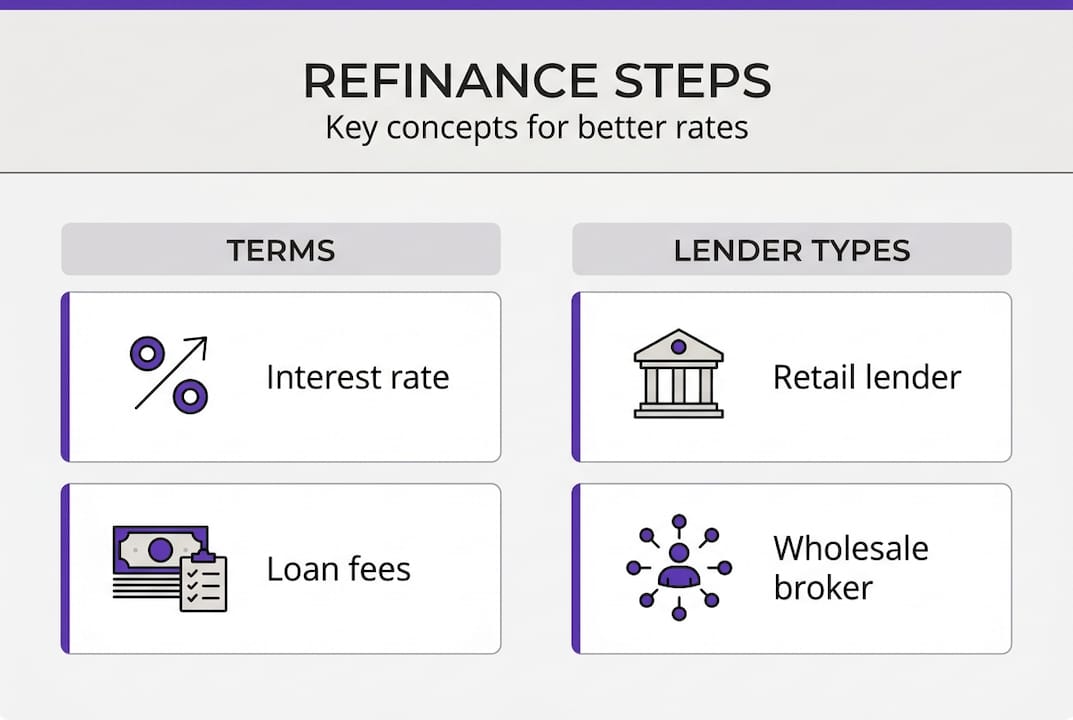
Skipping the evaluation steps is where most homeowners lose money. Refinancing can lower payments and save thousands when evaluated correctly, but rushing into a new loan without doing the math can mean paying more over time, not less.
Common reasons homeowners refinance include:
- Lowering their monthly payment
- Reducing their interest rate
- Switching from an adjustable rate to a fixed rate
- Shortening the loan term to build equity faster
- Pulling out cash for home improvements or debt consolidation
The confusion usually starts when homeowners don't realize that fees, loan structure, and lender type all affect the final outcome just as much as the rate itself. Learning home refinance basics before contacting any lender puts you in a much stronger position.
| Factor | Retail lender | Wholesale broker |
|---|---|---|
| Rate access | One lender's rates | Multiple lenders' rates |
| Fee transparency | Varies by institution | Typically more transparent |
| Loan options | Limited to their products | Broader product range |
| Negotiation leverage | Low | Higher due to competition |
| Personalized guidance | Depends on loan officer | Core part of broker service |
Preparing for your refinance evaluation
Now that you understand the key concepts, here's how to get organized before diving into rate comparisons. Walking into a refinance conversation unprepared is like negotiating a car price without knowing what you can afford. Lenders will ask for specific documents, and having them ready speeds up the process and signals that you're a serious borrower.
Here's a checklist of what you'll need and why each item matters:
| Document | Why it's needed |
|---|---|
| Recent mortgage statements | Shows your current balance and payment |
| Proof of income (pay stubs, tax returns) | Confirms your ability to repay the new loan |
| Credit report | Lenders use this to determine your rate |
| Home value estimate | Establishes how much equity you have |
| Bank and asset statements | Verifies reserves and financial stability |
Proper preparation can help you save significant money during refinancing because lenders reward organized, low-risk borrowers with better terms.
Before you gather documents, clarify your goal. Your objective shapes every decision that follows. Follow these steps:
- Write down your current interest rate, monthly payment, and remaining loan term.
- Decide what outcome matters most: lower payment, faster payoff, or cash out.
- Check your credit score and identify any issues you can address before applying.
- Research current home values in your area to estimate your equity position.
- Review your home equity strategies if a cash-out refinance is on your radar.
Knowing the right questions to ask mortgage brokers before your first consultation also saves you from being caught off guard.
Pro Tip: If your credit score is below 740, spending 60 to 90 days paying down revolving balances before applying can meaningfully improve your rate offer. Even a 0.25% rate improvement on a $350,000 loan saves over $17,000 in interest across a 30-year term.
Step-by-step: Evaluating wholesale vs. retail refinance offers
Once all your information is ready, you can put offers from retail and wholesale channels head-to-head. This is where the real work happens, and where most homeowners either find significant savings or unknowingly leave money behind.
Here's how to approach the comparison:
- Request a Loan Estimate from at least two retail lenders and one wholesale broker.
- Compare the APR on each offer, not just the interest rate.
- Review Section A of each Loan Estimate for origination charges and lender fees.
- Ask each lender to explain any fee labeled as a "point" or "discount fee."
- Calculate the total cost of each loan over your expected time in the home.
Wholesale mortgage brokers often offer lower rates because they access multiple lenders and create competition for your loan. A retail lender, by contrast, can only offer you their own pricing. That's a structural disadvantage for the borrower.

| Offer element | Retail lender (typical) | Wholesale broker (typical) |
|---|---|---|
| Interest rate | Higher, single source | Lower, multiple sources |
| Origination fees | 0.5% to 1% of loan | Often lower or negotiable |
| Lender credits | Limited | More flexibility |
| Rate lock options | Standard | Can vary by lender |
| Turnaround time | Varies | Depends on lender pipeline |
The refinancing workflow advantages of using a broker become clearest when you see multiple competing Loan Estimates side by side. It's not just about the rate. It's about the full picture.
Pro Tip: Watch for "junk fees" with vague names like "processing fee" or "administrative fee." These are often negotiable or avoidable entirely. A good broker will flag these for you. A retail loan officer may not.
Also review your refinance tips for savings before finalizing any offer to make sure you haven't missed a cost-saving angle.
Common pitfalls and how to verify your refinance decision
With offers on the table, it's vital to avoid costly missteps and confirm your savings. Even homeowners who do their homework can fall into traps that make a refinance less valuable than it looks on paper.
Here are the most common mistakes to watch for:
- Focusing only on the interest rate while ignoring fees and APR
- Not calculating the break-even point before committing
- Choosing a longer loan term just to lower the monthly payment, which increases total interest paid
- Failing to account for closing costs when estimating savings
- Not checking whether a no-closing-cost option actually saves money in your situation
- Skipping a comparison between loan types (fixed vs. adjustable)
Blindly comparing rates without full evaluation can lead to higher overall costs, even when the new rate looks attractive at first glance.
Warning: A lower rate does not automatically mean a better deal. If you're rolling $8,000 in closing costs into a loan and only saving $120 per month, it takes over five years just to break even. If you sell or refinance again before that point, you've actually lost money.
To verify your decision, work through this self-check:
- Divide your total closing costs by your monthly savings to find your break-even point in months.
- Compare the total interest paid on the new loan versus staying in your current loan.
- Check whether your comparing mortgage rates process covered all fee categories, not just the headline number.
- Review your qualification steps to confirm you meet the criteria for the rate being offered.
If the numbers hold up after this review, you can move forward with real confidence.
Why most homeowners leave money on the table: A broker's perspective
After reviewing the technical steps, here's a perspective most guides won't give you. The biggest problem we see isn't that homeowners don't care about saving money. It's that they've been trained to focus on the wrong thing.
The mortgage industry has conditioned people to lead with one question: "What's your rate?" But the rate is just the headline. The real story is in the fees, the loan structure, and whether the offer actually fits your financial timeline.
A broker's structured approach works because it introduces competition into a process that retail lenders prefer to keep one-sided. When multiple lenders are bidding for your loan, the terms improve. When you walk into one bank and accept what they offer, they have no reason to sharpen their pencil.
We've seen borrowers turn down a 0.25% rate improvement from a broker because a familiar bank "felt safer." That comfort cost them thousands. The broker advice for better refinance rates that actually works isn't about chasing the lowest number. It's about understanding the full offer and knowing when to walk away.
Ready for a smarter refinance? How LoFiRate can help
If you've worked through this guide and you're ready to see what a real wholesale rate comparison looks like for your situation, LoFiRate makes that next step simple.

LoFiRate connects you with matched with top brokers who are licensed in your state and have access to wholesale lender pricing you won't find at a retail bank. There's no obligation and no pressure. You can explore your loan options and get a transparent second opinion on what you're currently being offered. Whether you're just starting to evaluate or you already have quotes in hand, lofirate.com is built to help you make a smarter, more informed refinance decision without the runaround.
Frequently asked questions
What documents do I need for a refinance evaluation?
You'll need recent mortgage statements, proof of income, credit report, and a home value estimate to start your refinance evaluation. Gathering key documents before contacting lenders keeps the process moving and improves your negotiating position.
How does a wholesale broker differ from a retail lender during evaluation?
Wholesale mortgage brokers access multiple lenders to offer competing rates, while retail lenders show you only their own products. Wholesale brokers often deliver lower rates and broader choices because they create lender competition on your behalf.
What is the biggest mistake homeowners make when evaluating refinance offers?
Many homeowners only compare interest rates and overlook fees, loan terms, and total loan cost. Ignoring fees and total loan cost can increase what you pay over the life of the loan, even when the rate looks favorable.
Is refinancing always the best choice if rates are lower?
Not always. You should calculate the break-even point and total costs before deciding to refinance. Checking the break-even point ensures the savings are real and not offset by closing costs or a longer loan term.