

Handling mortgage delays comes down to three things: complete documentation, proactive communication, and financial discipline from application through closing. The national average loan closing time is about 42 days as of late 2025, but missing paperwork, appraisal holdups, or a last-minute credit inquiry can significantly extend that period. Here is what you need to do from day one:
- Submit every requested document at once, in full, as clean PDFs
- Communicate with your loan officer at least every two to three days during underwriting
- Understand that TRID rules require a mandatory three-business-day waiting period after your Closing Disclosure is delivered before you can sign final documents
- Avoid any new credit applications, large purchases, or job changes until after closing
- Respond to underwriter condition requests the same day you receive them
- Flag any anticipated issues to your lender at least three days before they become a problem
These six habits alone eliminate the majority of preventable delays.
Table of Contents
- What causes mortgage delays, and how do you spot them early?
- How should you communicate with your underwriting team?
- Preventative steps that keep your mortgage on track
- What to do when a mortgage delay actually happens
- Expert insights on managing mortgage delays effectively
- What documents does your lender actually need?
- How do mortgage brokers and real estate agents help during delays?
- What legal protections do you have when a mortgage is delayed?
- How to manage your finances while waiting on a delayed closing
- Key Takeaways
What causes mortgage delays, and how do you spot them early?
Most mortgage delays are not random. They follow predictable patterns, and recognizing them early gives you time to act.
- Incomplete or missing paperwork. Bank statements with unexplained large deposits, missing tax return pages, or unsigned forms send files back to square one. Incomplete documents can add a week or more per re-submission cycle.
- Large deposit explanations. Any deposit that does not match your regular income pattern triggers a letter of explanation request. Have those ready before the underwriter asks.
- Title and lien issues. An unresolved lien, a boundary dispute, or a prior owner's unpaid judgment can freeze the title search for days or weeks.
- Appraisal scheduling gaps. In competitive markets, licensed appraisers are often booked out. A delayed appraisal report holds up the entire file.
- Third-party verification slowdowns. Employers, the IRS, and Social Security Administration all operate on their own timelines. IRS transcript requests alone can take several days.
- Financial changes after application. Opening new credit or making large purchases during underwriting forces a full re-review and can result in denial.
- Manual underwriting bottlenecks. Files that do not meet automated underwriting criteria get routed to a human reviewer, which adds time regardless of how clean your paperwork is.
Knowing which category your delay falls into tells you exactly who to call and what to fix.
How should you communicate with your underwriting team?
Communication is where most borrowers lose time without realizing it. A condition request that sits in your inbox for 48 hours while your file sits idle in the underwriting queue is a delay you created.
- Check your lender portal every morning during the final 10 days before closing.
- Respond to every condition request the same day, even if just to confirm receipt and give a delivery timeline.
- Submit documents as clean, legible PDFs rather than phone photos. Clean PDFs reduce manual review time and keep your file moving.
- Disclose any anticipated complications early. Transparency about delays three or more days before closing gives your loan officer room to find financial solutions before the problem becomes a crisis.
- Use your lender's online portal for all document submissions to create a clear, time-stamped record.
- Keep your real estate agent looped in on every status update so they can coordinate with the seller's side.
Pro Tip: Send a brief morning status email to your loan officer every day during the last 10 days of the process. A two-sentence "anything needed from my end today?" message catches overlooked conditions before they cause a same-day closing surprise.
Preventative steps that keep your mortgage on track
The best mortgage delay solution is the one you never need. Most of what slows down a loan file is avoidable with preparation that starts before you even make an offer.
- Get a fully documented pre-approval. This means submitting tax returns, W-2s, pay stubs, and bank statements upfront. A fully documented pre-approval resolves most underwriting questions before you are under contract, cutting days or weeks off the process.
- Submit all documents at once. Piecemeal submissions create multiple review cycles. Gather everything before you send anything.
- Freeze your finances. No new credit cards, no car loans, no large cash withdrawals. Keep your bank statements consistent and predictable.
- Schedule the appraisal early. Ask your lender to order the appraisal the same day you go under contract.
- Write preemptive letters of explanation. If you have a gap in employment, a recent job change, or an unusual deposit in the last 60 days, write the explanation letter now before the underwriter requests it.
- Use digital mortgage tools for document uploads and e-signatures. Delays from mailed or faxed documents are entirely avoidable in 2026.
- Review your credit report before applying. Dispute any errors through the credit bureaus before your lender pulls your file.
Preparation at this stage is what separates a 42-day close from a much longer timeline.
What to do when a mortgage delay actually happens
Even well-prepared borrowers hit delays. The difference is in how fast you respond.
- Tell everyone immediately. Your loan officer, real estate agent, and the seller's agent all need to know as soon as a delay is confirmed. Surprises on closing day are far more damaging than a heads-up three days earlier.
- Request a written timeline. Ask your loan officer for a specific expected resolution date, not just "we're working on it."
- Explore financial fixes. For repair-related delays, seller credits or escrow holdbacks often resolve the issue faster than waiting for physical work to be completed.
- Do not make any financial moves. A delay is not the time to open a new account, move large sums, or apply for anything. Underwriters re-verify your financials close to closing.
- Initiate your wire transfer early. Wire transfers initiated 24–48 hours before closing prevent last-minute funding failures caused by bank processing windows.
- Negotiate a rate lock extension. If your rate lock is close to expiring, contact your lender immediately. Extensions cost money, but losing your rate costs more.
- Stay calm and keep communicating. Most delays resolve within a few days when all parties are aligned and responsive.
Expert insights on managing mortgage delays effectively
Experienced loan officers and mortgage brokers share a consistent view: the borrowers who close on time are the ones who treat the process like a job, not a waiting game.
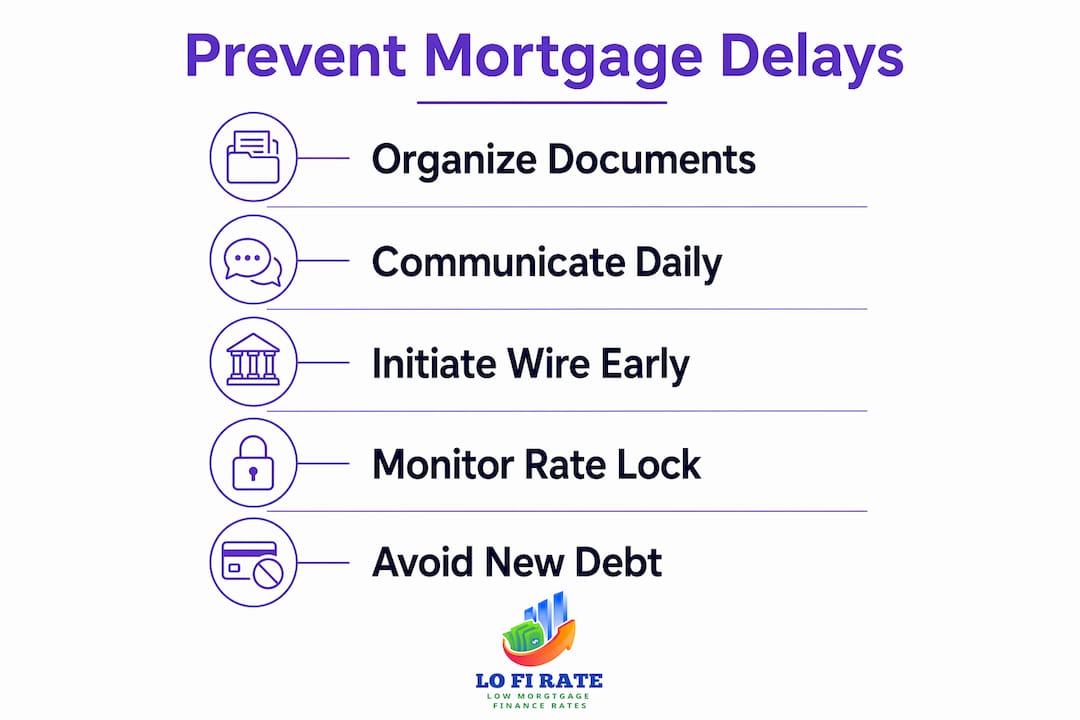
Underwriting is not a single approval event. It is an ongoing review process that includes repeated employment and credit verifications right up until closing day. A job change or new credit inquiry in week five of a six-week process can restart the clock entirely.
Document quality drives file speed more than almost any other factor. Loan officers consistently report that document quality and submission speed are the primary variables they can actually control on the borrower's side. A blurry photo of a bank statement is not a submitted document. It is a delay waiting to happen.
Nearly half of mortgage delays stem from incomplete paperwork or financial changes made after application. Addressing both before they occur is the most direct path to an on-time close.
Seller credits and escrow holdbacks deserve more attention than most buyers give them. When a home inspection reveals repairs, waiting for the contractor to finish and the appraiser to re-inspect can add two weeks. A negotiated credit at closing solves the same problem in an afternoon.
Pro Tip: Initiate your wire transfer 24–48 hours before your scheduled closing date. Bank processing windows are not flexible, and a wire that arrives one hour late can push your closing to the next business day.

For buyers still in the shopping phase, working with a wholesale mortgage broker rather than a single retail lender gives you access to multiple underwriting timelines and pricing options, which can itself reduce delay risk. For tailored guidance, see our Top Tipps Immobilienkauf auf Mallorca: Ihr Ratgeber.
What documents does your lender actually need?
The paperwork list for a mortgage is longer than most buyers expect, and gaps in any category create delays. Here is what underwriters typically require:
Income and employment verification:
- Two years of federal tax returns (all pages, all schedules)
- Two most recent W-2s or 1099s
- 30 days of pay stubs
- For self-employed borrowers: profit and loss statements, business tax returns, and a CPA letter
Asset documentation:
- Two to three months of bank statements (all pages, including blank ones)
- Investment and retirement account statements
- Gift letters if any portion of the down payment is a gift
Property and identity:
- Government-issued photo ID
- Purchase contract and any addenda
- Homeowner's insurance binder
- Title commitment from the title company
The most common mistake is submitting partial documents. A bank statement missing page four, or a tax return missing Schedule C, sends the file back immediately. Submit complete packages, every time. Understanding the full mortgage compliance requirements before you apply puts you ahead of most borrowers.
How do mortgage brokers and real estate agents help during delays?
Your broker and agent are not passive participants. Used correctly, they are your best tools for cutting through delays.

A mortgage broker who works with multiple lenders can sometimes shift your file to a lender with a shorter underwriting queue if your current lender is backlogged. That option does not exist with a single retail bank. Brokers also know which lenders are running slow on specific loan types, which is information you simply cannot get on your own.
Your real estate agent manages the seller's expectations during a delay. A skilled agent keeps the seller from walking away from the deal by communicating clearly about timelines and, when necessary, negotiating a closing date extension. Most sellers will agree to a short extension rather than relist the property, but only if they are kept informed.
Both your broker and agent should receive every status update you get from the lender. A three-way communication loop closes faster than a chain where information passes through one person at a time. If you are still in the process of finding the right broker, Lofirate connects buyers with licensed wholesale brokers who can compare loan options across multiple lenders.
What legal protections do you have when a mortgage is delayed?
Federal law gives borrowers several concrete protections during the mortgage process.
The Truth in Lending Act (TILA) and Real Estate Settlement Procedures Act (RESPA), enforced together under the TRID rules, require lenders to deliver your Loan Estimate within three business days of application and your Closing Disclosure at least three business days before signing. If a lender changes loan terms materially after delivering the Closing Disclosure, the three-day clock resets. That is a protection, not just a delay.
The Equal Credit Opportunity Act (ECOA) requires lenders to notify you within 30 days of a completed application whether your loan is approved, denied, or incomplete. If you are denied, you have the right to a written explanation.
If you have a mortgage contingency in your purchase contract, a lender-caused delay that prevents you from closing gives you the right to exit the deal and recover your earnest money. Understanding how a mortgage contingency protects you before you sign a purchase agreement is worth the 10 minutes it takes to read.
For complaints about lender conduct, the Consumer Financial Protection Bureau (CFPB) accepts formal complaints at consumerfinance.gov, and HUD's housing counseling program at hud.gov can connect you with a free advisor.
How to manage your finances while waiting on a delayed closing
A delayed closing creates real financial pressure, especially when you have already given notice on your current lease or scheduled movers.
Keep your cash liquid. Do not move your down payment funds into a new account or investment vehicle while waiting. Underwriters need to see a consistent, traceable paper trail. Any unexplained movement triggers another round of documentation requests.
Negotiate a rent extension. If you are renting, talk to your landlord the moment a delay looks likely. A month-to-month extension is far less expensive than a hotel or short-term rental. Most landlords prefer a known tenant over vacancy.
Watch your rate lock expiration date. Rate lock extensions typically cost 0.125%–0.375% of the loan amount per extension period, depending on the lender. Build that cost into your contingency budget if your timeline is tight.
Avoid new debt at all costs. Even a store credit card opened during a delay can change your debt-to-income ratio enough to require a new underwriting review. The hidden fees and costs that surface during delays are stressful enough without adding a self-inflicted one.
Stay in contact with your insurance provider. If your homeowner's insurance binder has an effective date tied to your original closing date, you may need to update it. A lapsed or mismatched binder can hold up final approval.
Key Takeaways
Handling mortgage delays effectively requires complete documentation, consistent communication, and financial discipline from application through closing day.
| Point | Details |
|---|---|
| Submit complete documents upfront | Incomplete packages restart the underwriting review, adding a week or more per re-submission. |
| Closing Disclosure wait period | Federal TRID rules require a mandatory three-business-day wait after Closing Disclosure delivery before signing. |
| Freeze your finances | New credit or large purchases during underwriting trigger a full re-review and can delay or derail closing. |
| Wire transfers need a head start | Initiating wire transfers 24–48 hours before closing prevents last-minute funding failures. |
| Pre-approval cuts underwriting time | A fully documented pre-approval resolves most underwriting questions before you go under contract. |