

Every lender will ask for the same core items: a government-issued photo ID, your two most recent pay stubs, the last two years of W-2s and tax returns, two to three months of bank statements, your current mortgage statement, and your homeowners insurance declaration page. Pull those together first. Once you have them in hand, the rest of the process moves faster than most homeowners expect.
Here is what to assemble the same day you decide to move forward:
- Current mortgage statement (log in to your servicer's portal and download the PDF)
- Last two years of federal tax returns, all pages
- Last two years of W-2s or 1099s
- Two most recent pay stubs
- Two to three months of bank and investment account statements, all pages
- Homeowners insurance declaration page
- Most recent property tax bill
- Government-issued photo ID (driver's license or passport)
Pro Tip: Name every file before you upload it: "Smith_BankStatement_Chase_Jan2026.pdf" beats "statement(3).pdf" every time. Underwriters work faster when files are labeled clearly, and you avoid the back-and-forth email asking which account a document belongs to.
Key Takeaways
A complete refinance wish list covers documents, financial readiness checks, and a break-even calculation before you ever contact a lender.
| Point | Details |
|---|---|
| Core documents first | Gather photo ID, pay stubs, W-2s, tax returns, bank statements, mortgage statement, and insurance declaration before anything else. |
| Run break-even before applying | Divide total closing costs by monthly savings; a result under 24 months is a strong signal the refinance makes financial sense. |
| Credit, DTI, and LTV matter | Check all three before applying; LTV at or below 80% avoids PMI and unlocks the best conventional rate tiers. |
| Shop at least two channels | Request Loan Estimates from at least two lenders or channels and compare Line A, Line B, and APR side by side. |
| Special cases need extra docs | Divorce decrees, VA COEs, FHA streamline eligibility, and rental leases must be ready before underwriting begins. |
| Lofirate for broker access | Lofirate matches homeowners with licensed wholesale brokers who shop multiple lenders for competitive refinance pricing. |
Table of Contents
- What belongs on a refinance wish list and why
- What documents do lenders require for a refinance?
- Are you financially ready to refinance?
- What do closing costs and break-even look like in practice?
- How does the appraisal affect your refinance outcome?
- Which lender channel gives you the best refinance pricing?
- What questions should you ask every lender before you commit?
- How does refinancing affect your credit score?
- What are the tax implications of refinancing?
- Lofirate connects you to wholesale brokers who shop your file
- Sources
What belongs on a refinance wish list and why
The items on a refinance wish list are not arbitrary. They map directly to your goal, and your goal determines which documents and prep steps deserve the most attention first.
Refinancing goals generally fall into four categories: lowering your interest rate to reduce monthly payments, shortening the loan term to save total interest, pulling cash out to access home equity, and switching from an adjustable-rate mortgage to a fixed-rate loan for payment stability. Each of those goals has a different document and readiness profile.
A rate-and-term refinance, where you are simply lowering your rate or changing your term, is the most straightforward. Income and credit documentation are the priority. A cash-out refinance adds an appraisal to the critical path because the lender needs to confirm your home's current value before releasing equity. An ARM-to-fixed switch often looks like a rate-and-term refinance on paper but may require additional explanation of your current loan terms. Shortening your term, say from 30 years to 15, will raise your monthly payment, so your debt-to-income ratio gets extra scrutiny.
Before you gather a single document, run three quick filters:
- Stay horizon. How long do you plan to stay in the home? If you are likely to move in two years, a refinance with significant closing costs rarely makes sense unless the monthly savings are unusually large.
- Break-even. Divide your estimated closing costs by your projected monthly savings. That number is the months it takes to recoup the cost. More on the math in the costs section below.
- Credit standing. Pull your credit report at AnnualCreditReport.com before contacting any lender. A score below 620 will limit your program options significantly; a score above 740 typically unlocks the best conventional pricing.
Knowing your goal before you start gathering documents means you spend time on the items that actually move your application forward.
What documents do lenders require for a refinance?
The short answer: lenders verify income, assets, and property value, and the paperwork for a refinance closely mirrors what you submitted when you bought the home. The table below maps each document type to where you find it and why the lender needs it.
| Document | Where to get it | Why the lender needs it |
|---|---|---|
| Government-issued photo ID | Wallet | Identity verification |
| Recent pay stubs (last 30 days) | Employer payroll portal | Current income confirmation |
| W-2s (last 2 years) | Employer HR or IRS transcript | Employment income history |
| Federal tax returns (last 2 years, all pages) | IRS.gov or tax software | Full income picture, especially for self-employed |
| Bank statements (2–3 months, all pages) | Bank portal | Asset verification and reserves |
| Investment/retirement account statements | Brokerage portal | Additional reserves |
| Current mortgage statement | Loan servicer portal | Payoff amount and loan details |
| Homeowners insurance declaration | Insurance provider | Proof of coverage |
| Property tax bill | County assessor or servicer escrow statement | Tax obligation confirmation |
| Title/deed | County recorder or closing file | Ownership verification |
For a deeper checklist you can download, the documents needed for refinancing guide at Lofirate covers each item with lender-specific notes.
Wage earners
If you receive a W-2 from an employer, your documentation path is the most direct. Two years of W-2s, your two most recent pay stubs, and your federal tax returns cover income verification for most conventional programs. If you changed jobs recently, be prepared to explain the gap or transition in writing.
Self-employed borrowers
Self-employed borrowers face more scrutiny. Lenders typically require two full years of tax returns and recent pay stubs for complex income cases, and they will often request a year-to-date profit and loss statement prepared by a CPA. If your business income fluctuates, lenders average the two-year figure, which can work against you if last year was a down year.
Unearned and other income
Social Security, pension, rental income, alimony, and child support can all count toward qualifying income, but each requires its own paper trail. Social Security needs an award letter. Rental income typically requires Schedule E from your tax returns and, in many cases, a current lease agreement. Alimony and child support require a court order and proof of receipt, usually six to twelve months of bank statements showing consistent deposits.
Asset documentation
Lenders want to see that you have enough reserves to cover closing costs and, depending on the program, two to six months of mortgage payments in liquid accounts. Every page of every statement matters. Lenders commonly require all pages of bank statements and documentation for any large deposits that are not clearly payroll. A $10,000 transfer from a family member, for example, will trigger a gift letter requirement.

Debt documentation
Outstanding debts affect your debt-to-income ratio. Gather your most recent statements for credit cards, student loans, auto loans, and any personal loans. If you pay child support or alimony, bring the court order. Lenders pull your credit report independently, but having your own debt picture clear helps you anticipate questions.
Special cases
- Divorce. Bring the full divorce decree and any separation agreement. If you are using alimony or child support as qualifying income, you need proof it will continue for at least three years.
- Bankruptcy. Chapter 7 requires a two-year waiting period after discharge for most conventional loans; Chapter 13 may allow refinancing after 12 months of on-time plan payments with court approval.
- VA loans. You will need your Certificate of Eligibility (COE), which you can request through the VA's eBenefits portal. VA Interest Rate Reduction Refinance Loans (IRRRLs) often require less documentation and may waive the appraisal.
- FHA streamline refinance. FHA streamline programs can reduce documentation requirements and sometimes waive the appraisal entirely, but you must have a current FHA loan and a clean payment history.
- Flood and FEMA insurance. If your property is in a designated flood zone, bring your current flood insurance policy. Lenders will not close without it.
- Rental properties. Investment property refinances require leases, rent rolls, and Schedule E from your tax returns. Expect stricter LTV requirements and higher rates than a primary residence.
- Subordination letters. If you have a home equity line of credit (HELOC), the HELOC lender must agree to remain in second position. Request a subordination letter early; it can add weeks to your timeline.
Pro Tip: Scan every document as a multi-page PDF, not individual JPEGs. Underwriters work in document management systems that handle PDFs cleanly. A 14-page bank statement sent as 14 separate image files creates unnecessary friction and slows your file.
Also worth checking: the mortgage document checklist from NestNoted, which organizes these items by loan stage and is useful if you want a printable version.
Are you financially ready to refinance?
Three numbers tell you most of what you need to know before you apply: your credit score, your debt-to-income ratio, and your loan-to-value ratio.
Credit score. Conventional loans typically require a minimum score of 620, but pricing improves meaningfully at 680, 720, and 740. If your score is below 700, spend 60 to 90 days paying down revolving balances before applying. A single 30-day late payment in the past 12 months can cost you a quarter point or more in rate.
Debt-to-income ratio (DTI). Most conventional programs cap DTI at 43–45%, though some programs allow up to 50% with compensating factors. DTI is your total monthly debt payments divided by your gross monthly income. If your DTI is above 43%, look at whether paying off a small installment loan before applying would move the needle.
Loan-to-value ratio (LTV). LTV is your loan balance divided by the appraised value of your home. At 80% LTV or below, you avoid private mortgage insurance (PMI) on conventional loans and access the best rate tiers. Cash-out refinances typically cap at 80% LTV on conventional programs, meaning you can only pull equity down to that threshold. If your LTV is above 80% and you are not doing a streamline refinance, expect either PMI or a slightly higher rate.
Common red flags that derail approvals, and what to do about each:
- Recent credit score drop. Check for errors at AnnualCreditReport.com and dispute inaccuracies. Avoid opening new credit accounts in the 90 days before applying.
- Large unexplained deposits. Document the source of any deposit over roughly one month's income before your lender asks. A paper trail prepared in advance prevents delays.
- Recent late payments. A pattern of late payments in the past 12 months is a serious underwriting concern. If you have one isolated late payment, a letter of explanation can help.
- Short employment history. Lenders generally want two years of continuous employment in the same field. A recent job change to a higher-paying role in the same industry is usually fine; a career switch mid-application is not.
- High revolving utilization. Credit utilization above 30% on any card suppresses your score. Pay balances down before applying, and do not close old accounts.
What do closing costs and break-even look like in practice?
Break-even is the core filter for any refinance decision: divide your total closing costs by your monthly payment savings, and the result is the number of months it takes to recoup what you spent. If you plan to stay in the home longer than that, the refinance likely makes financial sense.
Homeowners should compare the costs of a new loan against their goals and use a Loan Estimate to verify the true total dollar cost. The Loan Estimate gives you the exact figures you need to run the calculation accurately.
Typical closing-cost components include:
- Origination fee: charged by the lender for processing the loan, often 0.5–1% of the loan amount
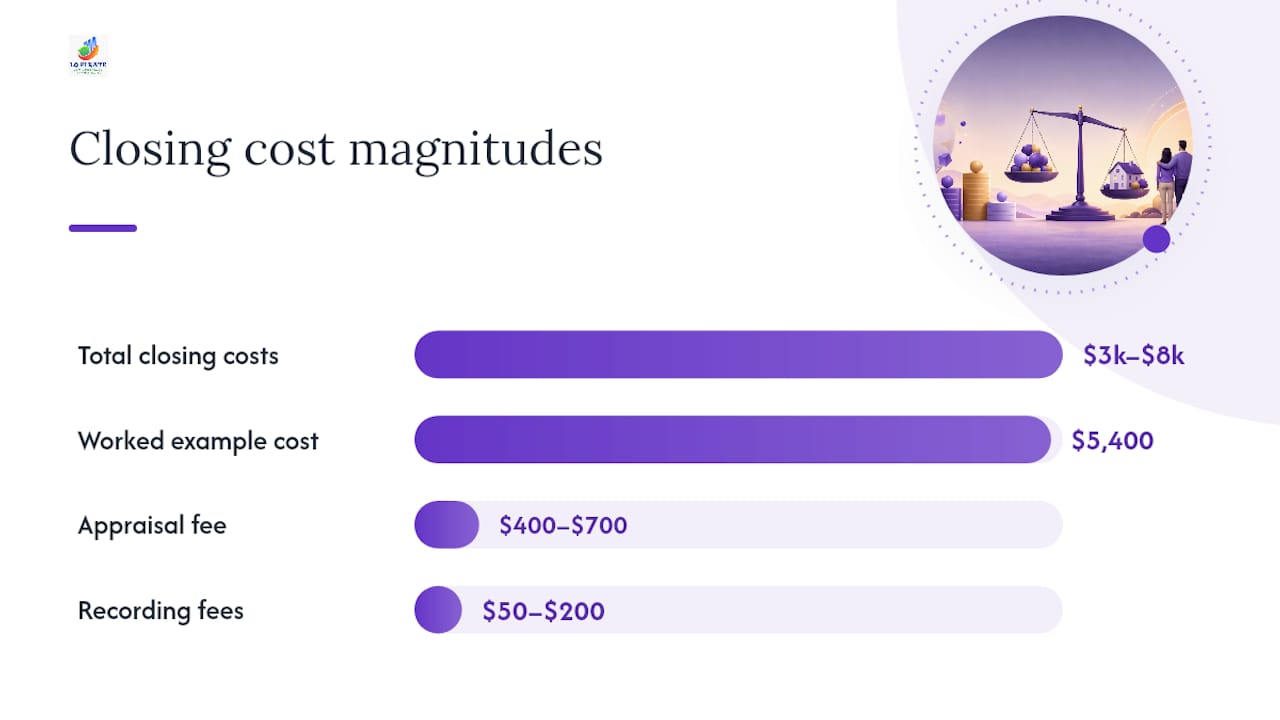
- Appraisal fee: typically $400–$700 for a single-family home
- Title insurance (reissue rate): often lower than the original purchase title policy
- Recording fees: set by the county, usually $50–$200
- Prepaid interest: covers interest from closing date to the end of the month
- Escrow setup: prepaid property taxes and homeowners insurance
Total closing costs commonly range from roughly $3,000 to $8,000, depending on loan size and location.
A worked example. Suppose your current payment is $2,100 per month and a new rate drops it to $1,875, saving $225 per month. Your closing costs are $5,400.
$5,400 ÷ $225 = 24 months to break even.
If you plan to stay in the home for at least three to four years, that break-even is comfortable. Many practitioners look for a break-even within a few years as a strong signal that a refinance is worth pursuing. If your break-even is 48 months and you are unsure about your stay horizon, the math argues for waiting.
One thing most homeowners miss: comparing total remaining payments, not just the monthly change, matters when you are shortening your term. Dropping from a 30-year to a 15-year loan raises your monthly payment but can save tens of thousands in total interest. Run both numbers before deciding.
Typical timeline to close a refinance:
- Application and document submission: Days 1–3
- Initial underwriting review: Days 4–10
- Appraisal ordered and completed: Days 7–21
- Conditional approval and document conditions cleared: Days 15–25
- Clear-to-close issued: Days 25–35
- Closing and funding: Days 30–45
Most refinances close in 30–45 days, though streamline programs (FHA, VA) can move faster when appraisals are waived.
How does the appraisal affect your refinance outcome?
The appraisal sets your LTV, and your LTV determines which programs you qualify for, whether you owe PMI, and how much equity you can access in a cash-out refinance. A low appraisal can block a cash-out entirely or push you into a higher-rate tier. A strong appraisal, on the other hand, can open programs you did not expect to qualify for.
Appraisals are typically required for conventional rate-and-term and cash-out refinances. Waivers sometimes apply when the loan has strong equity, a clean payment history, and the property type is straightforward. Fannie Mae's Desktop Underwriter and Freddie Mac's Loan Product Advisor both have automated appraisal waiver programs, but approval is not guaranteed and depends on the lender's eligibility check.
Low-cost steps that can protect your appraised value:
- Clean the exterior and address obvious curb appeal issues (peeling paint, overgrown landscaping)
- Fix visible defects: broken windows, damaged gutters, water stains on ceilings
- Gather receipts for any improvements made in the last five years (kitchen updates, new roof, HVAC replacement)
- Prepare a list of recent comparable sales in your neighborhood if you know of any
- Have contractor estimates ready for any deferred maintenance you have not yet addressed
Pro Tip: Before the appraiser arrives, prepare a one-page summary of improvements with dates, costs, and before/after photos where you have them. Appraisers are not required to use it, but a well-documented improvement list reduces the chance they overlook a $15,000 kitchen remodel that genuinely adds value.
A home that shows well and has documented upgrades tends to appraise closer to the owner's expectations. The appraiser's job is to find comparable evidence; your job is to make sure the relevant evidence is easy to find.
Which lender channel gives you the best refinance pricing?
Wholesale mortgage brokers can offer a competitive advantage because they shop multiple lenders and may find more transparent or lower-priced options than a single retail lender. That is the short answer for rate-focused borrowers. Here is how the channels compare:
| Channel | Rate options | Price transparency | Fees | Best for |
|---|---|---|---|---|
| Retail bank | One lender's pricing only | Limited | May include relationship discounts | Existing customers with strong loyalty benefits |
| Direct lender | One lender's pricing only | Moderate | Varies by lender | Borrowers who want a single-lender process |
| Mortgage broker | Multiple lenders | High | Broker fee disclosed on LE | Borrowers shopping for best rate |
| Wholesale broker | Multiple wholesale lenders | High | Often lower than retail | Rate-focused borrowers seeking competitive pricing |
A retail bank or direct lender can only offer their own rate sheet. A mortgage broker, and especially a wholesale broker, shops across multiple lenders simultaneously and presents options you would not find by calling lenders individually. For more on how that process works, the mortgage refinance tips guide at Lofirate walks through the mechanics in detail.
Before you commit to any channel, verify the broker or lender is properly licensed at NMLS Consumer Access. Every licensed mortgage professional has an NMLS number you can look up.
Questions worth asking any lender or broker before you proceed:
- Are you compensated by the lender, the borrower, or both? How is your compensation disclosed on the Loan Estimate?
- How many lenders are you able to submit my file to?
- What is your current average time from application to clear-to-close?
Pro Tip: Prepare one clean borrower file and submit it to at least two different channels simultaneously. Request a Loan Estimate from each. You have three business days to receive it after submitting an application, and comparing Line A (origination charges), Line B (services you cannot shop), and the APR across two LEs is the fastest way to spot a pricing gap.
For a step-by-step walkthrough of shopping lenders through wholesale brokers, Lofirate's guide covers the process from first contact to final comparison.
What questions should you ask every lender before you commit?
Start with this one: "Can you provide a Loan Estimate?" Any lender who hesitates is a red flag. The Loan Estimate is a standardized three-page form that every lender is legally required to provide within three business days of receiving your application. It is the only apples-to-apples comparison tool you have.
Beyond that, bring this list to every lender conversation:
- What is the interest rate, and what is the APR? (The gap between the two reveals the cost of fees.)
- Is this rate locked, and for how long? What does it cost to extend the lock if closing is delayed?
- What are the total origination charges on Line A of the Loan Estimate?
- Are there any prepayment penalties on this loan?
- Is the appraisal fee collected upfront or rolled into closing costs?
- Can closing costs be rolled into the loan balance? What does that do to my break-even?
- What loan programs do I qualify for given my credit score and LTV?
- Are there any discount points included in this rate? What would the rate be with zero points?
- What is your current average time from application to clear-to-close?
- Who will service this loan after closing? Will it be sold?
- What conditions are you anticipating based on my file?
- Is there a rate float-down option if rates drop before closing?
- What happens if my appraisal comes in below the expected value?
When you receive Loan Estimates from multiple lenders, compare Section A (origination charges), Section B (services you cannot shop), and the APR on Page 1. The interest rate alone does not tell the full story.
Track your LEs in a simple spreadsheet: lender name, rate, APR, total closing costs, monthly payment, and break-even. Three columns and five rows will tell you more than an hour of phone calls.
How does refinancing affect your credit score?
Refinancing does affect your credit score, but the impact is typically modest and temporary. When you apply, the lender runs a hard inquiry, which can lower your score by a few points. If you shop multiple lenders within a short window, credit scoring models from FICO treat multiple mortgage inquiries within a 14–45 day period as a single inquiry, so rate shopping does not compound the damage.
The more significant credit event is the closure of your existing mortgage account and the opening of a new one. Your average account age will drop, which can suppress your score slightly. For most borrowers with established credit histories, the effect is minor and recovers within a few months of on-time payments on the new loan.
To mitigate the impact:
- Do all your rate shopping within a 30-day window to consolidate inquiries.
- Avoid opening any other new credit accounts (credit cards, auto loans) in the 90 days before and after your refinance application.
- Continue making on-time payments on your current mortgage through closing. A late payment during the refinance process is a serious underwriting problem.
- After closing, set up autopay on the new loan immediately. The first payment on a new account is the one most commonly missed.
The credit score dip from refinancing is real but short-lived. Borrowers who refinance into a lower payment and maintain on-time payments typically see their scores recover and often improve within six to twelve months.
What are the tax implications of refinancing?
Refinancing changes your mortgage, and that has tax consequences worth understanding before you close.
Mortgage interest deduction. Interest paid on a refinanced mortgage is generally deductible if you itemize, up to the same limits that apply to your original loan. If you refinance for more than your original loan balance (a cash-out refinance), the deductibility of interest on the additional amount depends on how you use the funds. Interest on cash-out proceeds used to buy, build, or substantially improve your home is deductible; interest on cash-out proceeds used for other purposes (paying off credit cards, for example) is not. The IRS Publication 936 covers home mortgage interest deduction rules in detail.
Points and origination fees. When you refinance, points paid to lower your rate are not fully deductible in the year you pay them the way they might be on a purchase loan. Instead, they are deducted ratably over the life of the loan. If you refinance again or sell the home before the loan is paid off, you can deduct any remaining undeducted points in that year.
Cash-out proceeds. Cash-out proceeds from a refinance are not taxable income. You are borrowing against your equity, not receiving a payment, so the IRS does not treat the funds as income.
Escrow and prepaid items. Property taxes paid through escrow remain deductible (subject to the $10,000 SALT cap for itemizers). Prepaid homeowners insurance is not deductible.
Tax rules change, and individual situations vary. Confirm the current rules with a CPA or tax advisor before filing, particularly if you are doing a cash-out refinance or if your loan balance exceeds the deductibility thresholds.
What I'd tell you to do first
The most common mistake homeowners make when starting a refinance is spending too much time researching rates online and not enough time getting their file ready. Rates change daily. Your documents do not.
My recommended sequence: gather your documents first (one afternoon, done), then run your break-even using your current mortgage statement and a rough rate quote, then contact at least two lender channels simultaneously and request Loan Estimates from both. That sequence takes the emotion out of the decision. When you have two LEs in hand, the comparison is mechanical.
One timing note: rate locks typically run 30–45 days. If you are in a period of market volatility, locking early and paying a small extension fee if needed is usually cheaper than floating and hoping. Ask your broker or lender what a 60-day lock costs versus a 30-day lock before you decide.
Lofirate's position in this process is straightforward: if you want to compare wholesale pricing against what a retail lender quoted you, a broker connection is the fastest way to do it. The refinancing strategy guide at Lofirate is a good next read if you want to go deeper on the decision framework before you pick up the phone.
Lofirate connects you to wholesale brokers who shop your file
Gathering your documents and running your break-even math gets you ready. The next step is getting actual numbers from lenders who compete for your loan.

Lofirate connects homeowners directly with licensed wholesale mortgage brokers who shop multiple lenders simultaneously, rather than presenting a single rate from a single institution. That means you see competitive options side by side, with a broker who can walk you through the Loan Estimate line by line and help you identify the lowest total-cost option for your situation.
What you get through Lofirate:
- Multiple lender quotes from a single broker submission, not separate applications to separate lenders
- Broker guidance on reading and comparing Loan Estimates
- Help confirming your documentation checklist is complete before submission
Ready to see what wholesale pricing looks like for your refinance? Start with Lofirate's broker-matching service and get a no-obligation consultation with a licensed broker in your state.
Sources
The sources below are the authoritative references behind this checklist. Regulators and government agencies publish the rules; consumer finance sites translate them into practical checklists. Both are worth bookmarking.
- A Consumer's Guide to Mortgage Refinancings
- Should I refinance my mortgage? (CFPB handout)
- Documents Needed to Refinance a Home (Real Estate Ledger)
- Mortgage refinance document checklist (HSH)
This article is general information, not a substitute for advice from a qualified financial advisor. Consult a qualified financial professional about your own circumstances before acting on anything here.