
A mortgage bond is a debt security backed by a pool of real estate mortgages, giving investors a direct claim on the cash flows generated by homeowners' monthly payments. When borrowers pay principal and interest on their home loans, that money flows through to bondholders. If borrowers default, the underlying property serves as collateral, which is why mortgage bonds generally carry less credit risk than unsecured corporate debt. The industry term "mortgage-backed security," or MBS, is often used interchangeably with mortgage bond, though MBS more precisely describes the securitized instrument traded in capital markets.
A few core features define how these securities work:
- Collateral backing: Each bond is secured by real property, giving investors a recovery claim in default scenarios.
- Cash flow source: Homeowner mortgage payments, covering both principal and interest, fund investor distributions.
- Issuer types: Ginnie Mae (a true U.S. government agency), Fannie Mae (Federal National Mortgage Association), and Freddie Mac (Federal Home Loan Mortgage Corporation) issue or guarantee the majority of U.S. MBS.
- MBS vs. mortgage bond: A mortgage bond can refer to a single loan secured by property or to a pooled, securitized instrument. In modern usage, the pooled MBS structure dominates the market.
- Payment frequency: Most MBS pay principal and interest monthly, unlike traditional bonds that pay interest semi-annually and return principal at maturity.
How the securitization process turns mortgages into tradable bonds
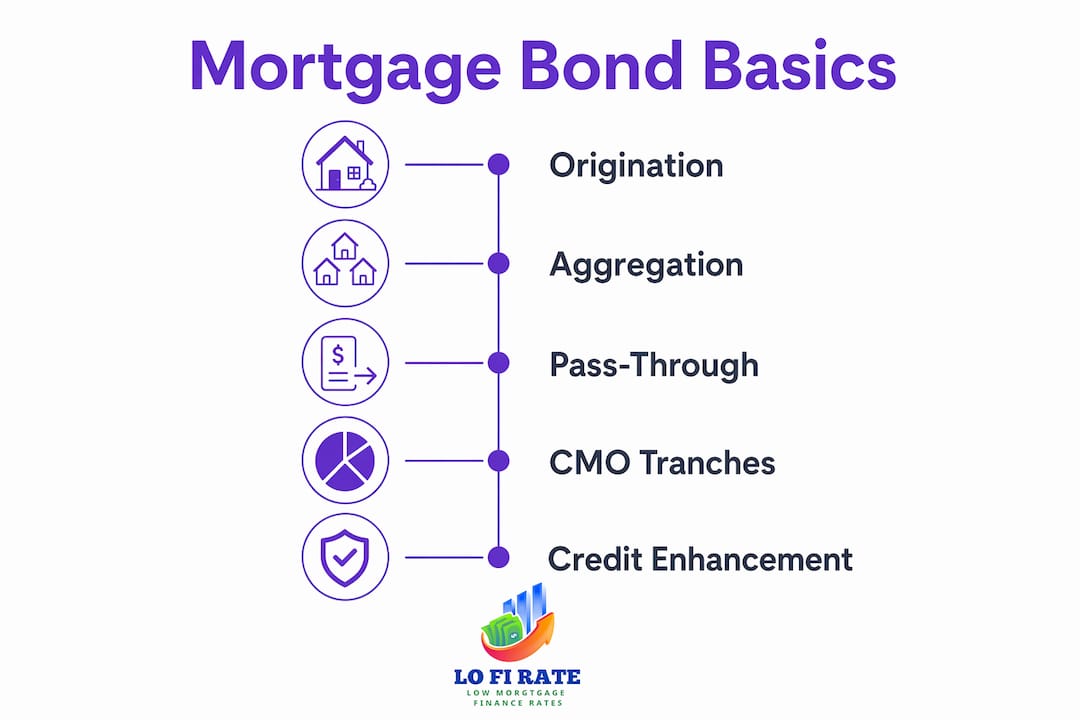
Securitization is the engine that converts individual home loans into the bonds you can buy in a brokerage account. The process has several distinct stages, each involving different market participants.
Step 1: Origination. A bank, credit union, or mortgage company lends money to a homebuyer. That loan is documented with a promissory note and secured by a deed of trust or mortgage on the property. Understanding the mortgage origination process helps clarify why loan quality at this stage directly affects bond performance downstream.
Step 2: Aggregation. The originating lender sells the loan to an aggregator, often Fannie Mae or Freddie Mac, or to a private institution. The aggregator pools thousands of similar loans together, grouping them by characteristics like loan size, interest rate, and credit quality.
Step 3: Issuance. The pool is used as collateral to issue securities. Investors buy those securities and receive a proportional share of the cash flows the pool generates.
The key participants in this chain:
- Originators: Banks, credit unions, and mortgage companies that make the initial loans.
- Government-sponsored enterprises (GSEs): Fannie Mae and Freddie Mac buy conforming loans, guarantee timely payment, and issue agency MBS.
- Ginnie Mae: Guarantees MBS backed by government-insured loans (FHA, VA, USDA), with the full faith and credit of the U.S. government.
- Private-label issuers: Investment banks and other institutions that securitize non-conforming loans without a government guarantee.
- Servicers: Companies that collect monthly payments from borrowers and pass them through to the trust.
- Investors: Pension funds, insurance companies, mutual funds, and individual investors who buy the resulting securities.
Two primary structures emerge from this process. A pass-through security gives each investor a pro-rata share of every payment the pool receives. A collateralized mortgage obligation (CMO) slices the pool into tranches, each with different priority of payment, maturity, and risk exposure, letting issuers tailor instruments to specific investor needs.
Pro Tip: When evaluating a pass-through MBS, check the weighted average coupon (WAC) and weighted average maturity (WAM) of the underlying pool. These two figures tell you more about expected cash flow timing than the stated coupon rate alone.
The liquidity benefit here is real and structural. By selling loans into the secondary market, banks free up capital to originate new mortgages, decoupling the act of lending from the act of holding debt long-term.
What are the main types of mortgage bonds and MBS?
Not all mortgage bonds carry the same risk, structure, or investor profile. The broadest dividing line is agency versus non-agency.

Agency MBS are issued or guaranteed by Fannie Mae, Freddie Mac, or Ginnie Mae. A large portion of all U.S. residential mortgages have been securitized into agency MBS. Fannie Mae's MBS programs received a (P)Aa1 provisional senior secured rating from Moody's in 2026, reflecting very high credit quality. Ginnie Mae securities carry the explicit backing of the U.S. government, while Fannie Mae and Freddie Mac securities carry agency guarantees but are not direct government obligations.
Non-agency MBS (also called private-label MBS) are issued by private financial institutions without a government guarantee. They typically carry higher yields to compensate for greater credit risk, and credit quality and investor protections vary widely between agency and non-agency structures.
Beyond that split, several product structures exist:
- Pass-through securities: The simplest form. All principal and interest payments flow directly to investors on a pro-rata basis.
- CMOs (Collateralized Mortgage Obligations): Multi-tranche structures that redirect cash flows to different investor classes based on priority, maturity, and risk tolerance.
- REMICs (Real Estate Mortgage Investment Conduits): A tax-advantaged legal structure commonly used to issue CMOs.
- Residential MBS (RMBS): Backed by home loans, including single-family and multifamily properties.
- Commercial MBS (CMBS): Backed by loans on commercial properties such as office buildings, retail centers, and hotels.
| Type | Issuer | Government Backing | Risk Level | Typical Investor |
|---|---|---|---|---|
| Ginnie Mae MBS | Ginnie Mae | Full U.S. government | Very low | Conservative income funds |
| Fannie Mae / Freddie Mac MBS | GSEs | Agency guarantee only | Low | Pension funds, insurers |
| Private-label RMBS | Banks, investment firms | None | Moderate to high | Hedge funds, credit investors |
| CMO (senior tranche) | GSEs or private | Varies by tranche | Low to moderate | Insurance companies |
| CMO (subordinate tranche) | Private | None | High | Institutional credit funds |
| CMBS | Private or GSE | Varies | Moderate to high | Real estate investors |
Advantages and disadvantages of investing in mortgage bonds
Mortgage bonds sit in a specific corner of the fixed-income universe: safer than most corporate bonds, more complex than plain Treasury notes. That combination creates a distinct set of trade-offs.
Advantages:
- Collateral protection: Real property backs each loan in the pool, providing a recovery mechanism that unsecured bonds lack.
- Government guarantees on agency MBS: Ginnie Mae securities carry the full faith and credit of the U.S. government. Fannie Mae and Freddie Mac provide contractual guarantees of timely principal and interest payment.
- Monthly income: Unlike semi-annual coupon bonds, most MBS distribute cash monthly, which suits income-focused investors.
- Diversification: A single MBS may contain thousands of individual mortgages spread across multiple states and borrower profiles, reducing concentration risk.
- Market liquidity: Agency MBS trade in one of the deepest fixed-income markets in the world, making entry and exit relatively straightforward.
Disadvantages:
- Lower yields: Mortgage bonds generally offer lower yields than corporate bonds because the real estate collateral adds a layer of safety that the market prices in.
- Prepayment risk: When interest rates fall, homeowners refinance, returning principal early. Early repayments force reinvestment at lower prevailing rates, capping the gains an investor might otherwise expect in a rate rally.
- Extension risk: The flip side of prepayment risk. When rates rise, fewer homeowners refinance, extending the bond's effective duration beyond what was originally expected.
- Credit risk in non-agency MBS: Without a government guarantee, investors bear the full weight of borrower defaults. The subprime mortgage crisis illustrated this starkly: low-credit borrowers defaulting at scale caused massive losses and triggered broader financial turmoil in 2008.
- Complexity: CMO tranches can be difficult to analyze without specialized tools, and pricing depends on prepayment model assumptions that can shift quickly.
Pro Tip: Prepayment risk cuts both ways. In a falling-rate environment, you get your money back faster but must reinvest at worse rates. In a rising-rate environment, your bond extends and loses market value. Model both scenarios before sizing a position.
How the U.S. government shaped the mortgage bond market
The modern U.S. mortgage bond market did not emerge organically. It was built, piece by piece, through deliberate government policy.
Fannie Mae was created in 1938 as part of the New Deal to expand the secondary mortgage market and make home loans more accessible. Freddie Mac followed in 1970, originally to provide competition and further liquidity. Both were chartered as government-sponsored enterprises, meaning they are privately owned but operate under a federal charter with an implicit (and, after 2008, explicit) government backstop. Ginnie Mae, established in 1968, operates differently: it is a true government agency within the Department of Housing and Urban Development, and its guarantees carry the full faith and credit of the United States.
Key milestones in the market's development:
- 1938: Fannie Mae founded to purchase FHA-insured mortgages and inject liquidity into the housing market.
- 1968: Fannie Mae privatized; Ginnie Mae created to handle government-backed loans.
- 1970: Freddie Mac established; first conventional mortgage pass-through securities issued.
- 1983: First CMO issued by Freddie Mac, introducing tranche structures to the market.
- 1986: Tax Reform Act created the REMIC structure, providing a tax-efficient vehicle for CMO issuance.
- 2008: The subprime crisis exposed the fragility of non-agency MBS backed by poorly underwritten loans. Fannie Mae and Freddie Mac were placed into federal conservatorship in September 2008, where they remain today.
- Post-2008: Regulatory reforms under the Dodd-Frank Act tightened underwriting standards and introduced risk-retention requirements for private-label securitizers.
One misconception persists widely: that Fannie Mae and Freddie Mac securities carry the same guarantee as Ginnie Mae. They do not. Fannie Mae and Freddie Mac guarantees provide timely payment of principal and interest but are not obligations of the U.S. government. That distinction affects how you should think about credit risk, especially in a stress scenario.
Market size, liquidity, and how mortgage bonds are priced
The U.S. agency MBS market is one of the largest and most liquid fixed-income markets in the world. Over $11 trillion outstanding and $300 billion in average daily trading volume put it in the same tier as the U.S. Treasury market. That scale matters for investors because it means tight bid-ask spreads and the ability to move large positions without significant price impact.
Much of that liquidity runs through the TBA (To-Be-Announced) market. The TBA market allows forward trading of agency MBS by standardizing key parameters, so buyers and sellers agree on a trade before the specific pool is identified. This fungibility is what makes agency MBS uniquely liquid compared to most corporate debt.
| Market Segment | Outstanding Volume | Avg. Daily Trading | Issuer Type |
|---|---|---|---|
| Agency MBS (total) | Very large | Very high | Fannie Mae, Freddie Mac, Ginnie Mae |
| Private-label MBS | Significantly smaller | Lower, varies | Banks, investment firms |
| CMBS | Hundreds of billions | Moderate | Private and GSE |
Pricing a mortgage bond involves several moving parts:
- Interest rates: MBS prices move inversely with rates, like all bonds. But the relationship is non-linear because of prepayment behavior.
- Prepayment speed assumptions: Analysts use models (expressed as a percentage of the PSA prepayment benchmark) to estimate how fast the pool will pay down. Faster prepayment shortens duration; slower extends it.
- Credit spread: The yield premium over comparable Treasury securities reflects credit risk, liquidity, and supply-demand dynamics.
- Option-adjusted spread (OAS): A more precise measure that strips out the embedded prepayment option to give a cleaner view of relative value.
Yield comparisons with other fixed-income securities depend heavily on the type of MBS. Agency MBS typically yield more than comparable Treasuries but less than investment-grade corporate bonds, sitting in a middle band that reflects their government-adjacent credit quality.
What research reveals about MBS liquidity and agency guarantee misconceptions
Two issues consistently trip up investors who are new to this market: overestimating the government's role in agency MBS, and underestimating how the TBA structure creates liquidity that most bond markets cannot match.
On the guarantee question: Fannie Mae and Freddie Mac guarantee timely payment of principal and interest on their MBS, but that guarantee is a contractual obligation of the enterprise, not the U.S. Treasury. The distinction matters most in a severe stress scenario. Ginnie Mae is the only issuer whose guarantee carries the full faith and credit of the United States. Investors who treat all agency MBS as equivalent to Treasuries are mispricing risk.
On liquidity: the primary benefit of the MBS market is liquidity, allowing banks to free up capital and issue more loans, effectively decoupling lending from long-term debt holding. The TBA market amplifies this by creating a forward market where standardized contracts trade before the underlying pools are even assembled. That forward-trading convention gives agency MBS a depth of liquidity that most corporate bonds, even investment-grade ones, cannot approach.
Statistic callout: The U.S. agency MBS market is among the most actively traded fixed-income markets globally, with a very high daily trading volume.
Prepayment risk deserves a more nuanced framing than it usually gets. Most discussions treat it purely as a downside. A better way to think about it: prepayment behavior is a structural feature of mortgage bonds that continuously reshapes duration and interest rate sensitivity. When you buy an MBS, you are implicitly selling an option to the borrower, the right to refinance. That option has value, which is why MBS yields are higher than Treasuries of similar stated maturity. Understanding that trade-off, rather than just labeling prepayment a "risk," gives you a clearer picture of what you actually own.
The U.S. also lacks the covered bond market that dominates mortgage finance in Europe, and that absence is not accidental. The Federal Home Loan Bank system provides a structural alternative for mortgage liquidity, reducing the need for covered bonds that are common in European markets. The FHLB system lets member banks borrow against mortgage collateral directly, which achieves a similar capital-recycling effect through a different mechanism.
What legal rights do bondholders have in mortgage bonds?
Bondholders in mortgage-backed securities hold legal claims on the cash flows generated by the underlying loan pool, not on individual properties directly. The trust structure that holds the mortgage pool is legally separate from the issuer, which protects investors if the issuing institution becomes insolvent. That separation is one of the foundational protections in securitization law.
For agency MBS, the guarantee from Fannie Mae, Freddie Mac, or Ginnie Mae provides an additional contractual right: timely payment of principal and interest even if borrowers default. Investors in Ginnie Mae securities can also rely on the U.S. government's explicit backing. In non-agency MBS, bondholder rights depend entirely on the trust indenture and the priority of the tranche held.
CMO tranche holders have clearly defined priority rights. Senior tranche investors receive payments first; subordinate tranche holders absorb losses first. This waterfall structure is legally binding and documented in the prospectus. Investors in subordinate tranches accept higher risk in exchange for higher yield, and that trade-off is enforceable under the terms of the trust. Understanding mortgage loan documentation at the individual loan level also matters, since defects in loan origination can affect the validity of the collateral backing a bond.
How credit enhancement protects mortgage bond investors
Credit enhancement is the set of techniques used to improve the credit quality of an MBS above what the raw pool of mortgages would support on its own. It is why a pool of B-rated mortgages can produce AAA-rated bonds.
The most common techniques:
- Subordination (tranching): Junior tranches absorb losses before senior tranches, shielding senior investors from all but catastrophic default scenarios.
- Overcollateralization: The pool contains more collateral than the face value of the bonds issued against it, creating a buffer.
- Excess spread: The interest collected from borrowers exceeds the interest paid to bondholders. That surplus builds a reserve that absorbs early losses.
- Reserve funds: Cash accounts funded at issuance that cover shortfalls in the early life of the deal.
- Mortgage insurance: Borrower-paid or lender-paid insurance that covers a portion of losses on individual loans. Learning how mortgage insurance works at the loan level helps explain why insured pools can achieve higher credit ratings.
- Government guarantees: For agency MBS, the GSE or Ginnie Mae guarantee functions as external credit enhancement, effectively replacing the need for most internal structural protections.
The 2008 crisis revealed that credit enhancement models had underestimated the correlation of defaults across geographies. When housing prices fell nationally rather than regionally, subordination buffers that looked adequate under historical assumptions proved insufficient. Post-crisis, rating agencies and issuers rebuilt their models with more conservative correlation assumptions and higher subordination levels.

Tax implications for mortgage bond investors
The tax treatment of MBS income depends on the type of security, the investor's account type, and the specific components of each payment received.
Interest income: Coupon payments from most MBS are taxed as ordinary income at the federal level. Unlike municipal bonds, agency MBS do not carry a federal tax exemption. State tax treatment varies: some states exempt income from Ginnie Mae, Fannie Mae, and Freddie Mac securities, while others do not.
Principal return: The portion of each monthly payment that represents a return of principal is not taxable. However, tracking the principal component requires attention to the amortization schedule and any prepayments, which change month to month.
Premium and discount amortization: If you buy an MBS above par (at a premium), you must amortize that premium over the life of the security, reducing your taxable interest income each year. Buying below par creates original issue discount (OID) or market discount income, which has its own set of rules under the Internal Revenue Code.
Account type: Holding MBS in a tax-deferred account like an IRA or 401(k) eliminates the annual tax drag on interest income, which can be meaningful given that MBS pay monthly. Taxable accounts require careful record-keeping because each monthly payment contains a different mix of interest and principal.
REMIC income: REMICs pass income through to investors, who report it based on their tranche's characteristics. The IRS has specific rules for REMIC residual interests, which can generate phantom income, taxable income without corresponding cash flow, making them unsuitable for most individual investors.
How mortgage bonds compare to other fixed-income securities
Mortgage bonds occupy a distinct position in the fixed-income spectrum, and understanding where they sit relative to Treasuries, corporate bonds, and municipal bonds helps clarify when they make sense in a portfolio.
Versus U.S. Treasuries: Treasuries carry zero credit risk and no prepayment complexity. MBS yield more than comparable Treasuries to compensate for prepayment risk and the slightly higher credit risk of non-Ginnie Mae securities. The trade-off is complexity: a 10-year Treasury has a known maturity; a 30-year MBS has an uncertain effective duration that shifts with interest rates.
Versus investment-grade corporate bonds: Corporate bonds carry credit risk tied to a specific company's financial health. Agency MBS carry minimal credit risk but significant prepayment risk. Historically, agency MBS have offered yields between Treasuries and investment-grade corporates, with a risk profile that is different rather than simply better or worse.
Versus high-yield corporate bonds: High-yield bonds offer higher yields but carry substantial default risk. Non-agency MBS subordinate tranches can offer similar yield levels with real estate collateral as a partial offset, though the 2008 experience showed that collateral value can fall sharply in a systemic downturn.
Versus municipal bonds: Municipal bonds offer tax-exempt interest income, which is their primary advantage for high-bracket investors. Agency MBS offer no federal tax exemption but provide higher pre-tax yields and far greater liquidity. For investors in lower tax brackets or in tax-deferred accounts, MBS often compare favorably on a risk-adjusted basis.
Versus covered bonds: In European markets, covered bonds are a close analog to agency MBS, offering dual recourse to both the issuer and the collateral pool. The U.S. has no active covered bond market at scale, partly because the Federal Home Loan Bank system and the GSE securitization model serve a similar function through a different structure. The 2026 housing market environment also shapes relative value between MBS and other fixed-income alternatives, as rate expectations and home price trends directly affect prepayment assumptions and credit performance.
For investors building a fixed-income allocation, agency MBS typically serve as a higher-yielding complement to Treasuries rather than a replacement for corporate bond exposure. Their monthly cash flow, deep liquidity, and government-adjacent credit quality make them a practical tool for income-focused portfolios, provided the investor understands and can tolerate the prepayment dynamics that make duration management more active than with plain coupon bonds.
Key Takeaways
Mortgage bonds and agency MBS offer a government-adjacent, collateral-backed income stream, but prepayment risk, tax complexity, and the agency-versus-government guarantee distinction require careful analysis before investing.
| Point | Details |
|---|---|
| Agency guarantee vs. U.S. government | Fannie Mae and Freddie Mac guarantee timely payment but are not U.S. government obligations; only Ginnie Mae carries that backing. |
| Market scale and liquidity | The agency MBS market is very large and highly liquid, facilitating extensive daily trading activity. |
| Prepayment risk is structural | Early loan payoffs force reinvestment at lower rates; this is a built-in feature of MBS, not just a downside scenario. |
| Credit enhancement matters | Subordination, overcollateralization, and excess spread protect senior tranche investors even when underlying loans default. |
| Tax treatment requires tracking | Monthly MBS payments mix taxable interest and non-taxable principal return, requiring careful record-keeping in taxable accounts. |
If you are a homeowner or buyer trying to understand how mortgage financing connects to the broader bond market, Lofirate connects you with licensed wholesale mortgage brokers who shop multiple lenders to find competitive rate options. There is no obligation and no retail markup. Visit Lofirate to request a free consultation and see what wholesale mortgage access can mean for your rate.