

A no cost refinance lets you replace your mortgage without writing a check at closing. The catch? The costs don't disappear. As the Consumer Financial Protection Bureau makes clear, lenders recover those expenses one of two ways: by rolling them into your loan balance or by charging you a higher interest rate. You pay either way, just not upfront.
Here's what typically gets covered under a no-closing-cost refinance:
- Origination fees (lender charges for processing the loan)
- Underwriting fees
- Appraisal fees
- Title insurance and title search fees
- Recording fees
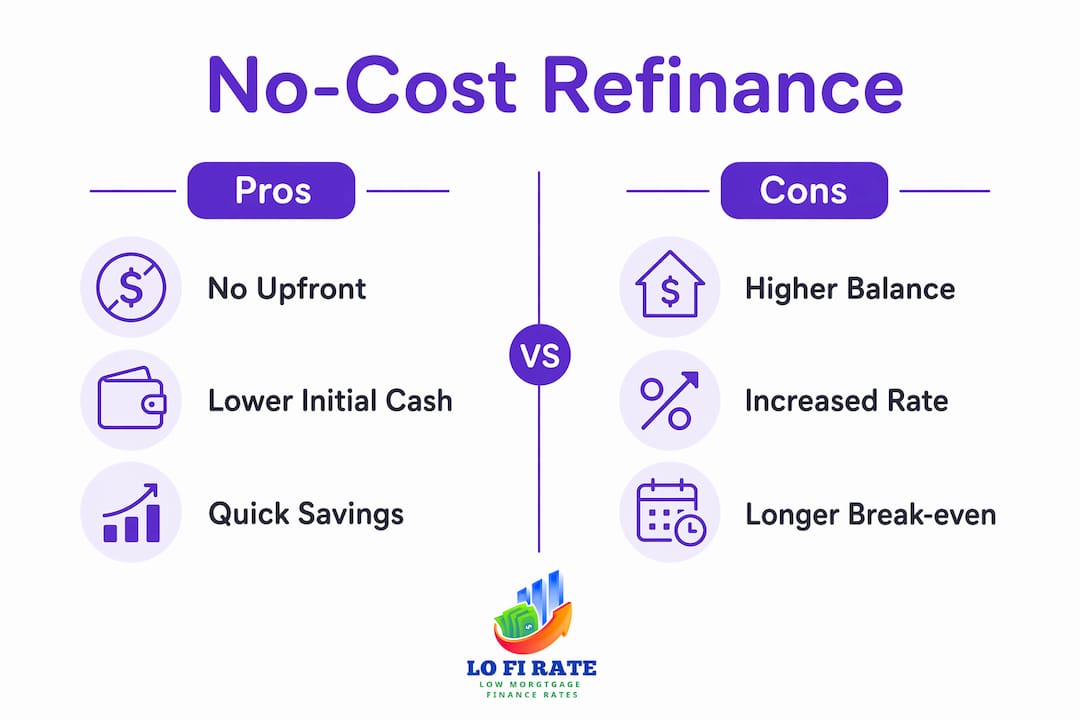
The tradeoff is straightforward but easy to underestimate. A higher loan balance means larger monthly payments and slower equity growth. A higher interest rate means more total interest paid over the life of the loan. Neither outcome is free, and the right choice depends entirely on how long you plan to keep the loan.
How no-cost refinancing actually works
Two mechanics drive every no-cost refinance deal, and understanding both changes how you evaluate any offer a lender puts in front of you.

Method 1: Rolling closing costs into the loan principal
Your lender adds the closing costs directly to your new loan balance. If you owe $240,000 and your closing costs total $6,000, your new loan starts at $246,000. You finance those costs over the full loan term, which increases both your monthly payment and the total interest you pay. Lenders typically cap this approach based on your loan-to-value (LTV) ratio, so you need enough equity to absorb the added balance.

Method 2: Accepting a higher interest rate for lender credits
Your lender covers the closing costs upfront in exchange for a rate bump, often 0.25% to 0.5% above what you'd otherwise qualify for. On a $300,000 loan at 6.5% instead of 6%, your monthly payment rises by roughly $97, and over 30 years that adds up to about $34,920 in extra interest paid. The lender recoups the closing cost credit through that spread.
Loan types eligible for zero cost refinancing include:
- Conventional loans (subject to Fannie Mae and Freddie Mac LTV guidelines)
- FHA loans (with lender credit structures)
- VA loans (the VA Interest Rate Reduction Refinance Loan, or IRRRL, is specifically designed for low-cost refinancing)
- USDA loans (streamlined refinance options exist)
One thing worth knowing: lenders set their own policies on how much of the rate they'll adjust and which fees qualify for credits. There's no universal standard, so two lenders offering "no-cost" deals on the same loan can produce very different long-term costs.
Pros and cons of a no-closing-cost refinance
The appeal is real, but so are the downsides. Here's an honest breakdown.
Pros:
- No upfront cash required. You preserve your savings, which matters if you're cash-constrained or just bought the home.
- Useful for short-term holders. If you plan to sell or refinance again within a few years, you may exit before the higher rate or balance costs you more than the upfront savings.
- Liquidity stays intact. Keeping $5,000–$10,000 in your pocket has real value, especially for homeowners managing renovation costs or an emergency fund.
- Accessible when rates drop sharply. A quick rate-and-term refinance with no out-of-pocket cost can lock in savings immediately without a large cash commitment.
Cons:
- Higher total interest. A no-closing-cost mortgage costs more over the long run through elevated monthly payments or a larger balance.
- Slower equity buildup. Rolling costs into the principal means you're starting with a higher balance and building equity more slowly from day one.
- Rate premium compounds. Even a modest rate increase of 0.25% costs thousands over a 30-year term.
- Less negotiating leverage later. Locking in a higher rate now limits your options if you want to refinance again before rates fall further.
The homeowner who benefits most from this structure is someone with limited cash, a shorter expected stay, or a specific reason to preserve liquidity. For everyone else, the math usually favors paying closing costs upfront.
Key factors to evaluate before choosing this option
Not every homeowner qualifies for a no-cost refinance, and not every one who qualifies should take it. A few factors determine whether it makes sense for your situation.
Loan balance and LTV ratio
Rolling closing costs into your loan principal requires sufficient equity. Most conventional lenders cap LTV at 80%–97% depending on the program, and adding $5,000–$15,000 to your balance could push you over that limit. Check your current home equity before assuming this route is available. You can find more on how equity affects your options in this guide to home equity in refinancing.
Credit score and debt-to-income ratio
Your credit profile directly affects how much of a rate adjustment the lender charges for covering your costs. A borrower with a 760+ credit score will typically receive a smaller rate bump than someone at 680. Lenders are also more willing to negotiate fees and credits with borrowers who carry strong profiles and competing offers.
Closing cost size
Typical refinance closing costs run 2%–6% of the loan amount. On a $350,000 loan, that's $7,000–$21,000. The larger the closing cost figure, the more it costs you to finance it, whether through a higher rate or a bigger balance.
Key decision points to assess:
- Do you have enough equity to roll costs in without exceeding LTV limits?
- How much will the rate increase to cover lender credits?
- How long do you plan to keep this loan?
- What is your current credit score, and does it qualify you for a competitive rate adjustment?
- Are there specific fees (origination, underwriting) the lender is willing to waive outright rather than finance?
How to calculate the break-even point
The break-even point is the number of months it takes for your monthly savings to offset the extra cost you're carrying because of the no-cost structure. It's the single most useful number in any refinance decision.
The formula:
Say your closing costs would be $6,000, and the no-cost option raises your monthly payment by $50. Your break-even is 120 months, or 10 years. If you sell or refinance before then, the no-cost route saved you money. If you stay longer, you've paid more than you would have by covering the costs upfront.
Factors that shift the break-even calculation:
- Loan amount. Larger loans carry larger closing costs, which take longer to recoup.
- Rate difference. A bigger rate gap between the standard and no-cost offers means a higher monthly payment increase, which shortens the break-even period.
- Closing cost size. The more costs being financed, the longer it takes to break even.
- How you structure the deal. Rolling costs into principal vs. taking a rate increase produces different monthly payment impacts and different break-even timelines.
The break-even calculation is most useful when you have a realistic sense of your timeline. If you're planning to move in three years, a 10-year break-even makes the no-cost option look attractive. If you're settling in for the long haul, paying upfront almost always wins.
Pro Tip: Run the break-even calculation for both no-cost structures separately: once for rolling costs into principal and once for the rate-increase option. The two timelines often differ by years, and the better choice isn't always obvious until you see both numbers side by side.
How to shop and compare no-cost refinance offers effectively
"No-cost" is a marketing description, not a regulated term. Two lenders can both advertise a no-closing-cost refinance and deliver wildly different total costs. The way to cut through that is to compare APRs, not base interest rates.
The APR captures the full cost of the loan, including fees embedded in the rate, which is why comparing APRs gives you a more accurate picture than looking at the headline rate alone. A lender offering 6.75% with no fees might be cheaper over five years than one offering 6.5% with costs rolled in, depending on how long you keep the loan. You can dig deeper into this distinction in Lofirate's breakdown of APR vs. interest rate.
Practical steps for comparing offers:
- Request Loan Estimates from at least three lenders. The Loan Estimate is a standardized three-page document that lets you compare fees, rates, and APRs on an apples-to-apples basis. Lofirate's guide to reading a Loan Estimate walks through exactly what to look for.
- Identify which fees are truly waived vs. rolled in. Some lenders waive origination fees outright; others just move them into the rate. The Loan Estimate shows both.
- Use competing offers as leverage. Lenders can negotiate which fees to waive, and borrowers with strong credit and a competing offer in hand tend to get better terms.
- Watch for third-party fees. Appraisal, title, and recording fees are often passed through at cost. A lender claiming "no fees" may still be charging these, just not calling them out.
Understanding what a closing agent actually does and charges helps you spot which line items are negotiable and which are fixed third-party costs.
Pro Tip: When comparing Loan Estimates, look at the "Total Interest Percentage" (TIP) field on page 3. It shows the total interest you'll pay over the loan's life as a percentage of the loan amount. That single number makes long-term cost comparisons fast and concrete.
When a no-cost refinance ends up costing you more
The scenario where zero cost refinancing backfires is predictable: you stay in the home longer than you expected. Life changes, rates don't drop enough to justify another refinance, and you end up carrying a higher rate or a larger balance for 15 or 20 years instead of 3.
Consider a homeowner who refinances a $300,000 loan and accepts a 0.5% rate increase to avoid $9,000 in closing costs. If that rate increase adds $97 per month to the payment, the break-even is about 93 months, roughly 7.75 years. Stay past that point and the no-cost option has cost more in total than simply paying the $9,000 upfront. Over a full 30-year term, the extra interest can exceed $34,920.
There are a few specific scenarios where this structure tends to hurt borrowers:
- Long-term holders in a stable rate environment. If rates stay flat and you keep the loan for 10+ years, the rate premium compounds into a significant overpayment.
- High-balance loans. On a $600,000 loan, even a 0.25% rate increase adds up fast. The math tilts toward paying upfront much sooner.
- Borrowers who roll costs in and then refinance again. Each time you roll costs into the principal without paying down the balance, you're compounding the debt. Serial no-cost refinancers can find themselves owing more than they originally borrowed years into homeownership.
- Rising equity situations. If your home is appreciating and you're building equity, a higher loan balance from rolled-in costs slows that process and can affect future borrowing capacity.
No lender truly waives closing costs. The money moves, it doesn't disappear. Knowing that going in changes how you read every "no-cost" offer.
No-cost refinance vs. traditional refinance: which is better for you?
The honest answer is that it depends on one thing more than anything else: how long you'll keep the loan.
A traditional refinance requires you to pay 2%–6% of the loan amount upfront. That's a real cash outlay, but it buys you the lowest available rate and the smallest possible monthly payment going forward. For homeowners who plan to stay put for a decade or more, that upfront cost pays for itself relatively quickly and then saves money every month after.
A no-cost refinance makes sense when:
- You don't have the cash to cover closing costs without depleting savings
- You expect to sell, move, or refinance again within 3–5 years
- Rates have dropped enough that even a slightly higher no-cost rate beats your current rate by a meaningful margin
- You need to preserve liquidity for a near-term expense (renovation, job transition, medical costs)
A traditional refinance makes sense when:
- You plan to stay in the home long-term and want the lowest possible rate
- You have the cash available and won't need it for other purposes
- Your loan balance is large enough that even a small rate difference creates significant long-term savings
- You've already done a no-cost refinance and are now in a position to pay down costs permanently
The break-even point is the deciding line. Calculate it for both structures, compare it to your realistic timeline, and the right choice usually becomes clear. If you're unsure, working with a wholesale broker through a platform like Lofirate can surface options from multiple lenders at once, so you're comparing real numbers rather than marketing language.
Key Takeaways
A no-cost refinance shifts closing costs to your loan balance or interest rate rather than eliminating them, making your break-even timeline the single most important factor in deciding whether it saves or costs you money.
| Point | Details |
|---|---|
| Costs are deferred, not waived | Closing costs are paid via a higher rate or larger loan balance, not eliminated. |
| Closing costs run a small percentage of the loan amount and are financed into your loan or rate. | |
| Break-even drives the decision | Divide total closing costs by the monthly payment increase to find your break-even in months. |
| Short-term holders benefit most | Homeowners planning to move or refinance within a few years often come out ahead with no-cost options. |
| APR comparison is non-negotiable | Always compare APRs across Loan Estimates, not just headline rates, to find the true lowest-cost offer. |