

If you want a lower rate or a smaller monthly payment, refinancing usually wins. If you need a defined amount of cash without disturbing a first mortgage rate you locked in years ago, a second mortgage (a home equity loan or HELOC) is often the smarter, more cost-effective move. The right answer depends on your current rate, how much cash you need, and how long you plan to stay in the home.
TL;DR:
- Refinancing generally offers lower interest rates but can involve higher closing costs and resets your loan term, affecting long-term interest.
- Second mortgages, such as home equity loans or HELOCs, typically have lighter fees and leave your original mortgage untouched, but carry higher rates and added repayment risks.
- If your current first-mortgage rate is significantly below today's refinance rates and penalties are steep, a second mortgage may be more cost-effective.
- For small cash needs under roughly $25,000, especially if held for less than a year, a HELOC or home equity loan often costs less than refinancing.
- Comparing actual quotes from multiple lenders or brokers helps identify the most cost-efficient option, considering breakeven timelines and total fees.
Table of Contents
- Refinance vs. Second Mortgage: How Each Option Actually Works
- What Numbers Should You Check Before Deciding?
- How Do Closing Costs Compare to a Second Mortgage's Fees?
- How Do You Get Started Comparing Offers?
- What Risks and Timelines Should You Expect?
- Why Getting a Second Opinion Beats Guessing
- Get a No-Obligation Second Opinion Before You Choose
- Sources
- FAQ
Refinance vs. Second Mortgage: How Each Option Actually Works
A rate-and-term refinance replaces your existing mortgage with a new one, usually to secure a lower interest rate or shorten the term. A cash-out refinance does the same thing but borrows more than you owe, handing you the difference in cash while resetting the entire loan. A second mortgage is a separate loan layered on top of your current mortgage, most often structured as a home equity loan (fixed rate, lump sum) or a HELOC (variable rate, revolving credit you draw against as needed).
Here's how they stack up on the factors that actually change your finances:
- Access to cash: Cash-out refinance and home equity loans both give you a lump sum; a HELOC gives you a flexible credit line you draw down over time.
- Interest rate and payment: Refinances typically carry lower rates than second mortgages, but a cash-out refinance raises your loan balance and can push your payment up even at a lower rate.
- Closing costs: Refinancing runs roughly 2% to 6% of the loan amount; second mortgages often carry lighter setup and appraisal fees.
- Loan term and total interest: Refinancing resets your amortization clock; a second mortgage leaves your original mortgage term untouched.
- Risk profile: A second mortgage adds a second lien and, if it's a HELOC, a variable rate that can rise later.
If your main goal is lowering your monthly payment, refinancing is usually the answer. If you need $20,000 for a kitchen remodel and don't want to touch a 3.5% first mortgage, a second mortgage is worth a hard look.
What Numbers Should You Check Before Deciding?
Run these checks before you fill out a single application:
- Your current first-mortgage rate. If it's meaningfully below today's refinance rates, breaking it usually costs you more than it saves.
- The prepayment penalty. Ask your servicer for the exact dollar amount or the interest-rate differential (IRD) calculation, not just the percentage.
- How much cash you actually need. A precise number, not a round guess, keeps you from over-borrowing and paying interest on money you don't use.
- How long you'll keep the loan. Short holding periods favor options with lower upfront costs, even if the rate is slightly higher.
- Your credit score and debt-to-income ratio. Both refinances and second mortgages have minimum thresholds, and a weaker profile can mean a worse rate on either path.
A few decision rules follow naturally from those numbers. If your existing rate is well below current market rates and your penalty is steep, lean toward a second mortgage. If today's refinance rate matches or beats your current one, a rate-and-term refinance is close to a free upgrade. If you need cash and current rates are attractive, a cash-out refinance can beat carrying two separate loans.
Pro Tip: A HELOC's variable rate resets after the draw period ends, and payments can jump substantially once you enter repayment. For a purely short-term need, that risk is often worth it. For anything you'll carry more than three or four years, price out a fixed-rate home equity loan instead.
How Do Closing Costs Compare to a Second Mortgage's Fees?
Refinancing costs come mostly from lender fees, title work, and appraisal, landing between 2% and 6% of your loan amount. On a $300,000 refinance, that's $6,000 to $18,000, often rolled into the new loan balance. A second mortgage typically carries lighter fees: an appraisal, a modest origination charge, and sometimes a small annual fee on a HELOC, but nothing close to full refinance closing costs.
To compare the two fairly, divide the closing costs by your expected monthly savings to find your breakeven point in months. Here's a simplified example using publicly available sample figures. Say you owe $250,000 at 6.5% and could refinance to 5.75%, but closing costs run $7,500. Your new payment saves roughly $115 a month, so breakeven lands around 65 months, more than five years.
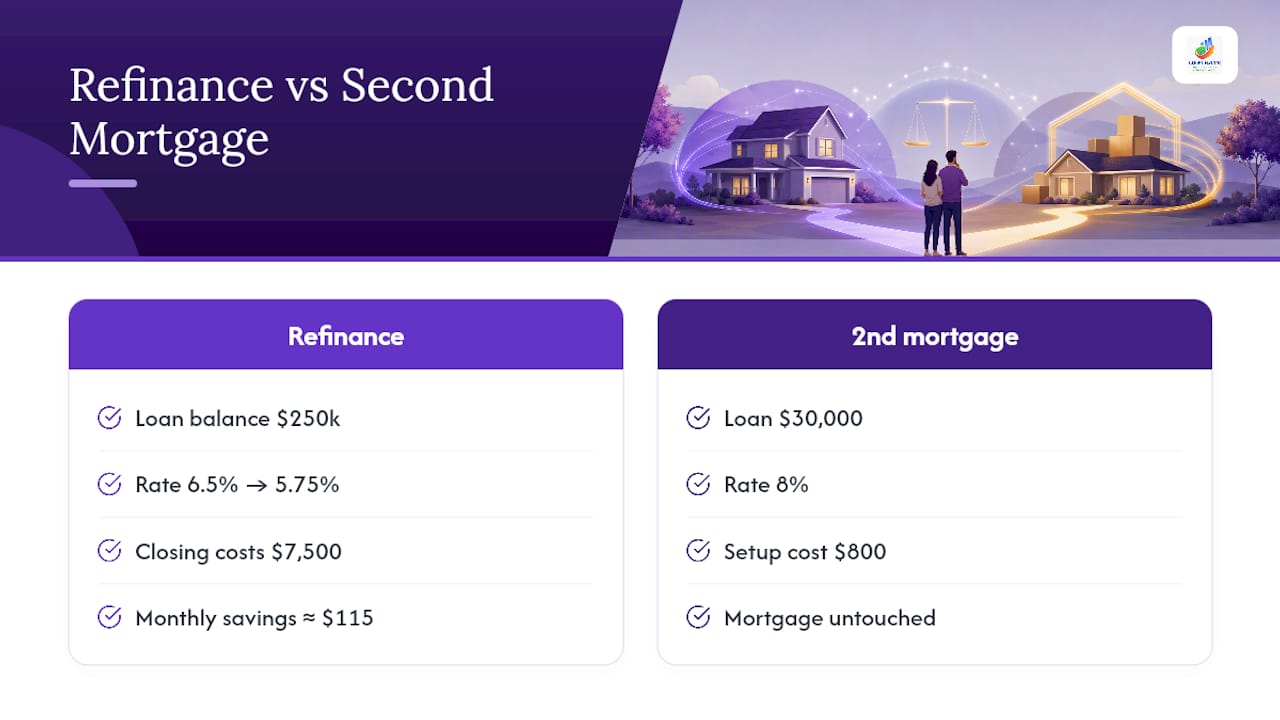
Now compare that to a $30,000 home equity loan at 8% for a bathroom renovation, with $800 in setup costs and your existing mortgage untouched. There's no breakeven calculation needed against your first mortgage because you're not disturbing it. The choice comes down to whether an 8% rate on $30,000 costs less over your planning horizon than refinancing your entire balance to access the same amount through a cash-out structure. For smaller amounts under roughly $25,000 held for less than a year, a HELOC or short-term line of credit frequently wins once setup costs are factored in.
How Do You Get Started Comparing Offers?
Start by pulling your documents together: your latest mortgage statement, an official payoff quote, income verification, and either a recent appraisal or an automated valuation estimate of your home's worth.
From there, follow this sequence:
- Call your current servicer and get the exact prepayment penalty or IRD figure in writing.
- Request quotes for all three structures, rate-and-term refinance, cash-out refinance, and a second mortgage or HELOC, so you're comparing real numbers instead of estimates.
- Ask each lender for an itemized fee breakdown, not just an interest rate, since origination and third-party fees vary widely between offers.
- Run the breakeven math from the section above using the actual numbers you received.
- Decide, then apply with the lender or broker offering the best total cost for your specific timeline.
Shopping multiple lenders or licensed mortgage brokers at this stage is where most homeowners either save real money or leave it on the table.
What Risks and Timelines Should You Expect?
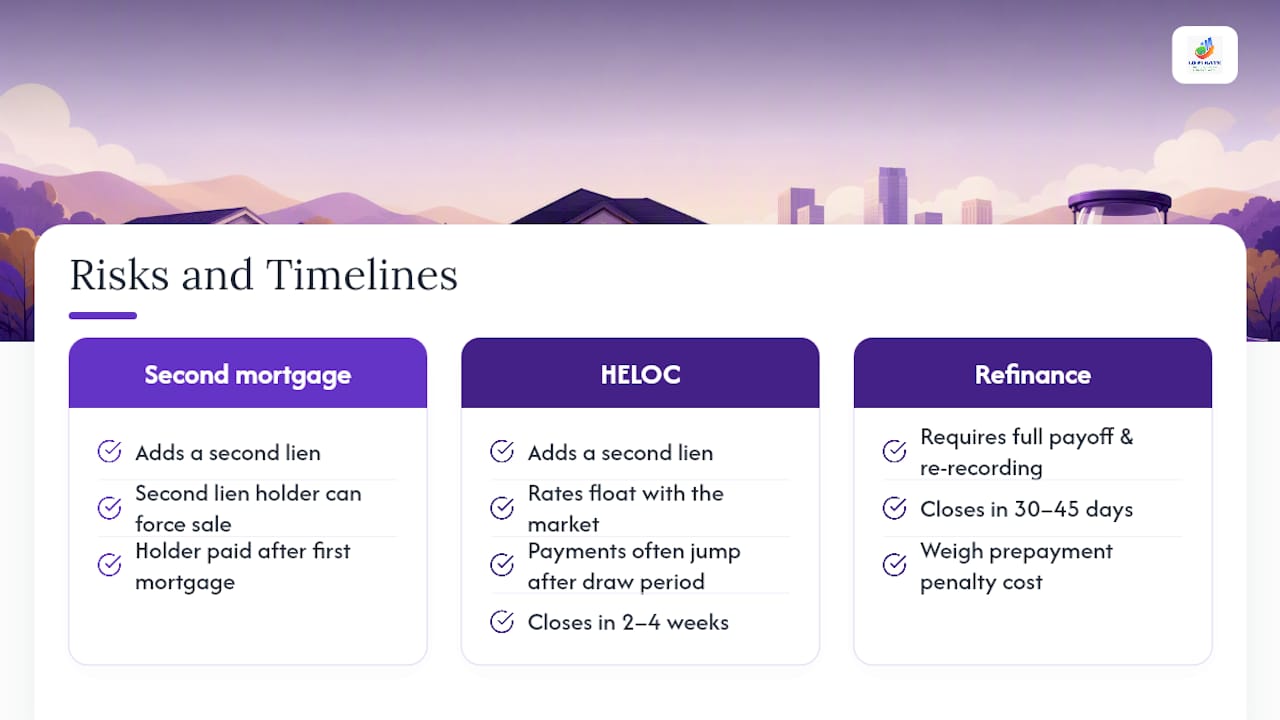
Adding a second mortgage means adding a second lien on your home. If you fall behind on payments, the second lien holder can force a sale to recover what's owed, and they get paid only after the first mortgage is satisfied. HELOCs carry an added layer of risk: rates float with the market, and payments often jump once the interest only draw period ends and principal repayment begins.
Timelines differ too. A HELOC or home equity loan can often close in two to four weeks since there's no need to pay off an existing loan. A refinance typically takes 30 to 45 days, partly because it requires a full payoff and re-recording of the mortgage. If your current loan carries a hefty prepayment penalty, that cost needs to be weighed against any rate savings before you sign anything.
On taxes, mortgage interest deductibility depends on how you use the borrowed funds and is subject to IRS limits that changed under prior tax law updates. A tax advisor, not a lender, is the right person to confirm whether your specific interest is deductible.
Why Getting a Second Opinion Beats Guessing
Most homeowners compare exactly one refinance quote against their gut feeling about a second mortgage, and that's how good options get missed. Lofirate exists because wholesale mortgage brokers routinely surface rate options retail banks don't advertise, simply because they shop across multiple lenders instead of pricing their own single book of loans.
When you talk to a matched broker, ask three things directly: what a blended rate looks like if you keep your first mortgage and add a second lien versus refinancing the whole balance, what the exact prepayment penalty or IRD is on your current loan, and what the total fees add up to once appraisal, origination, and title costs are included. Those three answers, side by side, tell you more than any generic advice ever will.
— LoFi
Get a No-Obligation Second Opinion Before You Choose
Lofirate is the alternative to walking into a single bank branch and taking whatever rate they quote. Because it connects you with licensed wholesale brokers who shop multiple lenders at once, you can see competing offers for refinancing and second mortgages side by side instead of guessing which one is actually cheaper.

The process starts with a short intake about your current mortgage and what you're trying to accomplish, whether that's a lower payment or cash for a project. You get matched with a licensed broker in your state, and there's no obligation to move forward with anyone you're matched with. If you want to see the full range of loan types brokers in the Lofirate network handle, including conventional, FHA, VA, and cash-out options, that's the fastest way to find out what you actually qualify for. Request your no-obligation quote comparison today and see the numbers before you decide anything.
Sources
- Second Mortgage vs. Refinance: Which Is Right for You? - Benzinga
- Bank of America Better Money Habits (home equity & HELOC guidance)
This article is general information, not a substitute for advice from a qualified financial advisor. Consult a qualified financial professional about your own circumstances before acting on anything here.
FAQ
Is a Second Mortgage Worth It Compared to Refinancing?
It depends on your existing rate and how much cash you need. If your first mortgage rate is well below current market rates, a second mortgage usually preserves more value than refinancing your entire balance.
What's the Main Difference Between Refinancing and a Second Mortgage?
Refinancing replaces your existing mortgage entirely, while a second mortgage adds a new loan on top of it. Refinancing tends to carry lower rates but higher closing costs, and a second mortgage leaves your original loan term untouched.
How Much Does It Cost to Refinance a Mortgage?
Refinance closing costs typically run between 2% and 6% of the loan amount, covering appraisal, origination, and title fees. A cash-out refinance carries these same costs plus a larger loan balance.
Should I Refinance or Take Out a Home Equity Loan?
Choose refinancing if today's rates beat your current rate and you plan to stay in the home long enough to clear the breakeven point on closing costs. Choose a home equity loan if you need a smaller, defined amount of cash and don't want to disturb a favorable existing mortgage rate.
Does Lofirate Charge Homeowners for Broker Matching?
Lofirate's broker-matching service has no published consumer fee listed on its site; brokers in the network are compensated separately when a loan closes. Current details are available directly on the Lofirate site.