

A lender credit is money your mortgage lender applies toward your closing costs in exchange for a higher interest rate. It lowers what you pay upfront and raises what you pay every month for as long as you hold the loan. Credits make sense mainly when cash is tight now or you don't expect to keep the loan long. If you plan to stay put for a decade or more, that higher rate usually costs more than it saves.
TL;DR:
- Lender credits vary by lender, loan type, and borrower credit profile, and they typically go toward closing costs, prepaid items, or loan principal reduction.
- You can verify the exact credit amount on the Loan Estimate and Closing Disclosure, where it appears as a negative number reducing your cash to close.
- If the credit shrinks between your Loan Estimate and Closing Disclosure, a delay or reassessment might occur, so compare the documents carefully before signing.
- Calculating your break-even point helps determine if accepting a higher rate makes financial sense based on how long you plan to stay in the home.
- Shopping from multiple lenders or brokers ensures you get accurate comparisons and the best credit-to-rate balance for your specific situation.
Table of Contents
- What Are Lender Credits and What Can They Cover?
- Where to Find Lender Credits on Your Loan Paperwork
- The Math: An Example and How to Find Your Break-Even Point
- Lender Credits vs. Discount Points: Opposite Bets
- When Lender Credits Actually Make Sense
- How to Ask for Lender Credits Without Getting Played
- Other Ways to Cover Closing Costs
- Comparing Lender-Credit Offers Across Brokers
- When I'd Take the Credit, and When I Wouldn't
- Compare Lender-Credit Offers Before You Choose One
- Where to Verify Everything in This Article
- Sources
- FAQ
What Are Lender Credits and What Can They Cover?
Lenders sometimes call this "negative points" or "premium pricing," and the mechanics are the mirror image of buying discount points. Instead of paying extra upfront to lower your rate, you accept a higher rate and the lender hands you money back, priced in against that rate bump. It's typically expressed as a percentage of the loan amount, and Bankrate's breakdown of lender credits notes that sizing varies by lender policy, loan program, loan-to-value ratio, and your credit profile. There's no fixed number every lender offers.
Credits can only go toward specific things:
- Closing costs like origination fees, appraisal fees, and title charges
- Prepaid items such as homeowners insurance premiums or property tax reserves
- Any leftover amount after covering those costs, which must be applied to your loan principal or reduced. Lenders can't just hand you a check for the difference.
That last point matters because it's also where the rules get strict. Fannie Mae draws a hard line between a lender credit and a lender incentive. A credit reduces closing costs and commonly comes from that premium pricing trade. An incentive, by contrast, has to be funded from the lender's own business funds, never from loan proceeds, and follows separate documentation requirements under Fannie Mae's selling guide. If a lender is vague about which one you're getting, ask directly. The funding source tells you whether you're really trading rate for cash or getting a genuine promotional perk.
Where to Find Lender Credits on Your Loan Paperwork
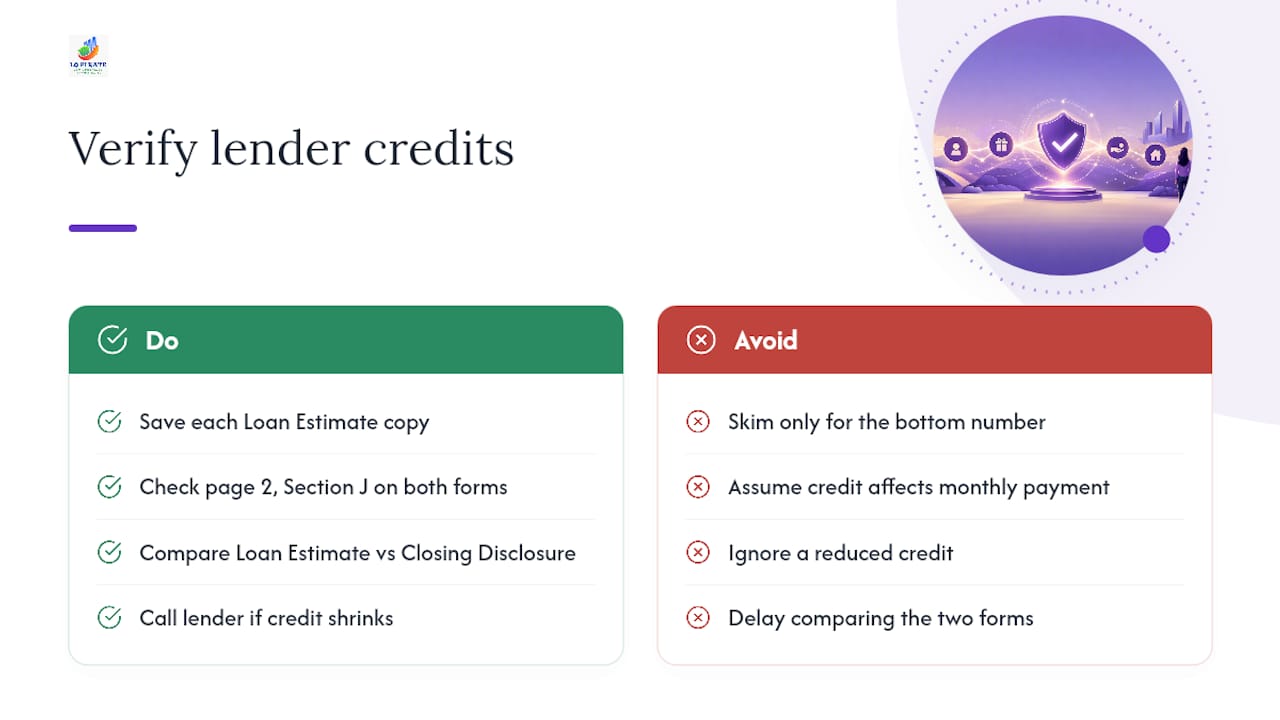
Lender credits aren't a verbal promise. They're a line item, and you can verify every dollar of them on two federal disclosure forms.
On the Loan Estimate, and again later on the Closing Disclosure, lender credits show up on page 2 in Section J, under "Calculating Cash to Close." They appear as a negative number, because they're subtracted from what you owe at the closing table rather than added anywhere else. That's the whole point: they directly reduce your cash to close, not your monthly payment.
Pro Tip: Save a copy or screenshot of every Loan Estimate you receive, especially the Section J numbers. When your Closing Disclosure arrives, put the two side by side. A shrinking credit and a rising cash-to-close figure is worth a phone call before you sign anything.
Here's the number that should make you double check both documents: if the lender credit shrinks between your Loan Estimate and your Closing Disclosure, that's a material change that can trigger a new three-day review period before you're allowed to close. That delay protects you, but only if you're actually comparing the two forms line by line instead of skimming for the bottom number.
The Math: An Example and How to Find Your Break-Even Point
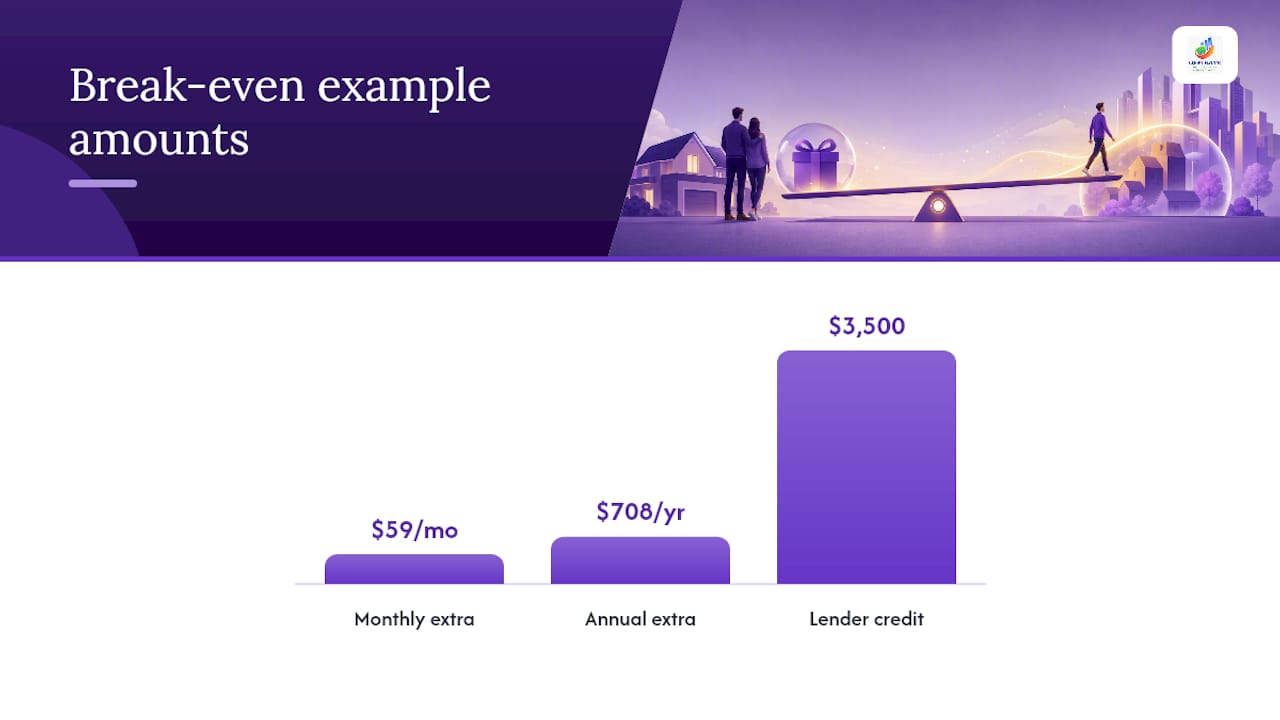
Say you're financing $350,000 over 30 years. That's a $59 monthly difference, or about $708 a year.
To find your break-even point:
- Divide the credit amount by the monthly payment increase: $3,500 ÷ $59 comes to about 59 months, or just under five years.
- Compare that number to how long you actually expect to keep the loan.
- If you'll sell or refinance before the break-even point, the credit saved you money overall. If you'll stay longer, the higher rate eventually costs more than the credit was worth.
The CFPB's own guidance on points and credits frames this exact trade-off: points buy a lower rate for cash now, credits buy cash now for a higher rate. Both bets hinge on how long you'll actually hold the loan. Small changes in either the rate spread or your expected timeline can flip the recommendation entirely, so run the math with your real numbers, not a generic example.
Most borrowers get the arithmetic right and still make a mistake: they forget to factor in whether they'll refinance in three years anyway, or how mortgage insurance premiums interact with a higher loan balance if the credit gets rolled in rather than applied directly to costs.
Lender Credits vs. Discount Points: Opposite Bets
Points and credits are the same lever pulled in opposite directions, and mixing them up in casual conversation is easy to do. A point lowers your rate today in exchange for cash paid at closing. A credit raises your rate in exchange for cash back at closing. You're never doing both for the same reason at once.
- Buying points tends to win when you're planning to stay in the home well past your break-even point and want to minimize total interest paid over the loan's life.
- Taking credits tends to win when cash reserves are thin, you expect to sell or refinance within a handful of years, or you'd rather keep money liquid than lock it into your closing costs.
- The decision rule the CFPB outlines boils down to this: if your break-even horizon is longer than your expected years in the home, credits usually make more sense than points. If it's shorter, points usually pay off first.
Curious how the points side of this works in more detail? This guide to discount points walks through the upfront math the same way.
When Lender Credits Actually Make Sense
Credits aren't a universal good deal, and they aren't a trap either. They're a tool that fits certain situations well and others poorly.
Scenarios where credits tend to help:
- Cash is tight after the down payment. If closing costs would drain your reserves to nearly zero, a credit that keeps a few thousand dollars in your account for emergencies or moving expenses is often worth the rate bump.
- You expect to sell or refinance within three to five years. Consumer guidance from Zillow points out this is the single biggest factor in whether credits pay off. A short ownership window means you'll never reach the break-even point where the higher rate starts costing more than it saved.
- You want to preserve your down payment size without stretching into closing costs. Some buyers would rather put more down and take a credit for costs than shrink their down payment to cover fees out of pocket.
Scenarios where paying points usually wins instead: you're buying a forever home, you're already stretched on monthly payment capacity, or your loan program limits how large a credit you can accept.
Pro Tip: Before choosing either direction, write down your best guess for how many years you'll keep this loan. That single number, more than anything a lender tells you, should drive the decision.
Run through this quick checklist before you decide: your realistic timeline in the home, the odds you'll refinance regardless of rate direction, your current cash reserves after a down payment, and whether your specific loan program (FHA, VA, conventional) caps how much credit you can take.
How to Ask for Lender Credits Without Getting Played
Lenders don't always volunteer credit options unless you ask specifically. Bring these questions to every loan officer or broker conversation:
- What lender credit is available at each rate tier you're quoting me?
- Is this credit funded through premium pricing, or is it a separate lender incentive?
- How will the credit appear on my Loan Estimate and Closing Disclosure, specifically in Section J?
Negotiating well means comparing apples to apples across lenders. Pull multiple Loan Estimates, line up the credit amount against the rate on each one, and calculate the total cost over your expected time in the home, not just the closing day number. Once you settle on terms, get written confirmation that the credit will carry through unchanged to your Closing Disclosure.
Watch for these warning signs:
| Red Flag | Why It Matters |
|---|---|
| "No closing costs" advertising with no rate disclosed | Often means a much higher rate is baked in to fund the credit |
| A credit that shrinks between Loan Estimate and Closing Disclosure | May signal a bait rate that was never fully priced correctly |
| An "incentive" or "gift" funded from premium pricing but not documented as such | Against Fannie Mae and Freddie Mac funding-source rules, and worth clarifying before you sign |
If any of these show up, ask for a closer look at how hidden fees typically surface before you commit to that lender.
Other Ways to Cover Closing Costs
Lender credits aren't the only lever for closing-cost relief, and they're not always the cheapest one.
- Seller concessions work similarly but come from the home seller instead of the lender, with their own documentation rules and program-specific dollar caps.
- Down payment assistance and local closing-cost grants exist in many states and cities, often aimed at first-time buyers, and typically don't carry a rate penalty the way lender credits do.
- Gift funds from family, paying discount points instead, or simply drawing from reserves are the more direct routes, each trading liquidity or long-term cost differently than a credit does. Rolling costs into the loan balance is another option worth weighing against a straight credit, since it affects your loan-to-value ratio differently.
Full context on what typically shows up in your closing costs is covered in this breakdown of home financing cost factors.
Comparing Lender-Credit Offers Across Brokers
Every lender prices credits differently, which is exactly why shopping around matters more than most borrowers realize. Some platforms connect homebuyers with licensed wholesale mortgage brokers who pull quotes from multiple lenders rather than pitching one bank's own pricing. That gives you several Loan Estimates to run the same break-even math against, side by side, before you commit to a rate or a credit structure.
When I'd Take the Credit, and When I Wouldn't
My rule is simple: take the credit if you're not confident you'll own this loan past your break-even point, otherwise buy the rate down instead. Verify every number on your Loan Estimate against your Closing Disclosure yourself, don't take a loan officer's word for it. Get more than one broker quote before deciding either way.
— LoFi
Compare Lender-Credit Offers Before You Choose One
A single lender's quote tells you nothing about whether that credit is generous or stingy, you only find out by comparing it against what other lenders are willing to offer for the same loan. Lofirate's broker-matching service connects you with licensed wholesale brokers who shop your loan across multiple lenders at once, which means you see several credit and rate combinations instead of just one bank's pitch.

That matters most in the exact scenario this article walks through: figuring out whether a credit's break-even point actually lines up with how long you'll keep the loan. Rather than running that math against a single offer, request quotes through a broker-matching service and compare Loan Estimates line by line. If you want to see how credits interact with different loan program options first, that's a good place to start before requesting broker quotes.
Where to Verify Everything in This Article
- The CFPB's Loan Estimate and Closing Disclosure pages explain every disclosure line item in plain language.
- Fannie Mae's selling guide section on lender incentives spells out the funding-source rules in full.
- Freddie Mac's lender-contribution guidelines cover program-specific limits, including restrictions on certain refinance buydowns.
This article is general information, not a substitute for advice from a qualified financial advisor. Consult a qualified financial professional about your own circumstances before acting on anything here.
Sources
- Closing disclosure | Consumer Financial Protection Bureau
- Lender Incentives | Fannie Mae
- What are lender credits? | Zillow
FAQ
What is a lender credit on a U.S. mortgage?
A lender credit is money your lender applies toward your closing costs and prepaid items in exchange for accepting a higher interest rate, and it appears as a negative number in Section J of your Loan Estimate and Closing Disclosure.
How common are lender credits?
Lender credits are widely offered across conventional, FHA, and VA loans, though the exact amount available depends on the lender's pricing, your loan program, and your credit profile rather than a fixed industry standard.
Are lender credits the same as points?
No. Discount points lower your rate in exchange for cash paid upfront, while lender credits raise your rate in exchange for cash applied to your closing costs, making them opposite strategies rather than the same tool.
How do I calculate my break-even point on a lender credit?
Divide the credit amount by the monthly payment increase caused by the higher rate; the result is roughly how many months you'd need to keep the loan before the credit stops being the cheaper option.
Can I use a lender credit and still shop multiple lenders?
Yes, and you should. Requesting Loan Estimates from several brokers, such as through Lofirate's broker-matching platform, lets you compare credit amounts and rate tradeoffs before locking in a loan.