

Mortgage brokers get paid one of two ways: the borrower pays them directly through an origination fee or points, or the lender pays them a commission built into the interest rate. Both methods are legal, and federal rules forbid either one from being tied to the specific loan terms you get, but the method still changes your bill. Borrower-paid compensation shows up as cash you hand over at closing. Lender-paid compensation gets folded into a slightly higher rate, so you pay it back gradually over the life of the loan.
You don't have to guess which one you're getting. It's spelled out on your Loan Estimate and Closing Disclosure, under "Origination Charges," split between a "Paid by Others" column and a borrower-paid column.
Before signing anything, do this:
- Pull up your Loan Estimate and find the origination charges section.
- Ask your broker to show you both a borrower-paid and a lender-paid version of the same loan, side by side.
- Compare the APR, not just the interest rate, since APR bakes in most of the financed costs for a clearer picture of your mortgage expenses (CompareSpot Blog).
Key Takeaways
Broker compensation comes from either the borrower or the lender, and federal rules require that pay stay tied to loan amount, not loan terms, so the real variable for you is timing and cost, not fairness.
| Point | Details |
|---|---|
| Two payment paths | Borrower-paid fees hit you at closing; lender-paid commission gets financed into a higher rate over time. |
| Check disclosures directly | Origination Charges on your Loan Estimate and Closing Disclosure show exactly who is paying your broker. |
| Compare APR, not just rate | A lower headline rate can still carry a higher APR once financed compensation is factored in. |
| Ask for side-by-side scenarios | Request both borrower-paid and lender-paid Loan Estimates before choosing a structure. |
| Lofirate matches you to licensed brokers | The platform connects borrowers to wholesale brokers who provide documented, comparable Loan Estimates across lenders. |
Table of Contents
- What Is Broker Compensation and How Does It Work?
- How Does Broker Pay Change Your Rate, APR, and Cash to Close?
- What Federal Rules Protect You From Unfair Broker Pay?
- Checklist: How to Compare Broker Offers Before You Commit
- How Do Mortgage Brokers Get Paid Differently Than Real Estate Agents?
- Do State Rules Change How Much Your Broker Can Charge?
- What Disclosures Show Broker Pay Beyond the Loan Estimate?
- How Lofirate Approaches Transparent Broker Comparisons
- Get Matched With a Licensed Broker Who Shows Their Numbers
- Sources
What Is Broker Compensation and How Does It Work?
Broker compensation is the fee a licensed mortgage broker earns for originating your loan, and it comes from one of two sources: you, the borrower, or the wholesale lender funding the loan. The Consumer Financial Protection Bureau confirms both arrangements are legal, and it pushes borrowers to ask directly who pays and how much before committing to a broker.
Borrower-paid compensation is the more straightforward version. You pay an origination fee or discount points at closing, typically quoted as a percentage of the loan amount, and that fee shows up on your Loan Estimate as an origination charge you're covering yourself. This route tends to buy you a lower interest rate, since the broker isn't relying on the lender to fund their pay through rate markup.
Lender-paid compensation works differently. The broker gets paid by the wholesale lender that funds your loan, and that payment is often structured as a yield spread premium, or YSP. A YSP exists because a lender has a "par rate," the wholesale rate at which it neither pays nor charges the broker anything extra. When the broker delivers you a retail rate above that par rate, the lender pockets the difference and passes part of it to the broker as commission. As Fortra Law explains, this lets you finance the broker's pay into your rate instead of writing a check for it at the table.
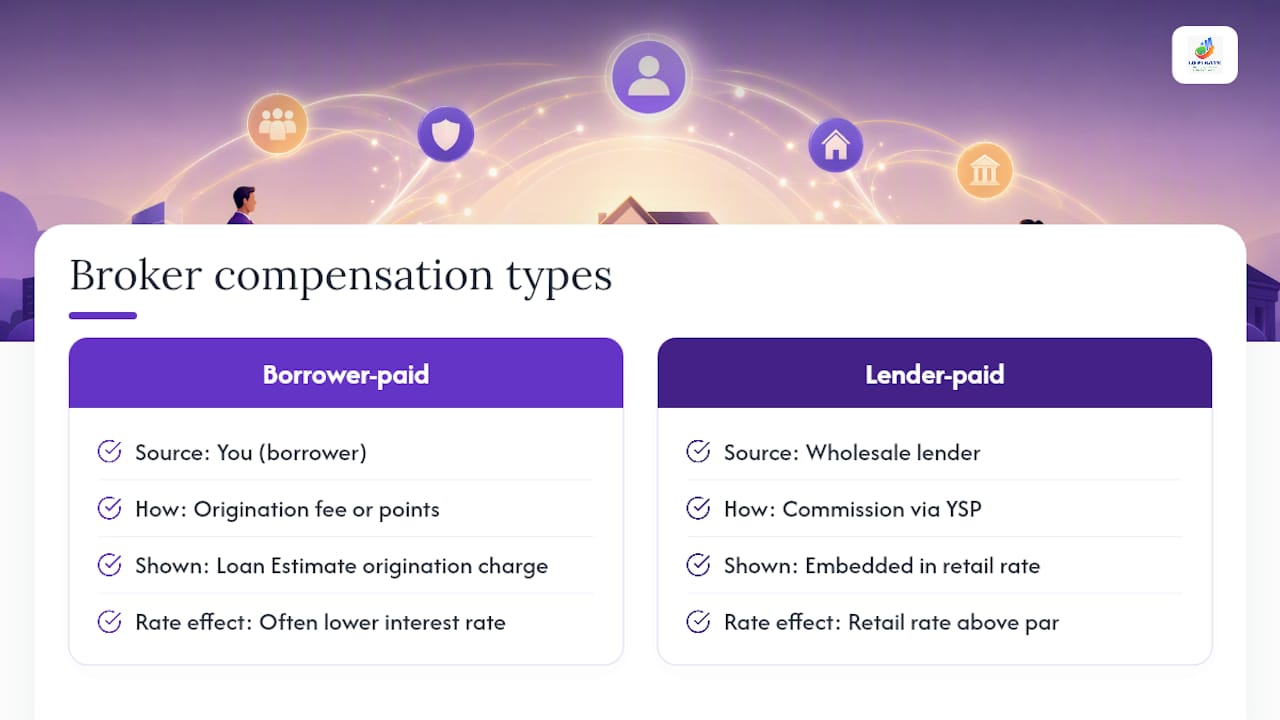
Commission percentages vary by lender and loan size, but industry sources put typical broker commissions somewhere in the range of roughly 1% to 2.75% of the loan amount, according to LegalClarity's breakdown of broker fee structures. On top of that commission, you may see separate administrative or processing fees, and third-party costs like appraisal or credit report fees that simply pass through the broker's file without padding their income.
Pro Tip: A 2% commission on a loan sounds like a significant amount, but licensing costs, NMLS continuing education, state bonding requirements, and office overhead reduce the broker's take-home pay. Gross commission is not take-home pay, and knowing that can help you negotiate without assuming the broker is gouging you.
Understanding state-licensed broker requirements helps explain why that gross number looks bigger than it really is once compliance costs come out.
How Does Broker Pay Change Your Rate, APR, and Cash to Close?
The math here is simple once you see it laid out. Paying points upfront buys a lower rate; letting the lender pay the broker through a YSP means a higher rate but less cash due at closing.
Say you're borrowing $350,000. That half-point difference adds roughly $120 a month to your payment, and it shows up in a noticeably higher APR even though your "cash to close" line looks better on day one.
Three questions determine which version actually saves you money:
- How long do you plan to keep this loan? If you'll refinance or sell within three or four years, the higher-rate, no-cost option often wins, since you never recoup the upfront points.
- How much cash do you have available right now? Paying points at closing only makes sense if it doesn't drain your reserves or force a smaller down payment.
- What's your break-even point? Divide the upfront cost by the monthly savings from the lower rate. If breakeven lands past your expected hold period, skip the points.
Never compare loans on interest rate alone. Look at the APR, the monthly payment, and the cash-to-close figure together, because a broker can make one number look attractive while quietly worsening another. Our guide to APR versus interest rate walks through exactly how that gap forms.
What Federal Rules Protect You From Unfair Broker Pay?
Two federal frameworks govern how brokers can get paid, and both exist specifically because pre-2011 practices let brokers steer borrowers into pricier loans for bigger paydays.
Regulation Z, through the Loan Originator Compensation Rule, bars a broker's pay from varying based on your loan's terms, meaning they can't earn more by pushing you toward a higher rate or a prepayment penalty. The one exception is loan amount, since larger loans can legitimately generate more work and higher percentage-based fees.
RESPA Section 8 bans kickbacks and unearned referral fees between settlement service providers, and it works alongside the dual-compensation ban that stops a broker from collecting money from both you and the lender on the same transaction. CFPB guidance traces this back directly to reforms following the 2008 crisis, when steering incentives helped fuel risky lending.
On your documents, watch for:
- Origination Charges broken into specific line items, not a vague lump sum.
- A clear split between the "Paid by Others" column and what you're paying yourself.
- Consistency between your initial Loan Estimate and the final Closing Disclosure; if the numbers shift without explanation, ask why.
- Any administrative or processing fee that doesn't describe what it's actually for.
Checklist: How to Compare Broker Offers Before You Commit
Comparing broker offers properly takes five steps, and skipping any of them is how borrowers end up overpaying without realizing it.
- Request two Loan Estimates from the same broker: one showing the borrower-paid version, one showing the lender-paid version, using the identical loan amount and term.
- Ask for the wholesale parity check. Have the broker tell you the funding lender's par rate versus the retail rate they're quoting you. The gap between those two numbers is roughly the YSP being generated.
- Get a line-by-line fee breakdown. Every origination, admin, and processing fee should have a plain description of what it covers, not a generic label.
- Collect a second opinion. Get an estimate from another broker or a direct lender for the same scenario, and put both Loan Estimates side by side.
- Negotiate and get it in writing. Broker commissions are often negotiable, particularly on larger loans, and any fee reduction a broker verbally agrees to should appear on the revised Loan Estimate before you move forward.
Pro Tip: If a broker resists showing you both compensation scenarios or gets vague about the wholesale rate, treat that as a signal to shop elsewhere. Transparency on this specific point is one of the clearest indicators of a broker acting in your interest.
Our list of smart questions to ask a mortgage broker gives you exact wording for these conversations, and reviewing how to read a Loan Estimate beforehand means you won't be decoding the form in real time while a broker is sitting across from you.
How Do Mortgage Brokers Get Paid Differently Than Real Estate Agents?
Mortgage broker compensation and real estate agent commissions look similar on the surface, both percentage-based and both tied to a transaction, but the rules governing them diverge sharply.
Real estate agent fees are typically negotiated as a percentage of the home's sale price, commonly split between the listing and buyer's agents, and paid out of sale proceeds at closing. There's no federal rule equivalent to the Loan Originator Compensation Rule capping how that commission can be structured. Agents can, and often do, negotiate different splits deal by deal, and nothing stops a seller from offering a higher commission to incentivize a faster sale.
Mortgage brokers operate under a tighter federal cage. Their pay cannot legally shift based on the interest rate, loan term, or product type they steer you toward, only the loan amount. That single restriction is the biggest structural difference: a real estate agent's incentive can still be shaped by commission size, but a mortgage broker's incentive to push you into a specific rate or product is supposed to be neutralized by law.
Insurance brokers sit somewhere in between, often earning ongoing renewal commissions rather than one-time fees, which creates a different kind of long-term incentive entirely. The takeaway for homebuyers: mortgage broker pay is the most heavily regulated of the three, which is exactly why the disclosure paperwork around it is so detailed compared to a real estate closing statement.
Do State Rules Change How Much Your Broker Can Charge?
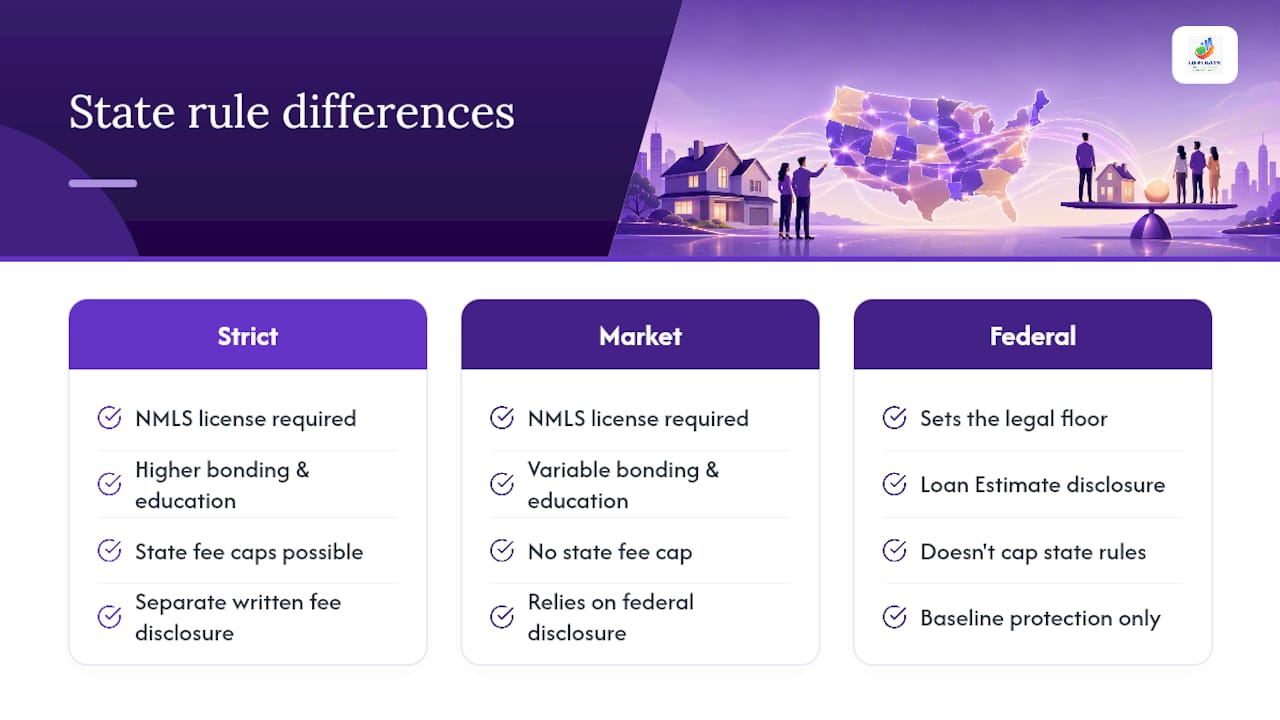
Federal law sets the floor, but states layer their own licensing and fee rules on top, and those differences are real enough to affect your closing costs depending on where you live.
Every mortgage broker must hold a license through the Nationwide Multistate Licensing System, but individual states set their own bonding requirements, continuing education hours, and, in some cases, fee caps or disclosure formats that exceed the federal minimum. A handful of states cap broker fees at a specific percentage of the loan amount or require additional written fee agreements signed before any application moves forward. Other states leave fee levels to the market and rely entirely on federal disclosure rules to keep things transparent.
This matters practically in two ways. First, a broker licensed in a state with stricter bonding and education requirements generally carries higher compliance overhead, which can factor into why commission percentages differ slightly from one region to another. Second, some states require brokers to provide a separate written disclosure of estimated compensation at application, ahead of the federal Loan Estimate, giving you an even earlier look at what you're likely to pay.
If you're comparing offers across state lines, such as buying a second home out of state, don't assume the fee structure will match what you're used to locally. Ask directly whether your state imposes any fee caps or extra disclosure requirements, since your broker should know this cold. Our overview of compliance obligations for mortgage brokers breaks down how licensing variance plays out in practice.
What Disclosures Show Broker Pay Beyond the Loan Estimate?
The Loan Estimate and Closing Disclosure get most of the attention, but they aren't the only place broker compensation shows up before you sign anything.
Most brokers provide an initial written disclosure at the point of application, sometimes called a mortgage broker fee agreement, that spells out how they intend to be paid, whether that's borrower-paid, lender-paid, or a combination structure that's still permitted under current rules as long as it doesn't violate the dual-compensation ban. This document typically arrives before the formal three-business-day Loan Estimate deadline kicks in, giving you an early signal of what to expect.
Some states require a separate compensation disclosure form specific to mortgage broker transactions, distinct from the federal paperwork, particularly in states with additional consumer-protection statutes layered onto RESPA and Regulation Z.
You'll also find compensation referenced indirectly in your rate lock agreement, since the locked rate reflects whatever markup, if any, is being used to fund lender-paid commission. And if your loan involves a mortgage broker agreement or contract for services, that document often restates the fee structure in plain terms, separate from the numerical disclosures on the Loan Estimate.
Reading all of these together, rather than relying on the Closing Disclosure alone, gives you the clearest possible picture of what you're actually paying and to whom.
How Lofirate Approaches Transparent Broker Comparisons
We built Lofirate around a simple frustration: most borrowers never see two competing Loan Estimates side by side, so they have no real basis for judging whether their broker's fee is fair. Lofirate connects you to state-licensed wholesale brokers who shop your loan across multiple lenders rather than pricing it against a single rate sheet.
Every match comes with documented Loan Estimates you can actually compare, plus the compliance safeguards built into the federal framework covered above. If you want more than one option on the table before you sign anything, that's exactly what the platform exists to give you.
— LoFi
Get Matched With a Licensed Broker Who Shows Their Numbers
Comparing borrower-paid against lender-paid pricing on your own means calling multiple brokers, decoding fee sheets, and hoping someone shows you the wholesale rate honestly. Lofirate skips that legwork by matching you directly with state-licensed wholesale brokers who shop several lenders for your loan instead of quoting from one price sheet.

The consultation is free and comes with no obligation to move forward. What you get in return: multiple lender options pulled from wholesale pricing, a documented Loan Estimate for each scenario so you can compare borrower-paid against lender-paid side by side, and a broker who has to answer your questions about compensation directly, not vaguely. Whether you're buying, refinancing, or looking into specific loan options like FHA, VA, or jumbo financing, the same transparency standard applies.
Ready to see your actual numbers instead of a sales pitch? Request your matched broker quotes and get side-by-side Loan Estimates built around your situation, not a generic rate sheet.
Sources
- How does a mortgage loan officer or broker get paid? | Consumer Financial Protection Bureau
- How does a mortgage broker make money? Commissions and fees - LegalClarity
- Yield Spread Premiums: A Key Tool For Brokers | Fortra Law