

Loan level price adjustments, or LLPAs, are risk-based fees that Fannie Mae and Freddie Mac tack onto conventional mortgages based on your credit score, down payment, and loan type. If you have a lower credit score, a small down payment, or you're financing an investment property, LLPAs will push up your rate or your closing costs.
- Who avoids them: FHA, VA, USDA, and HUD Section 184 loans are excluded entirely.
- Who pays more: Borrowers with lower credit scores combined with high loan-to-value ratios.
- What changed: The Federal Housing Finance Agency's 2023 overhaul reshuffled who wins and loses under the new pricing grid.
Quick fact: Fannie Mae's official LLPA Matrix lists dozens of pricing tiers, and the fees stack, meaning one borrower can trigger three or four separate adjustments on a single loan.
Key Takeaways
Loan level price adjustments are cumulative, risk-based fees that can add thousands of dollars to a conventional mortgage, and the exact amount depends on how many risk factors on your file stack together.
| Point | Details |
|---|---|
| LLPAs apply to conventional loans only | FHA, VA, USDA, and HUD Section 184 loans skip LLPAs entirely. |
| Fees stack across risk factors | Credit score, LTV, occupancy, and unit count combine rather than replace each other. |
| The 2023 framework shifted outcomes | Some lower-credit borrowers now pay less, while some higher-credit borrowers pay more. |
| A single bucket change can save the most | Moving your LTV or credit score into a cheaper tier often beats several smaller fixes. |
| Broker shopping reveals net pricing | Lofirate matches you with wholesale brokers who compare LLPA-driven costs across lenders. |
Table of Contents
- How Do Loan Level Price Adjustments Actually Work?
- Which Borrower Traits Trigger the Biggest LLPA Hits?
- What Did the 2023 LLPA Framework Change?
- How Much Can LLPAs Actually Cost You?
- Practical Ways to Reduce or Avoid LLPA Costs
- Do LLPAs Affect More Than Just Your Interest Rate?
- How Do LLPAs Compare to Other Mortgage Pricing Adjustments?
- How Have LLPAs Evolved Since They Were Introduced?
- What We See Borrowers Get Wrong About LLPAs
- Get a Broker to Shop Your LLPA Exposure for You
- Frequently Asked Questions
- Sources
How Do Loan Level Price Adjustments Actually Work?
LLPAs get pulled from a published pricing grid that Fannie Mae and Freddie Mac update periodically. Every risk factor on your loan, your credit score, your loan-to-value ratio, your occupancy status, gets matched against that grid, and the resulting fees add together rather than replacing each other. They eat the credit-score penalty and the LTV penalty stacked on top of each other.
Timing matters more than most borrowers realize. LLPAs are typically calculated based on when your loan becomes purchase-ready for delivery into a mortgage-backed securities pool, not necessarily the day you signed your application. That distinction explains why two borrowers who applied on the same day can end up with different fee structures if their loans close weeks apart. Clear pricing mechanics like this echo how contracting price adjustments work more broadly: a fee is only fair when everyone agrees on the exact index and the exact calculation window.
Here's how the cost typically shows up on your loan estimate:
- Built into your interest rate — the lender raises your rate slightly to cover the fee.
- Charged as points at closing — a direct dollar cost added to your closing costs.
- Offset by a lender credit — some lenders absorb part of the fee to stay competitive.
Don't confuse LLPAs with discount points. LLPAs are mandatory, risk-based charges you can't opt out of, while discount points are optional payments you choose to make in exchange for a lower rate.
Pro Tip: Ask your loan officer for a line-item LLPA breakdown before you lock your rate. Most lenders can print the matrix reference that applied to your file, and comparing that against a competing lender's number is one of the fastest ways to spot overpricing.
Which Borrower Traits Trigger the Biggest LLPA Hits?
Six factors drive most of the LLPA math on a conventional loan: credit score, loan-to-value ratio, loan purpose, occupancy, number of units, and debt-to-income ratio. Each one gets scored independently, and Fannie Mae's pricing grid applies them cumulatively.
- Credit score buckets: Scores below 680 sit in higher-fee tiers; scores above 740 often land in the cheapest bracket.
- Loan-to-value ratio: Higher LTV, meaning a smaller down payment, tends to mean a bigger fee.
- Loan purpose: Cash-out refinances carry noticeably steeper adjustments than standard purchases.
- Occupancy: Investment properties and second homes get hit harder than primary residences.
- Unit count: Two-to-four-unit properties often carry an added surcharge.
- DTI ratio: Higher debt loads relative to income can add another layer of cost.
Stack a few of these together and the effect compounds fast.
A borrower buying an investment property with 15% down and a 660 credit score can face several LLPAs simultaneously, each one adding to the last rather than replacing it.
The ones who pay the most are usually investors financing cash-out refinances on multi-unit properties with thinner credit files.
What Did the 2023 LLPA Framework Change?
Fannie Mae's Lender Letter LL-2023-01 redrew the entire LLPA grid, and most of the changes took effect May 1, 2023, with a separate debt-to-income attribute that arrived on a later date after lenders pushed back on implementation timing. The redesign wasn't cosmetic. It shifted the underlying logic of how risk gets priced across the credit spectrum.
Before the update, the fee curve rose fairly steadily as credit scores dropped. The new framework flattened some of that curve at the low end while adding new charges further up the credit spectrum, which meant a meaningful number of borrowers saw their outcomes reverse from what they would have paid under the old grid.
- Borrowers with credit scores in the 620 to 679 range and low down payments often saw smaller fees than before, particularly at higher LTV tiers.
- Some borrowers with credit scores above 720 and smaller down payments saw new or increased fees they hadn't faced previously.
- The new DTI attribute added a pricing hit for loans with debt-to-income ratios above 40%, layered on top of existing credit and LTV fees.
Real-world coverage of the rollout found the shift wasn't uniform. Analysts tracking the change found that some higher-credit borrowers ended up paying more while many lower-credit, low-down-payment borrowers paid less than they would have under the prior grid.
The waivers didn't disappear in the redesign. HomeReady borrowers and those using area median income-based credits still qualify for reduced or waived LLPAs, and Fannie Mae's matrix documents exactly which programs carry those exemptions. If you think you might qualify, the fastest way to confirm it is to ask your loan officer to check your file against the current published matrix rather than relying on last year's numbers, since the FHFA has shown it will revise this framework again as market conditions shift.
How Much Can LLPAs Actually Cost You?
Numbers make this concrete faster than any explanation of mechanics. Consider two borrowers buying similar $350,000 homes in 2026.
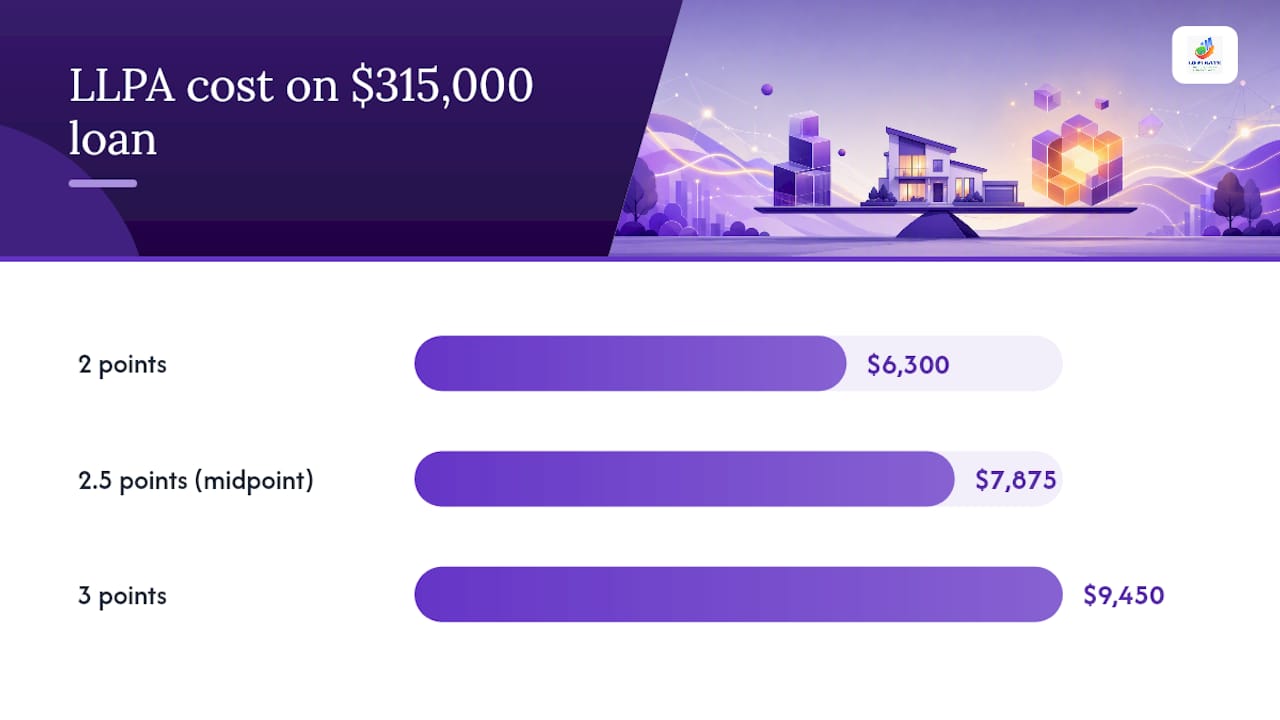
Under Fannie Mae's published grid, that combination typically lands in a mid-to-high LLPA tier, often adding somewhere in the range of 2 to 3 points in cumulative pricing adjustments once credit score and LTV fees stack together. On a $315,000 loan, that can translate into several thousand dollars added to closing costs, or an interest rate bump of roughly a quarter to half a percentage point if the lender rolls the fee into the rate instead.
That combination sits near the bottom of the pricing grid, often carrying minimal or even zero LLPA charges depending on loan purpose and occupancy.
Here's how those two scenarios typically compare:
The same underlying fee shows up differently depending on lender strategy:
- Rate absorption — the lender folds the LLPA into a slightly higher rate, so the borrower never sees a separate line item.
- Direct pass-through — the fee shows up as points on the loan estimate, visible and itemized.
- Partial lender credit — the lender eats part of the cost to win the deal, especially when competing for a strong borrower.
That variability is exactly why comparing net pricing across multiple lenders matters more than comparing headline rates alone.
Practical Ways to Reduce or Avoid LLPA Costs
You have more control over LLPAs than most borrowers assume, and the fixes range from immediate to gradual.
- Raise your down payment, even by a few percentage points, to jump into a cheaper LTV bucket.
- Pay down revolving debt before applying, since a 20-point credit score bump can shift you into a lower fee tier.
- Reconsider your loan purpose. A rate-and-term refinance often prices better than a cash-out refinance.
- Ask about FHA or VA alternatives if your LLPA exposure is heavy. Comparing FHA against conventional pricing sometimes reveals real savings once LLPAs are factored in.
- Request a written LLPA breakdown from every lender you talk to, so you're comparing net pricing instead of marketing rates.
- Shop through a broker who can pull quotes from multiple wholesale lenders, since pricing on the exact same loan file can vary between lenders based on how they choose to absorb or pass through fees.
Ask your loan officer which single adjustment would move you into a cheaper tier before you assume a full credit repair plan is your only option.*
Do LLPAs Affect More Than Just Your Interest Rate?
The visible number on your loan estimate is only part of the story. LLPAs also shape your loan amount indirectly, since a lender who rolls the fee into your rate instead of charging it upfront changes your amortization schedule for the life of the loan, not just at closing.
Over a 30-year term, even a modest rate bump driven by stacked LLPAs compounds into real money. A quarter-point rate increase on a $315,000 loan adds thousands of dollars in interest paid over three decades, even though it looked like a rounding error on the initial disclosure. That's the part borrowers miss when they focus only on the closing-cost line item.
LLPAs also affect your negotiating position. If a lender knows your file carries heavy LLPA exposure, they have less room to offer a competitive lender credit, because they're already absorbing risk-based costs elsewhere. That dynamic can make a borrower with a thin credit file feel like every lender quotes similar numbers, when in reality the LLPA floor is doing most of the work behind the scenes.
There's also a resale and refinance angle worth understanding. If you refinance later once your credit improves or your equity grows, you're not stuck with your original LLPA tier forever. A future refinance recalculates your LLPA exposure fresh, based on your credit and LTV at that time, which is one more reason improving your financial profile pays off twice: once on your current loan, and again if you refinance down the road.
How Do LLPAs Compare to Other Mortgage Pricing Adjustments?
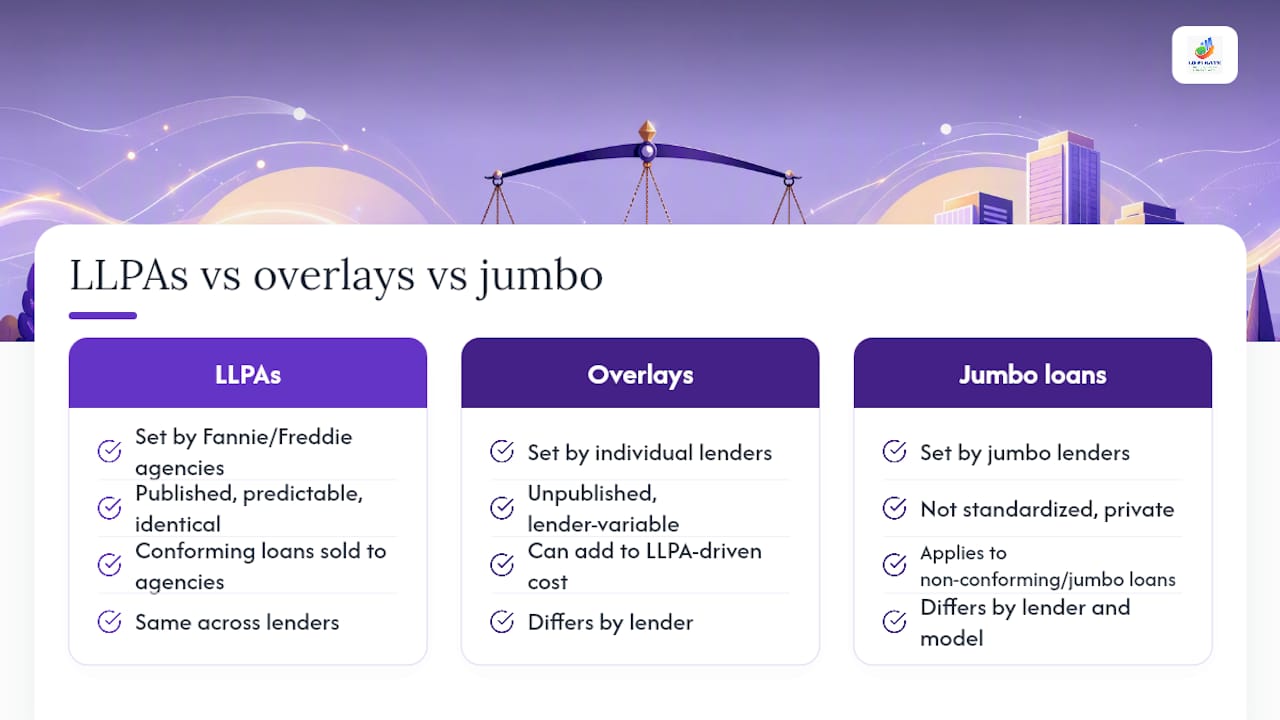
LLPAs aren't the only risk-based charge in mortgage pricing, but they're the most standardized one. Retail banks and portfolio lenders sometimes apply their own internal risk-based pricing, often called overlays, on top of whatever Fannie Mae or Freddie Mac requires. Overlays are lender-specific and not published in any public matrix, which makes them harder to anticipate than LLPAs.
The key difference comes down to transparency. LLPAs are published, predictable, and identical across every lender delivering loans to Fannie Mae or Freddie Mac. An overlay might add extra scrutiny or extra cost for the exact same borrower profile depending entirely on which lender you approach, since one bank might have a stricter internal policy on investment properties while another doesn't.
Jumbo loans complicate the comparison further. Because jumbo loans don't get sold to Fannie Mae or Freddie Mac, they aren't subject to LLPAs at all. Instead, jumbo lenders build their own risk-based pricing models, often influenced by the same underlying factors, credit score, LTV, occupancy, but without any standardized public reference point.
This is exactly why shopping matters more with mortgage pricing than with almost any other financial product. Two lenders can look at the identical LLPA-driven cost on a conventional loan and price their overlay completely differently, which means the same borrower with the same credit score can get meaningfully different quotes depending purely on which lender's internal risk appetite matches their profile. Comparing quotes from multiple sources isn't just useful advice. It's the only way to actually see how much of your quoted rate comes from the standardized LLPA grid versus a lender's own added-on caution.
How Have LLPAs Evolved Since They Were Introduced?
LLPAs have existed in some form since the aftermath of the 2008 housing crisis, when Fannie Mae and Freddie Mac needed a systematic way to price risk after years of underpricing it. The early versions were simpler: a handful of credit score tiers, a handful of LTV bands, and far fewer combinations than exist today.
Over the years, the grid grew more granular as regulators pushed for pricing that reflected actual default risk more precisely. More attributes got added, occupancy, property type, unit count, until the matrix became the multi-page document it is now. The 2023 overhaul marked the biggest structural shift in years, not just adjusting numbers within the existing framework but rethinking which attributes deserved the most weight.
That redesign drew unusual public attention for a pricing mechanic that normally stays buried in underwriting departments. News coverage framed it as a shift that could raise costs for some higher-credit borrowers to subsidize lower costs for others, a characterization that oversimplified the actual mechanics but revealed how directly LLPA policy connects to housing affordability debates.
The practical lesson for today's borrowers is that this pricing grid isn't static. It reflects current housing policy priorities, and it will likely shift again as regulators respond to market conditions, delinquency data, and political pressure over affordability. Treating today's matrix as permanent is a mistake. Borrowers who assume "that's just how it works" often miss savings that show up the next time the grid gets revised.
What We See Borrowers Get Wrong About LLPAs
Most borrowers fixate on the headline rate a lender quotes and never ask how much of that number comes from stacked LLPAs versus the lender's own margin. That's backwards. The rate is the output. The LLPA math is the input worth understanding.
Shopping through multiple wholesale channels tends to surface real differences, since lenders absorb or pass through these fees in different ways depending on their own pricing strategy. Before locking anything, ask for the specific matrix reference behind your quote.
Get a Broker to Shop Your LLPA Exposure for You
You've seen how much a single credit tier or LTV bucket can swing your closing costs. The problem is, you can't see how a specific lender chooses to absorb or pass through that fee until you actually get a quote, and calling five different lenders yourself eats hours you don't have.

Lofirate connects you directly with licensed wholesale mortgage brokers who already have access to pricing across dozens of lenders, instead of the single set of numbers a retail bank hands you. Because wholesale brokers shop your file across multiple channels, they can often surface a lender whose risk appetite matches your profile better, the kind of net pricing difference that never shows up if you only get one quote. Whether you're buying with a thin credit file or refinancing an investment property loaded with LLPAs, a broker match through Lofirate's services costs you nothing to explore. Browse current loan options and request a no-obligation consultation to see what your actual net pricing looks like once someone is shopping it on your behalf.
Frequently Asked Questions
What is an LLPA on a mortgage? An LLPA, or loan level price adjustment, is a risk-based fee that Fannie Mae and Freddie Mac apply to conventional mortgages based on factors like your credit score, down payment, and occupancy type.
Do FHA and VA loans have LLPAs? No. FHA, VA, USDA, and HUD Section 184 loans are excluded from LLPAs entirely, since those programs use their own separate risk pricing and insurance structures.
Can I avoid LLPAs by improving my credit score? Raising your credit score into a higher tier, even by 20 or 30 points, can move you into a cheaper LLPA bucket and lower your fee, sometimes significantly if it crosses a major threshold like 680 or 740.
Are LLPAs the same as discount points? No. LLPAs are mandatory, risk-based charges built into conventional loan pricing, while discount points are optional payments you choose to make in exchange for a lower interest rate.
How do I know if I qualify for an LLPA waiver? Programs like HomeReady and certain area median income based credits can waive or reduce LLPAs for qualifying borrowers. Ask your loan officer to check your file against the current Fannie Mae matrix to confirm eligibility.
This article is general information, not a substitute for advice from a qualified financial advisor. Consult a qualified financial professional about your own circumstances before acting on anything here.
Sources
- Understanding Loan-Level Price Adjustment (LLPA) for Mortgages
- Lender Letter LL-2023-01 – New Loan-level Price Adjustment Framework
- Loan-Level Pricing Adjustments (LLPA): A Complete Guide
- Loan-Level Price Adjustment | Government and Regulatory | Mortgage Terms Lexicon