

Mortgage rates confuse many homebuyers because there is no single rate that applies to everyone. Your neighbor might lock in 5.5% while you are quoted 6.2% for the same loan type. Rates vary widely based on your credit profile, loan details, and market conditions. Understanding what drives these differences empowers you to shop smarter and potentially save thousands over your loan term. This guide explains mortgage rates, the factors that influence them, and how wholesale brokers help you access better deals in 2026.
Table of Contents
- What Is A Mortgage Rate And What Influences It?
- How Loan-Level Pricing Adjustments (LLPAs) Affect Your Mortgage Rate
- Wholesale Lenders And How They Offer More Competitive Mortgage Rates
- Current Mortgage Rate Outlook And How Market Trends Impact Rates In 2026
- Find Your Best Mortgage Rates With LO FI RATE
- Frequently Asked Questions
Key takeaways
| Point | Details |
|---|---|
| Rates depend on borrower profile | Credit score, loan term, debt-to-income ratio, and property type all influence your mortgage rate. |
| Wholesale lenders offer lower rates | By cutting overhead, wholesale lenders often provide rates 0.125% to 0.50% below retail options. |
| Loan-Level Pricing Adjustments matter | LLPAs are risk-based fees that adjust conventional mortgage rates based on credit score and loan-to-value ratio. |
| Comparison shopping saves money | Getting multiple quotes can reduce your rate and save thousands in interest over your loan term. |
| 2026 rates remain elevated | Forecasts project 30-year fixed rates around 5.9% to 6.11%, with VA loans offering the lowest options near 5.50%. |
What is a mortgage rate and what influences it?
A mortgage rate is the interest charged on your home loan, expressed as an annual percentage. It determines your monthly payment and total interest cost over the life of the loan. Many borrowers assume rates are universal, but lenders customize pricing based on risk factors tied to your financial profile and loan structure.
Mortgage rates are influenced by various factors, including your credit score, loan term, debt-to-income ratio, and property type. A higher credit score signals lower risk, so lenders reward you with better rates. Shorter loan terms, like 15-year mortgages, typically carry lower rates than 30-year options because lenders collect their principal faster and face less interest rate risk.
Your debt-to-income ratio measures monthly debt payments against gross income. A lower ratio shows you can comfortably afford the mortgage, which reduces lender risk and improves your rate. Property type also matters: primary residences usually get the best rates, while investment properties and second homes face higher pricing due to increased default risk.
Fixed-rate mortgages lock your rate for the entire term, providing payment stability. Adjustable-rate mortgages (ARMs) start with a lower introductory rate that adjusts periodically based on market indexes. ARMs can save money initially but carry the risk of rising payments if rates climb.
Refinance rates are often similar to mortgage rates, but some lenders may charge more under certain circumstances. When refinance demand surges, lenders sometimes raise rates to manage volume and protect capacity. Understanding these dynamics helps you time your refinance strategically.
Pro Tip: Check your credit report before applying for a mortgage. Correcting errors or paying down small balances can boost your score and unlock better rates, potentially saving you thousands over your loan term.
"Your mortgage rate is not a one-size-fits-all number. It reflects your unique financial snapshot and the lender's risk assessment."
Key factors that shape your mortgage rate include:
- Credit score: Higher scores unlock lower rates, with the best pricing typically reserved for scores above 740.
- Loan-to-value ratio: Larger down payments reduce lender risk and improve your rate.
- Loan term: Shorter terms like 15 years usually offer lower rates than 30-year mortgages.
- Property type: Primary residences get better rates than investment properties or vacation homes.
- Debt-to-income ratio: Lower ratios signal financial stability and reduce your rate.
Understanding mortgage rate transparency helps you compare offers accurately and avoid hidden fees that inflate your effective rate.
How loan-level pricing adjustments (LLPAs) affect your mortgage rate
Loan-Level Pricing Adjustments (LLPAs) are risk-based fees on conventional mortgages, mandated by Fannie Mae and Freddie Mac, adjusting interest rates based on factors like credit score, down payment, occupancy, and other borrower characteristics. These adjustments fine-tune your rate to reflect the specific risk your loan presents to the lender.
LLPAs apply only to conventional loans backed by Fannie Mae and Freddie Mac. LLPAs do not apply to FHA, VA, or USDA loans, which have their own fee structures like upfront mortgage insurance premiums. If you are pursuing a conventional loan, understanding LLPAs is essential to predicting your final rate.
Your credit score and loan-to-value ratio are the primary LLPA drivers. A borrower with a 680 credit score and 10% down payment faces higher LLPAs than someone with a 760 score and 20% down. Each LLPA increment of 1.00% typically raises your mortgage rate by roughly 0.25%, though lenders may structure this as upfront fees instead.
Primary residences usually avoid the steepest LLPAs, while second homes and investment properties face additional charges. Occupancy type signals risk: borrowers are more likely to prioritize payments on their primary home during financial stress, so lenders price accordingly.
LLPA impact examples:
| Credit Score | Loan-to-Value | LLPA (%) | Rate Impact (approx.) |
|---|---|---|---|
| 760+ | 80% | 0.25% | +0.0625% |
| 700 | 85% | 1.50% | +0.375% |
| 680 | 90% | 2.75% | +0.6875% |
| 640 | 95% | 3.50% | +0.875% |
Understanding LLPAs helps you negotiate and plan better mortgage terms. If your credit score is borderline, improving it by even 20 points before applying can reduce your LLPA and save significant money. Similarly, increasing your down payment from 5% to 10% or 15% can lower your loan-to-value ratio and reduce LLPA charges.
Pro Tip: Ask your lender for a detailed LLPA breakdown. Some lenders absorb part of the adjustment to stay competitive, so comparing offers reveals who is passing the full cost to you versus offering pricing relief.
Key LLPA considerations:
- LLPAs increase your rate or upfront costs based on risk factors like credit score and down payment size.
- Conventional loans face LLPAs, but FHA, VA, and USDA loans use different fee structures.
- Improving your credit score or increasing your down payment can reduce LLPA charges significantly.
- Primary residences receive more favorable LLPA treatment than second homes or investment properties.
Navigating mortgage qualification steps with LLPA awareness ensures you optimize your financial profile before locking a rate.
Wholesale lenders and how they offer more competitive mortgage rates
Wholesale lenders operate with lower overhead than retail banks, enabling them to offer more competitive mortgage rates. Retail lenders maintain branch networks, advertise heavily, and employ large sales teams. Wholesale lenders skip these expenses by working exclusively through mortgage brokers, passing savings to borrowers in the form of lower rates.

Wholesale lenders often offer interest rates 0.125% to 0.50% lower than traditional mortgages. That difference might seem small, but over a 30-year loan, even 0.25% can save you tens of thousands in interest. A $300,000 mortgage at 6.00% costs roughly $347,000 in total interest, while the same loan at 5.75% costs about $328,000, a savings of nearly $19,000.
Mortgage brokers can shop around with multiple lenders to find the best rate and terms. Instead of applying to five different banks individually, you work with one broker who submits your profile to multiple wholesale lenders simultaneously. This competition drives pricing down and gives you leverage to negotiate better terms.
Getting multiple quotes is an effective strategy for cost-conscious borrowers. Wholesale brokers access lender rate sheets daily, so they know which lenders are offering the most competitive pricing for your specific profile. This real-time intelligence helps you lock a rate at the optimal moment.
Wholesale vs. retail mortgage rate comparison:
| Loan Type | Retail Rate (avg.) | Wholesale Rate (avg.) | Potential Savings (30 years) |
|---|---|---|---|
| 30-year fixed | 6.25% | 5.875% | ~$22,000 |
| 15-year fixed | 5.50% | 5.25% | ~$8,500 |
| 5/1 ARM | 5.75% | 5.50% | ~$12,000 |
Pro Tip: Ask your wholesale broker to show you rate sheets from at least three lenders. Transparency builds trust and ensures you are getting a genuinely competitive offer, not just the lender paying the broker the highest commission.
"Wholesale brokers level the playing field. You get access to institutional pricing that big banks reserve for their best customers, without needing millions in assets."
Benefits of working with wholesale brokers:
- Access to multiple lenders through a single application, saving time and effort.
- Lower rates due to reduced lender overhead and competitive bidding.
- Expert guidance on loan programs, rate locks, and timing strategies.
- Potential to negotiate lender credits or reduced closing costs alongside rate.
Exploring shopping lenders with wholesale brokers reveals how this approach simplifies the process while maximizing savings. Understanding competitive mortgage rates helps you recognize a good deal when you see one.
Current mortgage rate outlook and how market trends impact rates in 2026
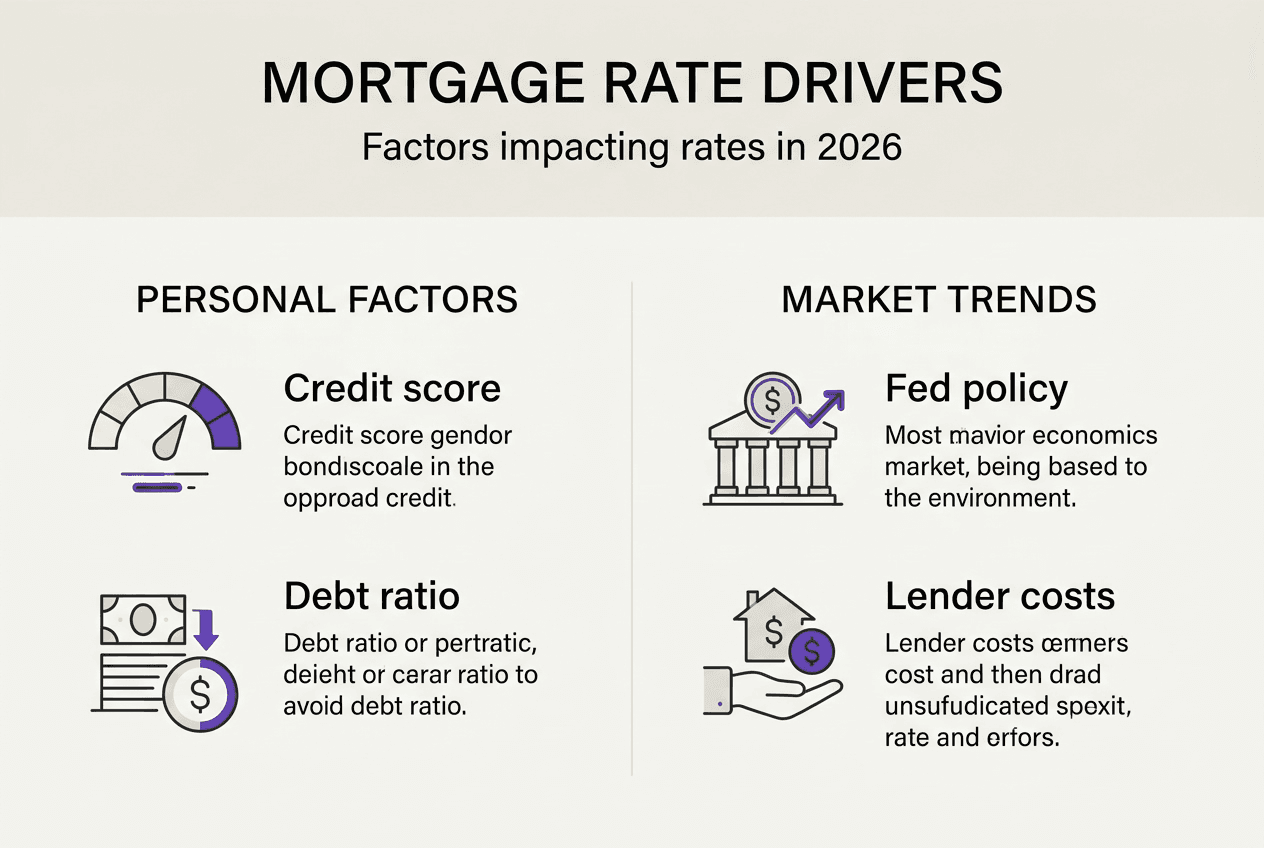
Fannie Mae's February 2026 forecast projects 30-year rates ending 2026 at approximately 5.9%. This reflects expectations that the Federal Reserve will hold rates steady or cut modestly, but inflation concerns and strong economic data keep upward pressure on long-term yields.
VA loans are running the lowest rates available to qualifying borrowers, around 5.50% for a 30-year fixed purchase, per Veterans United data from March 2026. VA loans eliminate mortgage insurance and offer flexible credit standards, making them an exceptional value for eligible service members and veterans.
Freddie Mac's Primary Mortgage Market Survey put the 30-year fixed rate at 6.11% as of March 12, 2026, but your actual rate could be 0.25% to 1.0% higher or lower depending on your profile. Published averages reflect a mix of borrower types, so your personalized quote will vary based on credit score, down payment, and loan characteristics.
The Federal Reserve held the federal funds rate at 3.50% to 3.75% at its January 2026 meeting, and markets now price in only one additional 0.25% cut in 2026. While the Fed does not set mortgage rates directly, its policy influences the broader interest rate environment. When the Fed holds or raises rates to combat inflation, mortgage rates tend to stay elevated or climb.
2026 mortgage rate snapshot:
| Loan Type | Typical Rate (March 2026) | Best Available Rate | Rate Range |
|---|---|---|---|
| 30-year fixed | 6.11% | 5.50% (VA) | 5.50% to 6.75% |
| 15-year fixed | 5.25% | 4.875% | 4.875% to 5.75% |
| 5/1 ARM | 5.50% | 5.00% | 5.00% to 6.25% |
| FHA 30-year | 5.875% | 5.625% | 5.625% to 6.50% |
Refinance rates fluctuate due to market demand and lender capacity. When refinance applications surge, lenders sometimes raise rates to slow volume and maintain service quality. Conversely, during slower periods, lenders may lower rates to attract business. Monitoring these cycles helps you time your refinance for maximum savings.
Individual mortgage rates vary widely based on borrower profile. Two applicants with different credit scores, down payments, and debt levels can receive quotes that differ by a full percentage point or more, even from the same lender on the same day. This variability underscores the importance of comparison shopping.
Key market influences on 2026 mortgage rates:
- Federal Reserve policy: Holding rates steady keeps borrowing costs elevated across the economy.
- Inflation trends: Persistent inflation pressures long-term yields, which drive mortgage pricing.
- Economic growth: Strong GDP growth can push rates higher as investors demand better returns.
- Geopolitical events: Uncertainty drives investors to safe assets like bonds, which can lower mortgage rates temporarily.
Staying informed about mortgage rate trends 2026 helps you anticipate changes and lock rates strategically. Understanding how market trends affect mortgage rates gives you context for daily rate movements. Recognizing why comparing lending options saves thousands motivates you to shop aggressively rather than accepting the first offer.
Find your best mortgage rates with LO FI RATE
You now understand what drives mortgage rates and how wholesale lenders deliver better pricing. The next step is putting that knowledge to work. LO FI RATE connects you with licensed wholesale mortgage brokers who shop multiple lenders to find competitive rates tailored to your financial profile.

Whether you are purchasing your first home or refinancing to lower your payment, working with expert brokers through LO FI RATE can save you thousands over your loan term. You get transparent quotes, personalized guidance, and access to wholesale pricing that retail banks do not offer. Explore loan options designed for your needs, or visit LO FI RATE to request a no-obligation consultation. Start shopping mortgage lenders with wholesale brokers today and discover how much you can save.
Frequently asked questions
What is a mortgage rate?
A mortgage rate is the annual interest percentage charged on your home loan. It determines your monthly payment and total interest cost over the loan term, varying based on your credit profile, loan type, and market conditions.
What is the difference between fixed and adjustable mortgage rates?
Fixed-rate mortgages lock your interest rate for the entire loan term, providing stable payments. Adjustable-rate mortgages (ARMs) start with a lower introductory rate that adjusts periodically based on market indexes, offering initial savings but potential payment increases later.
Why do mortgage rates vary so much between borrowers?
Rates vary because lenders customize pricing based on risk factors like credit score, down payment size, debt-to-income ratio, and property type. Borrowers with stronger financial profiles receive lower rates, while higher-risk profiles face higher pricing.
How can I find the best current mortgage rates?
Compare quotes from multiple lenders, including wholesale brokers who access competitive institutional pricing. Check your credit score, increase your down payment if possible, and monitor market trends to lock rates when conditions favor borrowers.
Do wholesale mortgage brokers really offer better rates than banks?
Yes, wholesale brokers often secure rates 0.125% to 0.50% lower than retail banks by accessing lenders with lower overhead and shopping multiple options simultaneously. This competition drives pricing down and gives you leverage to negotiate better terms.
How do Loan-Level Pricing Adjustments affect my mortgage rate?
LLPAs are risk-based fees on conventional loans that adjust your rate based on credit score, loan-to-value ratio, and property type. Each 1.00% LLPA typically raises your rate by roughly 0.25%, so improving your credit or increasing your down payment can reduce these charges significantly.