

TL;DR:
- No-obligation mortgage quotes are informal, risk-free estimates based on self-reported data.
- Comparing multiple quotes, especially with written documentation, helps negotiate better mortgage terms.
- These quotes serve as screening tools; final rates may differ due to market changes and verified information.
Many homebuyers assume that asking for a mortgage quote is the first step toward a binding commitment. It isn't. A no-obligation mortgage quote is a risk-free estimate that gives you real numbers to compare before you ever sign anything or let a lender run your credit. Yet most buyers skip this step entirely, walking straight into a bank and accepting the first offer they receive. That single mistake can cost thousands of dollars over the life of a loan. This guide explains exactly what a no-obligation quote is, how the process works, and how to use multiple quotes to negotiate from a position of strength.
Table of Contents
- Defining a no-obligation mortgage quote
- How no-obligation quotes work and what to expect
- Comparing lenders: why multiple quotes matter
- Common pitfalls and expert tips
- Our take: what most guides miss about no-obligation mortgage quotes
- Ready to shop for your best mortgage quote?
- Frequently asked questions
Key Takeaways
| Point | Details |
|---|---|
| No obligation, no risk | A no-obligation mortgage quote lets you explore loan options without commitment or credit impact. |
| Shop multiple lenders | Collect quotes from 3-5 lenders for the best rates and terms. |
| Focus on total costs | Compare APR, fees, and closing costs, not just the interest rate itself. |
| Get written quotes | Request written details to avoid confusion and ensure transparency. |
Defining a no-obligation mortgage quote
A no-obligation mortgage quote is not a contract, a pre-approval, or a Loan Estimate. Think of it as a snapshot: a preliminary picture of what your mortgage might look like based on the basic information you provide. According to industry resources, a mortgage quote is informal, pre-application, and carries no commitment from you or the lender.
Because this quote is informal, lenders build it from self-reported data. You tell them your estimated credit score range, your income, the loan amount you need, and the property type. They plug those numbers into their pricing engine and hand you a set of preliminary figures. No social security number is required for a true no-obligation quote, which means no hard credit inquiry and no impact to your score.
Here is what a typical no-obligation mortgage quote includes:
- Estimated interest rate (the base rate before other costs are factored in)
- Annual percentage rate (APR) (the broader cost including lender fees, expressed as a yearly rate)
- Estimated monthly payment (principal and interest)
- Origination fees or points (upfront charges the lender collects)
- Estimated closing costs (third-party fees, title charges, taxes)
Closing costs deserve special attention. They typically equal 2 to 5% of the loan amount, which means on a $400,000 loan you could be looking at $8,000 to $20,000 in upfront costs. A quote that buries these numbers is hiding something important.
Understanding how this document sits within the broader timeline also matters. Compare the major documents side by side:
| Document | When you receive it | Credit check required | Binding? |
|---|---|---|---|
| No-obligation quote | Before application | No | No |
| Mortgage pre-approval | After initial application | Yes (hard pull) | No |
| Loan Estimate | Within 3 days of application | Yes | Partially |
| Closing Disclosure | 3 days before closing | Yes | Yes |
The Loan Estimate is the official document lenders are legally required to provide once you formally apply. It locks in certain fees and gives you a clear, standardized comparison format. The no-obligation quote, by contrast, is a shopping tool. Use it to screen lenders before you ever reach the application stage. Understanding mortgage qualification steps early in the process helps you see where the quote fits within your overall home-buying timeline.
How no-obligation quotes work and what to expect
With a clear definition in hand, let's walk through how these quotes actually work and what you need to know before requesting one.
The process is simpler than most buyers expect. Here are the steps involved:
- Gather your basic information. Know your approximate credit score range, gross monthly income, the loan amount you want, and the property type (single family, condo, multi-unit).
- Contact the lender or broker. You can do this online, by phone, or through a mortgage connection platform. You do not need to fill out a formal loan application.
- Provide your self-reported data. The lender or broker inputs your figures into their pricing system.
- Receive preliminary numbers. Within minutes to a few hours, you get estimated rates, payments, and costs.
- Compare and follow up. Review each quote side by side, ask questions, and request clarification on any fees that seem unclear.
Because quotes are based on self-reported info, accuracy depends on you. If you overestimate your credit score or underreport your debts, the quote you receive will look better than what you actually qualify for. Be honest, even in this informal stage. A quote built on inflated numbers wastes everyone's time.
One edge case worth understanding: "no-cost" mortgage options. A no-cost quote strips out origination fees and some closing costs to make comparison easier. But those costs don't disappear. They get folded into a higher interest rate. In practice, no-cost quotes raise your rate by roughly 0.125 to 0.375 percentage points. That tradeoff can make sense if you plan to sell or refinance within a few years, but it costs more over a full 30-year loan term. Know what you are comparing before you call one option "better."
"Mortgage quotes used for shopping lenders allow borrowers to compare options without credit impact or fees, but the final terms depend on verified data and official documentation."
Quotes can also shift if market conditions change between the time you request one and the time you apply. Mortgage rates move daily, sometimes dramatically. A quote you receive today reflects today's pricing. Next week's pricing may look different.
Pro Tip: Always ask for written quotes. A verbal estimate over the phone has no accountability attached to it. Lenders who resist putting numbers in writing are giving you important information about how they operate.
Keeping an eye on how your credit score impacts your rate options also gives you a realistic baseline before you start collecting quotes.
Comparing lenders: why multiple quotes matter
Knowing how quotes are generated sets you up to use them effectively. Here's how to shop smart and make the most of your options.

The math behind shopping for quotes is compelling. A single percentage point difference on a $350,000 mortgage costs or saves roughly $60,000 to $70,000 over 30 years in total interest. Even a quarter-point difference is worth thousands. Getting multiple quotes is the lowest-effort, highest-impact action you can take before applying for a mortgage.
Wholesale brokers access better rates than many retail banks offer, because they source pricing from multiple wholesale lenders instead of selling a single product. That means one broker can effectively give you access to what would otherwise require contacting a dozen different lenders. The no-obligation quote stage is where that advantage is most visible.
When comparing quotes, keep these principles in mind:
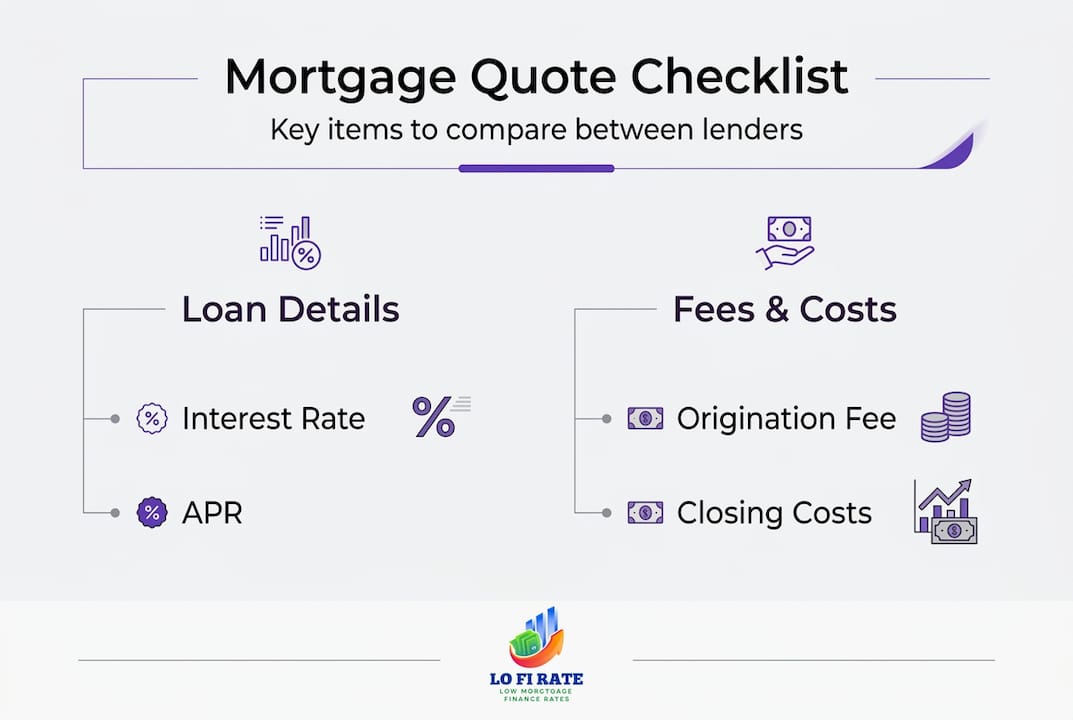
- Focus on APR, not just the interest rate. The interest rate shows the cost of borrowing. The APR adds fees and reflects the true annual cost of the loan. A lower rate with high fees can be more expensive than a slightly higher rate with fewer fees.
- Request the "no-cost" version first. Always request the no-cost version to get an apples-to-apples rate comparison across lenders. Once you identify the best rate, you can then decide whether paying points makes sense for your situation.
- Shop within a tight window. Compare 3 to 5 lenders, and if you move to formal applications, do it within a 14 to 45 day window so credit bureaus count all inquiries as a single event.
- Watch for unusual fees. Origination fees, underwriting fees, and processing charges vary widely. Ask each lender to list every fee separately.
Here's a quick comparison of what retail lenders versus wholesale brokers typically look like at the quote stage:
| Feature | Retail bank/lender | Wholesale mortgage broker |
|---|---|---|
| Number of products offered | One (their own) | Many (multiple lenders) |
| Rate transparency | Limited | Higher |
| Fee flexibility | Low | More negotiable |
| No-obligation quotes | Yes | Yes |
| Access to wholesale pricing | No | Yes |
Using a mortgage shopping checklist helps you track what each lender quotes and ensures you're capturing the same data points from every source. When comparing lenders, most buyers underestimate how much the non-rate terms matter. Fees, rate lock periods, and turnaround times all affect your final outcome.
Pro Tip: Build a simple spreadsheet with columns for lender name, interest rate, APR, origination fee, total closing costs, and estimated monthly payment. Side-by-side visibility changes the conversation immediately. Resources on comparing mortgage rates and choosing the right lender can sharpen your approach before you start collecting numbers.
Common pitfalls and expert tips
Even with the right quotes in hand, it's easy to trip up. Here are the pitfalls to watch for and how to avoid them.
The biggest mistake buyers make is treating an informal quote as if it were a final offer. It isn't. Use it as a screening tool, not a contract. The gap between a no-obligation quote and the official Loan Estimate can be meaningful, especially if any of your self-reported data changes during verification.
Here are the most common traps:
- Accepting verbal quotes. A lender can quote you 6.25% on the phone and then send documents showing 6.75% without any paper trail to challenge them on. Get everything in writing.
- Focusing only on the monthly payment. A lower payment could mean a longer loan term or higher fees rolled in. Always look at total cost over the life of the loan.
- Ignoring the APR. Some lenders advertise an attractive rate but load the loan with origination points and fees. The APR exposes that pattern.
- Not verifying fees at the Loan Estimate stage. Certain fees on a Loan Estimate cannot change at closing, but others can. Know which category each fee falls into.
- Skipping the broker option. Many buyers contact two retail banks, accept a quote, and stop shopping. Adding even one wholesale broker to your comparison can reveal pricing you didn't know was available.
"Mortgage quotes are screening tools, not final offers. Without verifying them against an official Loan Estimate, buyers risk bait-and-switch situations where costs inflate between quote and closing."
Quotes as screening tools carry real pitfalls if you don't stay vigilant. Knowing the right questions to ask mortgage brokers before you start the process helps you cut through vague answers and get the specific numbers that matter.
Pro Tip: Ask each lender to break down all fees in writing, line by line. If they can't or won't do that at the quote stage, that tells you something important about how the formal process will go.
Our take: what most guides miss about no-obligation mortgage quotes
Most articles on this topic explain what a no-obligation quote is and move on. What they underplay is how much can change between the quote you receive and the Loan Estimate you sign.
Rates shift. Lenders discover that your credit score is 20 points lower than you estimated. The appraisal comes in under the purchase price. Any of these events can alter the numbers significantly. Buyers who treat a quote as near-final are often blindsided. Buyers who treat it as one data point in an ongoing negotiation stay in control.
The real value of no-obligation quotes isn't the quotes themselves. It's the leverage they create. If you have three written quotes showing competitive rates, you can walk into any lender's office and say, "This is what I'm seeing in the market. Can you match it or beat it?" That conversation changes the outcome more often than most buyers realize.
Wholesale brokers are often the overlooked piece of this puzzle. They can show you comparing mortgage rates across multiple lenders in a single conversation, which saves you both time and multiple soft inquiries. But the advantage only shows up when you ask the right questions and stay detail-oriented through the entire process.
The uncomfortable truth is that most buyers put enormous energy into choosing the right house and almost none into comparing their financing options. A 0.5% difference in your mortgage rate matters more to your long-term finances than the granite countertops. The no-obligation quote stage is where you earn that difference.
Ready to shop for your best mortgage quote?
Now that you're prepared to shop like a pro, here's how to take the next step toward your best mortgage deal.
LoFiRate.com connects you with licensed wholesale mortgage brokers in your state who can shop multiple lenders on your behalf. You get competitive rate options without the pressure of a hard sell or a binding commitment.

Start by exploring your loan options to understand what programs apply to your situation. Then compare mortgage quotes through our network of licensed brokers and see what wholesale pricing looks like for your loan. For a full picture of what's available to you, visit LoFiRate.com and request a no-obligation consultation today. Wholesale access often reveals rates that retail bank customers never see.
Frequently asked questions
Does requesting a no-obligation mortgage quote affect my credit score?
No. As long as the lender doesn't perform a hard credit inquiry, your score is unaffected. Quotes based on self-reported info allow you to shop lenders without any credit impact.
How accurate are the numbers in a no-obligation mortgage quote?
They're estimates, not guarantees. Quotes may be inaccurate if your credit score, income verification, or market rates change before you formally apply.
Can I negotiate rates based on a no-obligation mortgage quote?
Yes. Use your best written quotes as leverage with other lenders. Wholesale brokers access better rates that enable risk-free comparison and create real negotiating power.
What information do I need to get a no-obligation mortgage quote?
You'll typically provide your income, estimated credit score range, desired loan amount, and property type. Quotes are built from self-reported info, so be as accurate as possible.
How many mortgage quotes should I get?
Get at least 3 to 5 quotes before deciding. Comparing 3 to 5 lenders gives you enough data to recognize what competitive pricing looks like and spot outliers on either end.