

TL;DR:
- A loan modification offers a permanent change to your mortgage terms, helping homeowners in financial hardship avoid foreclosure.
- It involves adjusting interest rates, extending loan terms, or deferring payments, differing from refinancing which replaces your loan.
When your income drops unexpectedly or medical bills pile up, keeping up with mortgage payments can feel impossible. A loan modification gives you a real path to stay in your home by changing the actual terms of your existing mortgage, not by starting over with a new loan. This guide walks you through exactly what loan modification is, what you need to apply, which programs exist, and how to avoid the mistakes that trip up most homeowners. You'll also learn when modification might not be the right call, and what options exist if you qualify for something better.
Table of Contents
- Understanding loan modification basics
- What you need before starting a loan modification
- Types of loan modifications and how they work
- Applying and avoiding common mistakes
- What to expect next and evaluating your results
- Why loan modification isn't always the best solution
- Get personalized help navigating loan modification
- Frequently asked questions
Key Takeaways
| Point | Details |
|---|---|
| Modification lowers payment | Loan modification changes loan terms for more affordable monthly payments. |
| Preparation is key | Gather complete documents before applying to avoid delays and denials. |
| Options differ by loan | FHA, Fannie Mae, and Freddie Mac offer unique modification programs and eligibility. |
| Brokers guide your choice | Wholesale mortgage brokers help you compare loan modification to refinancing for the best outcome. |
| Long-term fit matters | Evaluate costs and savings over time to ensure modification fits your financial goals. |
Understanding loan modification basics
A loan modification is exactly what it sounds like: a permanent change to your original mortgage agreement. According to the Consumer Financial Protection Bureau, loan modification is a permanent change to mortgage terms designed to make payments more affordable for homeowners facing financial hardship. Changes can include lowering your interest rate, extending your loan term up to 40 years, adding overdue amounts back into your loan balance (called capitalization of arrears), or temporarily pausing part of your payments through principal forbearance.
One thing many homeowners confuse is the difference between a modification and a refinance. A refinance replaces your loan with a completely new one, usually at a better rate when your credit is strong. A modification adjusts the loan you already have, typically because you're in financial distress and wouldn't qualify for a new loan. Understanding mortgage terminology explained can help you keep these concepts clear before you call your servicer.
Common reasons homeowners seek modification:
- Sudden job loss or reduction in hours
- Divorce or loss of a co-borrower's income
- Major medical expenses reducing take-home pay
- Death of a spouse or household earner
- Natural disaster damage affecting income or living situation
Here's a quick look at how the main types of modification compare:
| Modification type | What changes | Best for |
|---|---|---|
| Interest rate reduction | Lowers monthly interest cost | High-rate loans with hardship |
| Term extension | Spreads balance over more years | Temporarily tight budgets |
| Principal forbearance | Defers part of balance to loan end | Large payment gaps |
| Capitalization of arrears | Rolls missed payments into balance | Short-term delinquency |
| Payment supplement | Temporary monthly reduction | FHA loans in transition |
Pro Tip: Before you call your servicer, gather your last two pay stubs, your most recent bank statements, and a written summary of your hardship. Servicers respond faster when your documents are ready to go on the first call.
What you need before starting a loan modification
Preparation is where most homeowners either succeed or stall. Your servicer will ask for a specific set of documents, and submitting anything incomplete or outdated puts your application at the bottom of the pile. The CFPB strongly recommends that homeowners contact servicers early and work with a HUD-approved housing counselor if they get stuck, while making complete documentation a top priority to avoid denial or delays.
Here's your document checklist, in order of priority:
- Hardship letter describing what happened, when it happened, and why it affects your ability to pay
- Proof of current income, including recent pay stubs, self-employment records, or benefit award letters
- Last two years of federal tax returns
- Two to three months of bank statements for all accounts
- Recent mortgage statements showing your current balance and payment history
- Proof of other monthly obligations such as car loans, student loans, or child support
- Any insurance or property tax documents if those are paid outside your escrow
Different loan programs have slightly different requirements. Here's how the major ones compare:
| Loan type | Key eligibility criteria | Notable requirement |
|---|---|---|
| FHA | Owner-occupied, financial hardship proven | Must follow HUD waterfall process |
| Fannie Mae | Current or recently delinquent, hardship shown | Income verification forms required |
| Freddie Mac | Documented hardship, occupancy verified | Signed borrower response packet |
| Conventional (other) | Varies by servicer | Review your mortgage compliance explained rights |
All programs share one core requirement: you must prove both a genuine financial hardship and enough remaining income to handle the modified payment. If your income is near zero, modification may not be the right tool. Check your eligibility carefully using a mortgage qualification guide before applying.

Pro Tip: Use a physical checklist, not just a mental one. Servicers routinely deny applications because one document was missing or out of date. Print the list, check each item, and keep copies of everything you submit.
You can also get free help organizing your file through a HUD-approved housing counselor (1-800-569-4287). This service costs nothing and can prevent costly mistakes before they happen.
Types of loan modifications and how they work
Not every homeowner qualifies for the same program. The type of modification you can access depends almost entirely on who backs your loan.
FHA loans follow a structured waterfall process. Your servicer must work through options in a specific order: repayment plans first, then forbearance, then partial claims (a subordinate lien that covers your arrears), then a standalone or combination loan modification, and finally a payment supplement that temporarily reduces your payment by 5 to 25 percent for up to three years. Per HUD's loss mitigation guidelines, FHA modifications extend terms to 30 or 40 years at a current market rate, with arrears added to the principal. You can only receive one permanent FHA modification every 24 months, so timing matters.
Fannie Mae and Freddie Mac (Enterprise) loans work differently. Their focus is on principal forbearance and term extension. In the fourth quarter of 2025, the enterprises completed 55,000 foreclosure prevention actions, including roughly 20,000 permanent modifications. Of those modifications, 64 percent involved principal forbearance and 36 percent relied on term extension alone. Since 2008, a total of 2.83 million permanent modifications have been completed under Enterprise programs.
Key differences between FHA and Enterprise modifications:
- FHA uses a payment supplement as a short-term bridge; Enterprise programs do not
- Enterprise modifications more heavily favor principal forbearance as a tool
- FHA requires following the waterfall in order; Enterprise servicers have more flexibility
- Both programs can extend your term to reduce your monthly payment significantly
Why this matters to you:
Extending a 30-year loan by 10 more years lowers your monthly payment, but you'll pay interest for a decade longer. A $250,000 balance at 6 percent extended from year 20 to year 40 could add over $80,000 in total interest. That doesn't mean modification is wrong, but it means you need to understand the full cost before you agree to new terms.
| Loan program | Common modification type | Max term | Payment supplement option |
|---|---|---|---|
| FHA | Combo mod + partial claim | 40 years | Yes, 3 years |
| Fannie Mae | Principal forbearance | 40 years | No |
| Freddie Mac | Term extension | 40 years | No |
Applying and avoiding common mistakes
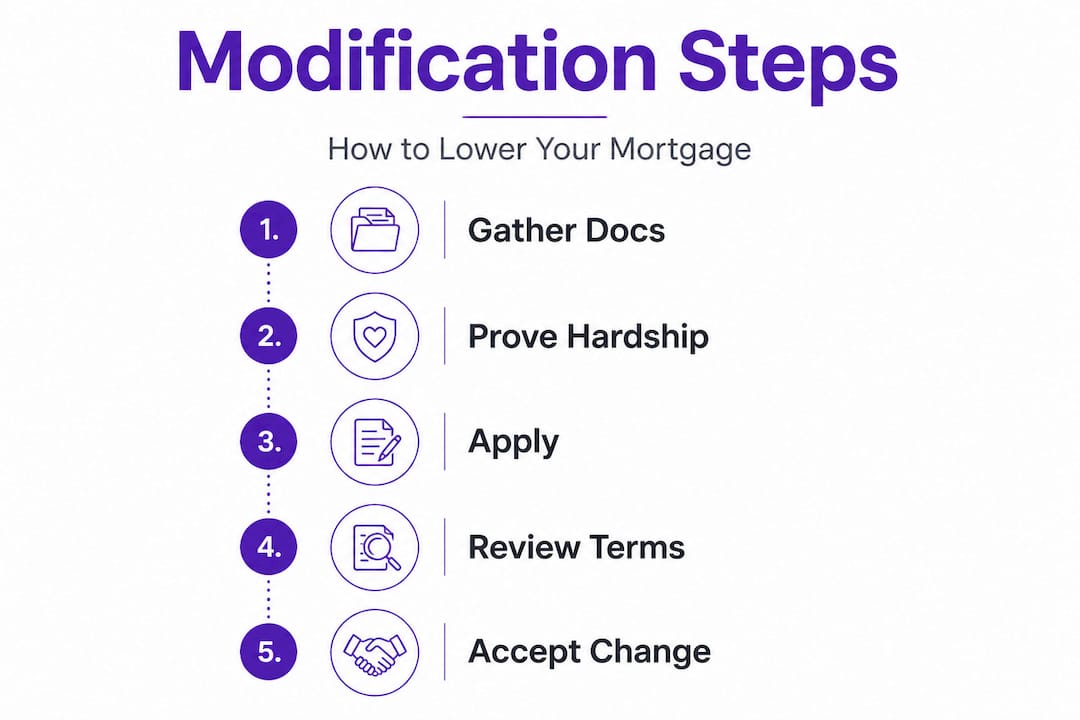
The application process itself is straightforward, but the execution is where homeowners lose momentum. Here's the step-by-step process:
- Contact your servicer directly. Call the number on your mortgage statement and ask for the loss mitigation department specifically.
- Request the modification application packet. Get the full list of required documents in writing, not just verbally.
- Submit your complete application. Use your checklist. Include every required document and make sure dates are current (most servicers want documents no older than 90 days).
- Respond immediately to any follow-up requests. Servicers may ask for updated documents. A slow response resets your timeline.
- Track your submission. Get a reference number and ask for written confirmation that your package was received.
- Follow up every two weeks. Don't wait for them to call you.
"Getting denied for incomplete paperwork is the most common mistake. Double-check every requirement before submitting!"
Most common pitfalls homeowners face:
- Submitting expired bank statements or outdated pay stubs
- Writing a vague hardship letter without specific dates and dollar amounts
- Missing the servicer's callback or response deadline
- Applying without understanding the modification program their loan falls under
A wholesale mortgage broker won't process your modification for you, since that relationship stays between you and your servicer. But a good broker can help you organize your financial picture, explain your options in plain language, and tell you whether refinancing benefits and tradeoffs might serve you better than modification. According to FHFA data, about 38 to 39 percent of foreclosure prevention actions are permanent modifications, which means other solutions account for the majority of cases. A broker helps you understand the full landscape. You can also compare those strategies by reviewing how refinancing compares side by side.
Pro Tip: Get every communication in writing. After any phone call with your servicer, send a follow-up email or letter summarizing what was discussed and agreed upon. This protects you if there's ever a dispute about what was promised.
What to expect next and evaluating your results
Once your application is submitted and confirmed complete, the waiting begins. Most servicers render a decision within 30 to 60 days. Stay reachable during this window and respond to any requests within 24 to 48 hours.
If your modification is approved:
- Read the new loan agreement carefully before signing
- Confirm your new monthly payment fits realistically within your budget
- Ask whether a trial period is required before the modification becomes permanent
- Ask your servicer what happens if your financial situation changes again
- Understand the new total loan cost over the full remaining term
If your modification is denied:
- Request the specific reason in writing
- Ask whether an appeal is possible and what documents would strengthen your case
- Explore other relief options: forbearance agreements, repayment plans, or selling the home
- Contact a HUD housing counselor to review your options objectively
The broader picture is encouraging. Since 2008, the enterprises have completed 2.83 million permanent mods as part of foreclosure prevention, with the current serious delinquency rate holding at just 0.58 percent. Modifications work, but they work best when you understand both their benefits and their long-term cost implications.
End-of-process checklist:
| Action | Status |
|---|---|
| New terms reviewed and understood | Confirm before signing |
| Monthly payment confirmed affordable | Check against current budget |
| Total loan cost calculated | Compare to pre-modification |
| Trial period requirements known | Ask servicer directly |
| Future option rights clarified | Request in writing |
Why loan modification isn't always the best solution
Here's what most articles about loan modification won't tell you directly: modification is a tool, not a solution. It works well in specific situations and poorly in others, and servicers are not required to explain the downsides to you.
The two biggest risks most homeowners overlook are interest-only traps and payment creep. Some modifications lower your initial payment by temporarily reducing the interest you owe, but your balance doesn't shrink. When the reduced-rate period ends, your payment can jump higher than it was before. Payment creep happens when an extended term keeps payments low now but locks you into decades of additional interest that gradually erodes your home equity.
According to FHFA data, modifications can be lifesaving for long-term hardship but may not suit every homeowner, particularly those who face interest-only traps or gradual payment increases. If your credit score is recovering or you plan to stay in your home for many more years, the math may favor refinancing over modification, even if your situation feels urgent right now.
This is exactly where working with a wholesale broker changes the outcome for many homeowners. Retail lenders show you one set of options: their own. A wholesale broker compares offers across multiple lenders and can tell you whether you qualify for a rate-and-term refinance that saves you more over time than any modification could. That second opinion costs nothing and can be the difference between a 40-year modified loan at a higher rate and a 30-year refinanced loan at a rate that fits.
Pro Tip: Before accepting a modification offer, run the numbers on a potential refinance. Calculate total interest paid under the modified terms versus total interest under a new loan at today's rates. The difference often surprises homeowners who assumed modification was their only option.
The honest truth is that modification and refinancing are not competing products. They solve different problems. Modification exists for homeowners in genuine distress who can't qualify for a new loan. Refinancing exists for homeowners who have enough stability to start fresh at a better rate. Knowing which situation you're actually in is the most valuable thing you can determine before you start either process.
Get personalized help navigating loan modification
If you're weighing modification against refinancing, or you're not sure which programs your loan qualifies for, talking to a licensed mortgage professional makes a real difference. LoFiRate connects homeowners with wholesale mortgage brokers who can review your full financial picture and help you compare every available option, not just the one your servicer offers.

At LoFiRate, we don't quote rates or lend money directly. Instead, we match you with licensed brokers in your state who shop multiple lenders to find the most competitive path forward. Whether you're pursuing modification, considering a refinance, or just trying to understand your loan options, our broker matching services are free, no-obligation, and built around your goals. You've already done the hard work of learning how this process works. Now let a broker put that knowledge to work for you.
Frequently asked questions
How does loan modification affect my credit score?
A loan modification may temporarily lower your credit score, but the impact is typically far less severe than foreclosure, bankruptcy, or a pattern of missed payments. Staying current during and after the modification process helps protect your score.
Can I refinance after a loan modification?
Yes, most lenders allow refinancing after a modification once you've made a consistent payment history and met the lender's waiting period, which usually ranges from 12 to 24 months depending on the loan type.
Is there a cost to apply for loan modification?
Most servicers do not charge fees to apply, but you should always confirm directly with your servicer. The CFPB recommends that homeowners contact their servicer early and be cautious of any third party that charges upfront fees to help you apply, since free help is available through HUD-approved counselors.
How long does the loan modification process take?
Once your application is complete and confirmed received, the servicer typically responds within 30 to 60 days. Missing documents or slow responses from the borrower can extend that timeline significantly.
What if my loan modification is denied?
Request the denial reason in writing, correct any errors in your documentation, and ask whether an appeal is available. The CFPB also advises that homeowners who get stuck seek a HUD housing counselor to review alternative relief options, including forbearance, repayment plans, or assisted sale programs.