

TL;DR:
- Most homebuyers are unaware that the wholesale mortgage market offers lower interest rates than traditional retail channels. Working with a licensed broker to access wholesale lenders can significantly reduce long-term borrowing costs through competitive pricing. Comparing multiple offers through wholesale channels enables buyers to save thousands over the life of their loans by avoiding the higher margins of retail lenders.
Most homebuyers walk into a bank, get quoted a rate, and assume that is simply "the going rate." They sign the paperwork, accept the terms, and move on. What they rarely realize is that another mortgage channel, one most banks never mention, could have offered them a meaningfully lower interest rate on that same loan. That channel is the wholesale mortgage market. If you are shopping for a home loan or thinking about refinancing, understanding how wholesale mortgages work could be one of the most financially valuable things you do before closing.
Table of Contents
- Understanding wholesale mortgages: The basics
- Wholesale vs. retail mortgages: Key differences and rate comparisons
- How wholesale mortgage brokers work and how you access better rates
- When a wholesale mortgage makes sense (and when it doesn't)
- The real secret behind wholesale mortgages: What most buyers overlook
- Unlock better mortgage options with professional guidance
- Frequently asked questions
Key Takeaways
| Point | Details |
|---|---|
| Wholesale mortgages explained | Wholesale mortgages are loans sourced by brokers from lenders, often at lower rates. |
| How savings happen | Working with a wholesale broker means access to more competitive and negotiable offers. |
| Key differences from retail loans | Retail lenders sell loans directly, usually with higher costs, while wholesale enables more rate shopping. |
| Deciding what's best | Wholesale loans are ideal for buyers who want choices and the lowest possible rate but may not suit every scenario. |
| Action step | Using a broker to shop wholesale lenders can help you unlock significant savings over your loan’s life. |
Understanding wholesale mortgages: The basics
A wholesale mortgage is a home loan that is not sold directly to you by the lender. Instead, a licensed mortgage broker acts as the go-between, connecting you to a wholesale lender who does not deal with consumers directly. Think of it like buying produce from a farmers' market supplier rather than a grocery store. The supplier sells in bulk, at lower margins, to sellers who then pass the savings on to buyers. Wholesale lenders operate the same way.
Wholesale lenders keep their costs low because they do not maintain retail branch networks, fund marketing campaigns to consumers, or pay teams of loan officers to sit in branches. All of that overhead is removed. That savings in operating cost gets reflected in the rates and pricing they offer to brokers, and ideally, to you. As lower overhead lenders show, wholesale mortgage brokers connect borrowers to lenders with competitive pricing that retail banks simply cannot always match.
Here is how the main parties in a wholesale mortgage transaction break down:
- Borrower: That is you. You apply through a broker, not directly with the lender.
- Mortgage broker: A licensed professional who shops your loan across multiple wholesale lenders to find the best fit.
- Wholesale lender: The institution that funds the loan. They set the rate and terms but work only through brokers, not directly with consumers.
- Servicer: Often a third party that collects your monthly payments after the loan closes, regardless of whether the loan was retail or wholesale.
The important thing to understand here is that wholesale mortgages are not some exotic financial product reserved for real estate investors or wealthy clients. They are available to first-time buyers, move-up buyers, and homeowners looking to refinance. You just need to work with a broker who has access to wholesale lending channels. Understanding the full role of mortgage broker in this process makes it much easier to navigate.
Pro Tip: Before you commit to a broker, verify their credentials through the Nationwide Multistate Licensing System (NMLS) at nmlsconsumeraccess.org. A licensed broker with wholesale access is your gateway to rates that most consumers never see.
Wholesale vs. retail mortgages: Key differences and rate comparisons
With the basics covered, let's see exactly how wholesale mortgages stack up against traditional retail loans on the metrics that matter most.
The most important distinction is how pricing gets built. Retail lenders, like big banks and credit unions, add a profit margin on top of their base rate. That margin funds their branches, advertising, and staff. Wholesale lenders skip all of that. A broker who has access to multiple wholesale lenders can often present you with pricing that is noticeably below what a retail loan officer would quote for the same loan product.

Here is a direct comparison of the two models:
| Feature | Wholesale mortgage | Retail mortgage |
|---|---|---|
| Who funds the loan | Wholesale lender | Bank, credit union, or direct lender |
| Who you work with | Licensed mortgage broker | Bank loan officer |
| Rate structure | Broker shops multiple lenders | Single institution's posted rates |
| Pricing transparency | Multiple quotes available | One quote per institution |
| Loan variety | Access to dozens of lenders | Limited to that institution's products |
| Broker involvement | Required | None |
| Consumer access | Through broker only | Direct to consumer |
The pricing difference between channels matters more than many buyers realize. Research confirms that saving thousands is genuinely possible when borrowers choose wholesale rates over traditional retail mortgages. On a $400,000 loan, even a 0.25% rate difference translates to roughly $60 per month less in payments, or over $21,000 saved across a 30-year term.
"Borrowers who take the time to compare wholesale options versus retail rates often discover significant savings that compound over the life of their loan."
Understanding mortgage origination helps explain why those savings exist. Origination costs are baked into the rates and fees you pay. When those costs are lower on the wholesale side, borrowers benefit.
Advantages of wholesale mortgages:
- Access to competitive, often lower rates
- Ability to compare multiple lenders through one broker
- Broader range of loan products and terms
- Broker advocates on your behalf during underwriting
Advantages of retail mortgages:
- Simpler process if you already have a strong bank relationship
- Some banks offer loyalty discounts or rate perks for existing customers
- Niche loan products (like portfolio loans for unusual properties) may only exist at retail banks
- Familiarity and brand recognition can ease anxiety for some borrowers
Neither option is universally better. But for most borrowers who are focused on getting the lowest possible rate and seeing multiple options before committing, wholesale is hard to beat. Choosing to avoid retail rates when you have wholesale access available often just comes down to knowing the option exists.
How wholesale mortgage brokers work and how you access better rates
Understanding the comparison is just the start. Here is how brokers actually help you access the best deals.
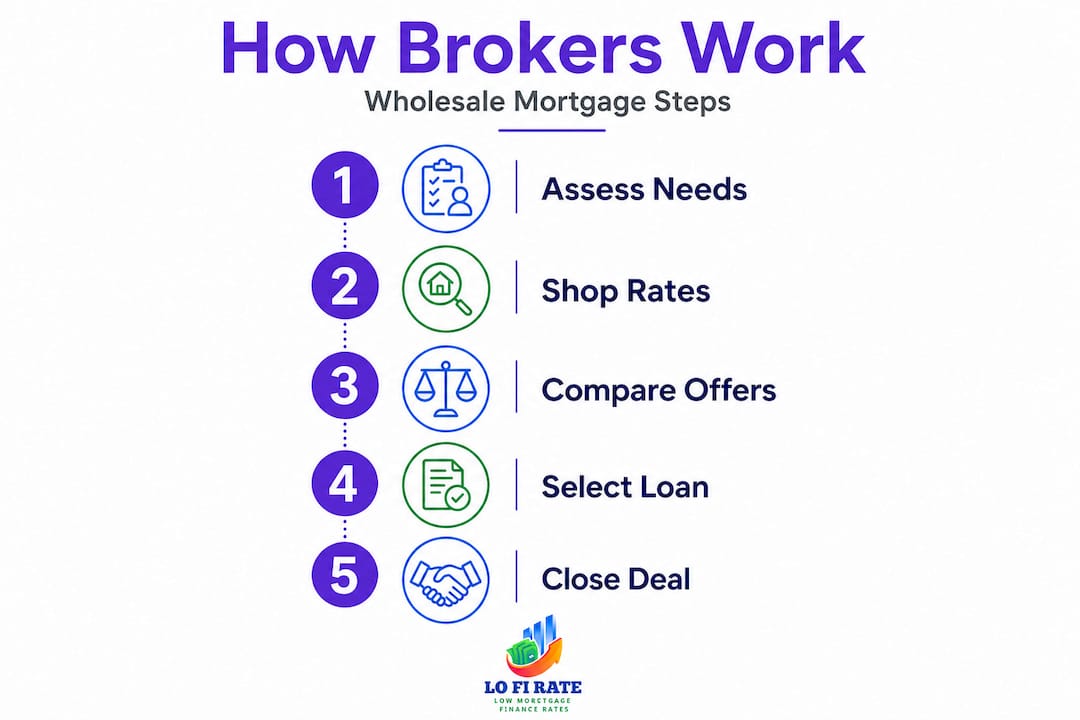
When you work with a wholesale mortgage broker, the process is not as complicated as you might expect. Brokers are highly regulated professionals who are legally required to act in your interest. Here is what a typical transaction looks like from start to finish:
- Initial consultation: You meet with a broker, share your financial goals, and discuss loan amount, down payment, credit history, and timeline.
- Application and documentation: You complete a standard mortgage application and provide documents like pay stubs, tax returns, and bank statements.
- Rate shopping: The broker submits your information to multiple wholesale lenders simultaneously, requesting rate quotes and loan scenarios.
- Comparison and recommendation: Your broker presents the best options, explains the tradeoffs between rate, fees, and loan terms, and recommends a path forward.
- Loan submission: Once you choose a lender, the broker submits your complete file for underwriting.
- Processing and closing: The broker works with the lender's team to satisfy any conditions and guide your loan to closing.
The key step most people underestimate is step three. That rate shopping happens behind the scenes on your behalf, and it is where wholesale brokers shopping multiple lenders create real value. Rather than you calling five different banks and getting five hard credit inquiries, your broker gathers competitive quotes through established wholesale relationships.
Who pays the broker? In most wholesale transactions, the lender pays the broker's compensation through what is called a lender-paid compensation (LPC) model. You, the borrower, typically do not write a separate check to your broker. That said, broker compensation is disclosed on your Loan Estimate, so you will always see it. Some brokers also offer borrower-paid options, which can sometimes lower your rate slightly in exchange for paying the fee at closing.
Pro Tip: Ask your broker to show you at least three loan scenarios side by side, with different rate and fee combinations. A slightly higher rate with lower fees can sometimes cost less over your expected time in the home. A good broker runs those numbers for you without being asked.
Brokers are licensed at the state level and must meet federal requirements under the SAFE Mortgage Licensing Act. You can verify any broker's license through NMLS. Working with a properly licensed broker is essential for getting lower rates safely and legally. Understanding the full wholesale mortgage process from application to closing helps you stay informed and avoid surprises.
When a wholesale mortgage makes sense (and when it doesn't)
Knowing how brokers operate, let's get practical. When is a wholesale mortgage your best move, and when might another route win out?
The short answer is that wholesale options benefit buyers who are actively comparing lenders and focused on minimizing long-term costs. If you are rate-sensitive, plan to stay in the home for several years, or simply want to see multiple offers before deciding, a wholesale broker is almost always worth consulting.
Wholesale mortgages work best when you are:
- A first-time buyer trying to find the most affordable loan terms
- Refinancing and want to compare your current rate against market options
- An investor buying multiple properties who needs flexible product options
- Someone with strong credit who wants to leverage it for maximum pricing
- A borrower who values transparency and seeing competing offers
Retail mortgages may be a better fit when:
- You have a specialty banking relationship offering documented rate discounts
- Your property type requires a portfolio loan only a specific bank offers
- You need an unusually fast close and your bank can move quicker
- You are combining a mortgage with a private banking arrangement
Here is a quick profile guide to help you identify which channel fits your situation:
| Borrower profile | Best mortgage channel | Key reason |
|---|---|---|
| First-time buyer, rate sensitive | Wholesale | Multiple lender access |
| Refinancing from a higher rate | Wholesale | Competitive pricing |
| Loyalty banking client with perks | Retail or compare both | Existing relationship discounts |
| Investor buying multiple units | Wholesale | Broader product range |
| Niche property type (unusual lot, etc.) | Retail (portfolio lender) | Flexible underwriting |
Before you choose a channel, ask yourself these questions:
- Have I compared rates from more than one lender or institution?
- Do I know what my credit score qualifies me for in today's market?
- Am I aware of how current rate trends in 2026 might affect my options?
- Have I reviewed the mortgage qualification steps needed for the loan amount I want?
- Do I understand the total cost of the loan, not just the monthly payment?
Looking at competitive mortgage rates across channels before committing is not just smart. It is one of the few moves in a home purchase where a few hours of effort can save you tens of thousands of dollars over time.
The real secret behind wholesale mortgages: What most buyers overlook
Here is what we consistently observe, and it is a pattern the mortgage industry benefits from every day. Most homebuyers do not comparison shop their mortgage the way they comparison shop anything else. They would never walk into a car dealership, accept the first sticker price without negotiating, and drive away satisfied. Yet with a mortgage, hundreds of thousands of dollars of debt, that is exactly what the majority of borrowers do.
The reason is not laziness. It is that most people do not know another option exists. When your bank quotes you 7.1%, you do not automatically wonder whether a wholesale broker could show you 6.85%. The bank certainly is not going to tell you. That information gap is the real cost of being loyal to a single institution without question.
Research consistently shows that comparing wholesale brokers is an underused strategy, even among financially savvy buyers. The mortgage industry is built on inertia. Most lenders know that the majority of borrowers will accept the rate they are offered, especially when the process is already stressful and confusing.
The uncomfortable truth is this: your bank is not obligated to offer you their best rate. They offer you a rate that balances their profit needs with enough competitiveness to close the deal. A broker working in the wholesale channel operates differently because their compensation depends on placing your loan competitively. Their incentive is to find you the best available price.
Think about it this way. Even a 0.375% rate difference on a $350,000 loan adds up to roughly $800 in savings per year. Over ten years, that is $8,000. Over a 30-year loan, the potential for big savings easily exceeds $25,000 when you factor in the long-term impact on interest paid. That is real money that stays in your pocket rather than going to a lender's bottom line.
Treat your mortgage search the way you would treat buying a car. Walk in knowing you have options. Ask for multiple offers. Use a broker to do the legwork. And remember that the lender quoting your rate has priced in a margin for themselves. The question is how wide that margin is, and whether you are willing to accept it without looking elsewhere first.
Unlock better mortgage options with professional guidance
If you have made it this far, you already know more about wholesale mortgages than the majority of homebuyers ever learn before closing. Now it is time to put that knowledge to work.
LoFi Rate connects homebuyers and homeowners with licensed wholesale mortgage brokers across the country. The process is simple, there is no obligation, and you are not committing to anything by exploring your options.

Through broker matching services, LoFi Rate helps you find a local, licensed professional who can shop multiple wholesale lenders on your behalf and present you with real, comparable rate options. Whether you are purchasing a new home or considering a refinance, exploring your current loan options through a wholesale broker could reveal savings your bank never volunteered to show you. A lower rate does not just reduce your monthly payment. It changes the total cost of owning your home. Start with a conversation, and find out what you might be leaving on the table.
Frequently asked questions
What is a wholesale mortgage broker and how do they differ from retail lenders?
Wholesale mortgage brokers connect borrowers with wholesale lenders offering lower rates through lower overhead, while retail lenders sell loans directly to consumers using their own, often higher-margin pricing. The key difference is access: brokers shop multiple lenders, while retail loan officers represent only one institution.
Do wholesale mortgages really offer lower interest rates?
Yes, and the savings can be substantial. Borrowers who use wholesale channels can save thousands over the life of a loan compared to accepting a standard retail rate, primarily because wholesale lenders carry lower overhead and compete aggressively for broker-submitted business.
Who pays the wholesale mortgage broker's fee?
In most cases, the lender pays the broker through a lender-paid compensation model, meaning you as the borrower typically do not pay a separate broker fee at closing. However, brokers shopping multiple lenders are always required to disclose their compensation on your Loan Estimate, so review it carefully before signing.
Are wholesale mortgages only for first-time buyers or can homeowners refinance too?
Both first-time buyers and existing homeowners can access wholesale mortgages. In fact, refinancing through wholesale brokers is one of the most common and effective ways for current homeowners to reduce their interest rate and lower their monthly payment without switching to a new loan type.